
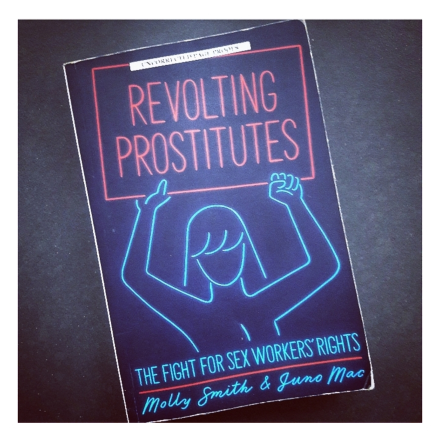
Workers’ Liberty’s Socialist Summer Camp this year saw the return of our ever-popular Socialist Feminist Reading Group ‘on tour’ session. This year we read and discussed ‘Chapter 3: Borders’, from ‘Revolting Prostitutes: The Fight For Sex Workers’ Rights’, by Juno Mac and Molly Smith.
Why are sex work and free movement so interlinked? How should we relate to the issues of sex work and sex trafficking as socialist feminists? Would sex work exist under socialism? These were some of the themes that came out of the reading.
BORDERS PRODUCE VULNERABILITY
The vast majority of trafficked people are not snatched off the street, authors Mac and Smith highlight. In fact, the majority are seeking to migrate. Much of the Global North is a fortress of hostile borders, and those migrating away from poverty often face very little possibility of entering through permitted routes. But while anti-immigration policies may dissuade some, many will still find other, more dangerous and difficult ways to enter – perhaps compelled by the need to financially support their family, for example. We know that such policies don’t stop migration. People migrate to live and work anyway – they just have very few legal rights and protections, and are far more vulnerable to exploitation with impunity. Borders create vulnerability, which is what abusive people and systems prey upon.
Strict immigration policies actually increase the demand for, and the cost of, people smuggling. (That is why the trafficking of kidnapped people is so rare – why do it for free when people will pay extortionate amounts for it?). Those who migrate via smuggling can easily become trapped in a horrifically exploitative trafficking system due to debts to people smugglers and/or their lack of legal rights and protections. While there are important differences, this actually isn’t as dissimilar as we might like to think to the ‘tied’ visa system, where a migrant worker whose visa is tied to a toxic and exploitative workplace cannot leave their job without risking deportation.
Victims are very unlikely to seek or receive help in these situations. They often have a very legitimate and realistic fear of detention, deportation and arrest for 'illegal working' (a conviction which can result in unlimited fines, confiscation of earnings and/or prison time). Once again, strict immigration policy makes undocumented people – including victims of trafficking – even more reliant on those who can exploit them.
INNOCENT VICTIMS AND WICKED PERPETRATORS
Anti-trafficking posters often depict a dark, shadowy figure kidnapping a young, fair-skinned girl. On the one hand, this plays into the idea of the danger of the foreign Other, the myth of the Black rapist. On the flip side, it creates a standard of innocence for those who are trafficked.
In this idea of lost innocence, there is no space for the woman – and it is usually, but not always, a woman – who paid a smuggler to cross borders in exchange for debts, knowingly or unknowingly to be paid off via sex work, and now finds herself in a shitty situation that she would prefer not to be ‘rescued’ from (i.e. forcibly moved on and likely deported). Such a worker may have had little choice to support herself and her family. But according to laws, such migrants can be considered somehow complicit in a crime against themselves.
As we have previously noted in Women’s Fightback, it is the nature of sex trafficking that the victims will be poor, working class and/or vulnerable. This critique is not to excuse those who exploit vulnerable people. Instead, it is to highlight that the way the law addresses sex trafficking often causes further harm to those who have been trafficked, and to migrant sex workers more broadly.
In reality, anti-trafficking laws are often used against migrant sex workers. Anti-trafficking policing looks very similar to border policing, but with the added paternalistic spin of a rescue operation. Under UK law, trafficking can include arranging or facilitating someone’s arrival for the purposes of exploitation for money. Since general prostitution offences are considered exploitation, sex workers can be prosecuted for the offence of smuggling or trafficking themselves, or for letting a migrant sex worker friend stay on their sofa for a night.
Rescue operations often include ‘educating' victims about the fact that they are victims of trafficking, and then detention and deportation. They can also include prosecutions for offences such as ‘illegal working’ – or ‘brothel-keeping’ for those working with a friend for safety – leading these 'rescues' to involve massive financial penalties. This can include confiscating all earnings and preexisting savings that could be considered proceeds of crime. Such laws compound the harms done to trafficking victims.
FOR OPEN BORDERS, FREE MOVEMENT AND DECRIMINALISATION
Criminalisation creates vulnerability. Full or partial criminalisation of abortion creates demand for and increases the prevalence of dangerous backstreet abortions. Similarly, strict immigration controls create demand for exploitative and unsafe alternatives to safe crossings. And the criminalisation of sex work forces workers to accept riskier and more precarious conditions.
Allowing safe passage for people to work abroad for decent pay, without having to bypass border controls and police crackdowns, would do away with the need to resort to people smugglers and traffickers in order to migrate.
Where sex work is decriminalised, workers have legal rights and protections, greater access to services and support, and the ability to fight back against exploitation – including the ability to collectively organise for better conditions.
But our demands must also include creating greater choice. We need better wages for other jobs, robust provision of disability, welfare and childcare support, and full legal rights and protections for migrant workers. The majority of people start in sex work out of financial need. For most sex workers, there are few other jobs that can provide the money they need to support themselves and their dependents, with the flexibility they need around caring responsibilities, disabilities or other constraints.
Would sex work exist after socialism? For those who enjoy their work, it would come with the same rights and protections as any other work, with easy access to support services and time away should anything go wrong. For those who choose sex work out of necessity, leaving would be a realistic choice.
Advocating for decrim does not mean that we believe sex work is inherently good. It means that it is work. And like any work, it can range from genuinely enjoyable to boring to traumatic. Nor does it mean that we don't recognise the misogyny of the sex industry. While not true of everyone's experience, it is often rife with gendered standards, expectations, exploitation and at times violence. But criminalisation doesn't change this – it just pushes workers into riskier situations with fewer legal protections or avenues for support.
We reject moralistic arguments against the decriminalisation of sex work as uniquely degrading or unfeminist. Under capitalism, many kinds of work can be exploitative and many jobs carry higher risk of assault (care work, for example). The idea of 'selling your body' applies as much to manual labour as to sex work.
Workers’ Liberty advocates for open borders, free movement and the decriminalisation of sex work.
If this sounds like a discussion you'd have liked to take part in, keep an eye out for Workers' Liberty's upcoming events: Ideas For Freedom (21-22 November, Camden School for Girls), and our socialist feminist day school, All The Rage, in early 2027.
We also host monthly Socialist Feminist Book Clubs in London, Manchester, Sheffield and Edinburgh - for more info, email womensfightback@workersliberty.org.
Comments?We welcome replies, corrections and debate pieces. Contact us