
So far, in surveying Marxist reference points, we have covered writings by Marx and Engels in the run-up to and around the revolutions of 1848.
They developed a school of socialism which:
• Connected socialism to democracy. "The first step in the revolution by the working class is to raise the proletariat to the position of ruling class, to win the battle of democracy".
• Showed that "the emancipation of the working classes must be conquered by the working classes themselves" (Marx wrote that wording only in 1864, in the rules of the First International, but the thought is there in the 1840s)
• Looked to long-term worker organisation and self-education, with persistence over ups and downs, not just to sudden rebellion. "The workers begin to form combinations (Trade Unions)... they found permanent associations in order to make provision beforehand for these occasional revolts… Now and then the workers are victorious, but only for a time. The real fruit of their battles lies, not in the immediate result, but in the ever expanding union of the workers… This organisation of the proletarians into a class, and, consequently into a political party, is continually being upset again by the competition between the workers themselves. But it ever rises up again, stronger, firmer, mightier".
Those ideas were radical departures in their time. Trade unions, for example, then existed with any size only in Britain, and were usually small, un-radical groups of better-off minorities of workers, often more mutual-aid societies than class-struggle outfits.
Yet Marx's ideas would gain such grip from the 1860s as to appear almost common-sense. They were overshadowed in the heyday of Stalinism by ideas of socialism as the product of militarised fighters for industrial development, and have been somewhat overshadowed since by ideas of socialism as a composite product of "social movements" (in practice, of left NGOs).
Between the early 1850s and the mid-1860s when Marx helped shape the First International and published Capital, the usual story is that he withdrew from active politics to devote himself to economic studies.
The story is not quite true. But on many issues on which he wrote in that interlude, his writings were relatively scrappy, and the best "reference points" come from later codifications by the Marxists of the Second International (1889-1914). Marx made his main writing effort in economic studies, as no previous socialist had done.
Why? Distinctively, he analysed capitalism not just to show that it is bad, but also that it creates new social possibilities. As he put it in the Communist Manifesto: "The advance of industry... replaces the isolation of the labourers, due to competition, by the revolutionary combination, due to association. The development of Modern Industry, therefore, cuts from under its feet the very foundation on which the bourgeoisie produces and appropriates products. What the bourgeoisie produces, above all, are its own grave-diggers".
Or, in Capital volume 1 (chapter 15): "The concentration of capital... by maturing the material conditions, and the combination on a social scale of the processes of production... matures the contradictions and antagonisms of the capitalist form of production, and thereby provides, along with the elements for the formation of a new society, the forces for exploding the old one".
In 1859 he published the Contribution to the Critique of Political Economy. But, as he wrote to a startled Engels "don't collapse… these sections do not yet contain anything about capital", only about value-form and money. He was still not sure enough of his ground, though he rationalised by writing that the Contribution's analysis of money could "win a scientific victory for our Party".
Polemically, he rationalised by saying that "communism must above all dispose of this 'false brother'," the idea of a socialism which improved on capitalism by instituting more equalised and uncorrupted market relations.
The followers in France of Pierre-Joseph Proudhon were still many. But in Britain, too, probably the most advanced socialists of the time were those who followed Bronterre O'Brien.
O'Brien: "Land, and whatever else the Deity has made for man’s use, must be expropriated, by commutation, on equitable terms for the general good, and never again be made private property. Credit must be accessible for every member of the community, on terms beneficial the individual, and just and safe for the public. And all commerce must be gradually reduced to equitable exchange on the principle of equal values for equal values, measured by a labour or corn standard".
The first ripe fruit of Marx's economic studies was Wages, Price, and Profit (WPP), a talk in 1865 to the General Council of the First International to reply to John Weston, who argued that trade-union struggle was worthless. (Weston, a carpenter, was an Owenite, a follower of Robert Owen. He may have been playing "devil's advocate", because there were Owenite trade unionists, and one of the First International's staple activities was support for trade-union strikes).
Marx rejected proposals to publish the talk at the time, apparently worried that it would gazump Capital. (Capital does not cover wage struggles in any rounded way, as WPP does. I don't know why. In Workers' Liberty study courses on Capital, we add WPP as an "extra chapter"). WPP was published, by Karl Marx's daughter Eleanor, only in 1898. It is sometimes titled "Value, Price, and Profit".
WPP refutes the ideas of inevitable working-class pauperisation or an "iron law of wages" often attributed to Marx. Early on in it Marx draws "attention to the real rise of wages that took place in Great Britain from 1849 to 1859", and to the fact that wages are higher in advanced capitalist countries than in poorer ones (in his day, higher in the USA than Britain, and higher in Britain than in France).
He does argue that capitalism will tend to reduce the exchange-value of labour power. In context he means it will reduce the hours of labour necessary to "cover" wages, not necessarily the equivalent product in goods and services of those hours. Research finds that nowadays in advanced capitalist countries maybe one-quarter of working hours correspond to the labour-time necessary to produce wage-goods, where Marx's estimate for his day was about a half. The one-quarter of working-time today produces much more than the one-half 150 years ago.
Marx did underestimate the elasticity of capitalism, though not half as much as many other socialists or even bourgeois economists in his day. In 1880 he objected to French socialists demanding a legal minimum wage on the grounds that it was implausible under capitalism. "Guesde insist[ed] on putting in his foolish minimum wage demand", wrote Engels, "and... we finally let him have his way although he admitted that theoretically it was nonsense".
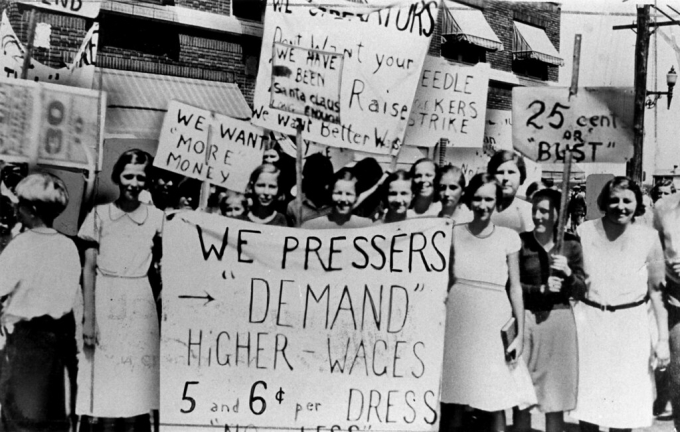
But Marx showed that workers' organisation can win improved wages and shorter hours. In the short term we do this at the expense of profits. In the longer term (as Marx demonstrated in Capital), it stimulates smarter technology and may not even reduce profits.
To those who disdained wage struggles he asked, should the workers "abandon their attempts at making the best of the occasional chances for their temporary improvement? If they did, they would be degraded to one level mass of broken wretches past salvation... By cowardly giving way in their everyday conflict with capital, they would certainly disqualify themselves for the initiating of any larger movement".
Which is another way of saying: by bravely fighting and winning our everyday conflicts with capital, we can upgrade our confidence and our leeway for socialising and organising and self-educating; we can qualify ourselves for the initiating of larger movements.
The text is at bit.ly/mx-wpp. Audio version at bit.ly/ptref-audio. Workers' Liberty study notes bit.ly/wpp-n1 and more at bit.ly/wpp-notes. §
Comments?We welcome replies, corrections and debate pieces. Contact us