
Marx and Engels wrote three surveys of the revolutions which started across Europe in 1848 — Revolution and Counter-Revolution in Germany, The Class Struggles in France, and The 18th Brumaire of Louis Bonaparte.
The 18th Brumaire was the last-written, and is usually reckoned the richest in unexpected arguments and intricate dissection. That is why it figures in our barebones “Marxist reference points”.
It was also the most intricately-woven. Although many passages in it are so famous as to be known to many people who have never read the whole text, a lot of it is difficult for people today who do not have the knowledge about current events since 1848 and about the French Revolution of 1789-94 which Marx assumed his readers would have.
This page therefore gives a skeleton timeline.
France (Paris, really) started the revolutions of 1848, with a street uprising which forced the king to flee and instituted a republican Provisional Government. At first the Provisional Government also had “social” policies of public works providing jobs for the unemployed, the National Workshops.
The closing-down of those workshops sparked a workers’ uprising in June 1848. A republican general, Louis-Eugène Cavaignac, suppressed it bloodily, using artillery to break barricades and killing thousands. The most radical and organised worker-politicians, Auguste Blanqui and his comrades, had already been jailed and sidelined after another rising in May.
Power was thus in the hands of the bourgeois republicans. But it was complicated.
The “republican” National Assembly was actually dominated by three monarchist or quasi-monarchist factions. The Legitimists wanted the restoration of the full-on reactionary Bourbon monarchy of 1815-30. The Orleanists wanted the restoration of the more conciliatory monarchy, led by another branch of the royal family, from 1830-48.
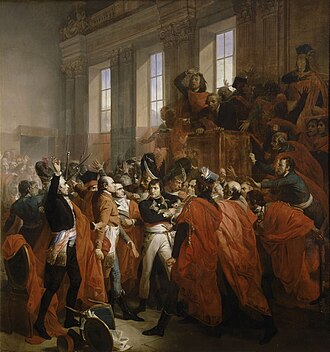
The Bonapartists wanted to restore the rule of the Bonaparte family. Napoleon Bonaparte, a general in the French armies during the European wars which followed the French revolution, had seized power in November 1799 (18th Brumaire by the French revolutionary calendar), and declared himself Consul and then (from 1799) hereditary Emperor. But he continued the anti-feudal, pro-free-trade social policies of the revolution, and even extended them to other parts of Europe.
Napoleon was finally defeated in 1815. His nephew and would-be heir Louis Bonaparte was a political adventurer, mostly living outside France. He was in poor health, a poor public speaker, and in later life obese and walking only slowly and with a cane; but he presented himself as a “social” candidate for power, and had some credit, especially among the peasantry.
Marx’s pamphlet tried to show how this “adventurer who hides his trivial and repulsive features behind the iron death mask of Napoleon” could nevertheless seize power. In doing so, he argued that working-class revolutions could and would not proceed as the Revolution of 1789-94 had done, by an apparently irresistible escalation to the left marked by successive days of street uprising and the drawing-in of increasing numbers of the urban poor.
They required a lot beyond bravery and bravado: political differentiation, critical discussion, organisation.
“The social revolution of the nineteenth century cannot take its poetry from the past but only from the future. It cannot begin with itself before it has stripped away all superstition about the past. The former revolutions required recollections of past world history in order to smother their own content. The revolution of the nineteenth century must let the dead bury their dead in order to arrive at its own content. There the phrase went beyond the content — here the content goes beyond the phrase”.
Further:
“Bourgeois revolutions, like those of the eighteenth century, storm more swiftly from success to success, their dramatic effects outdo each other, men and things seem set in sparkling diamonds, ecstasy is the order of the day — but they are short-lived, soon they have reached their zenith, and a long period of regret takes hold of society before it learns to assimilate the results of its storm-and-stress period soberly.
Proceed
“On the other hand, proletarian revolutions, like those of the nineteenth century [so Marx hoped], constantly criticize themselves, constantly interrupt themselves in their own course, return to the apparently accomplished, in order to begin anew; they deride with cruel thoroughness the half-measures, weaknesses, and paltriness of their first attempts, seem to throw down their opponents only so the latter may draw new strength from the earth and rise before them again more gigantic than ever, recoil constantly from the indefinite colossalness of their own goals — until a situation is created which makes all turning back impossible, and the conditions themselves call out: Hic Rhodus, hic salta! [Here is the rose, here dance!]”
Marx, Engels, and following them the left wing of the Second International, would work through those differences more in decades to come.
Marx depicts the relation between politics and social classes in much more complex fashion in this study of particular events in a particular period than he does in some sweeping generalisations in other texts.
He describes seven different political factions or coalitions, with different bases in different classes or fractions of classes or combinations. He variously describes Bonaparte as based on, or serving, three classes or fractions of classes. The fly-by-night Paris middle class were his active base; the peasants, his passive electorate; the solid capitalist class, those whose long-term interests he served.
All that is to be read with the necessary framing provided by Marx:
“One [must not] imagine that the democratic representatives are indeed all shopkeepers or enthusiastic champions of shopkeepers. According to their education and their individual position they may be as far apart as heaven and earth. What makes them representatives of the petty bourgeoisie is the fact that in their minds they do not get beyond the limits which the latter do not get beyond in life, that they are consequently driven, theoretically, to the same problems and solutions to which material interest and social position drive the latter practically. This is, in general, the relationship between the political and literary representatives of a class and the class they represent”.
In another counter to the simplistic “Marxist” ideas of the state being a plain reflection of power in civil society which can be derived from his polemics against non-communist democrats, in The 18th Brumaire Marx writes that the state “enmeshes, controls, regulates, supervises, and regiments civil society”.
The “Bonapartist” regime built from 1852, and lasting until 1870 when it collapsed with France’s defeat in the Franco-Prussian war, served the fundamental and longer-term social interests of the capitalist class. It fired up railway-building, expanded industry, promoted free trade.
At the same time, it did that by establishing some political autonomy for itself from day-to-day control by the capitalist class. And it built its political power on concessions, or apparent concessions, to the ruined urban middle classes, the peasantry, and even, at times, in the 1859-70 “liberal Empire” period, to workers. It shored up, or tried to shore up, its political power also by nationalism and militarism, with a number of (often not very successful) military ventures in the Crimea, Indochina, Mexico, Italy.
Timeline
1848, 22-24 February: the people of Paris come onto the streets and erect barricades in protest against the banning of a liberal banquet. The king abdicates. Provisional government set up by the previous liberal opposition. Social reforms, including National Workshops to create jobs for the unemployed.
23 April: elections to Constituent Assembly in France. Conservative rural votes give a majority to more conservative factions.
15 May: Blanqui and Barbès lead an attempt to dissolve the assembly. They are jailed
21 June: The conservative-republican government shuts the National Workshops. Workers’ protests suppressed by troops; over 3,000 killed, and 15,000 exiled.
10 December: elections for president of France: Bonaparte wins thanks to peasant votes
1849, 13 June: bourgeois radicals (“The Mountain”, led by Ledru-Rollin) stage a protest, especially against the French army’s intervention in Rome. They are suppressed, and Ledru-Rollin flees
1851, 2 December: Bonaparte carries out his coup. After street protests are suppressed, on 20-21 December a referendum endorses the coup
1852, 7 November: referendum makes Bonaparte Emperor rather than President.
Comments?We welcome replies, corrections and debate pieces. Contact us