
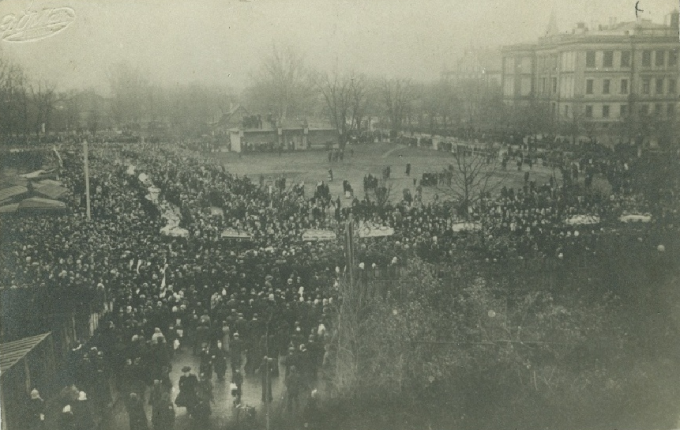
Image: funeral for those killed by Tsarist repression in Tallinn in October 1905
When the Storm Fell Silent. Volume 3 of the Truth and Justice pentalogy by Estonian writer A H Tammsaare. First published in 1931. English translation by Matthew Hyde, 2025, Vagabond Voices, Glasgow.
This is the third volume of the Estonian epic by A H Tammsaare (Anton Hansen, 1878-1940). I have reviewed Volumes 1 and 2 in Solidarity 638 https://www.workersliberty.org/story/2022-06-13/landmark-novel-estonian-literature and 666. https://www.workersliberty.org/story/2023-03-06/country-and-city-estonia They followed the young life of Indrek, the son of peasants eking out a poverty-riddled existence in the village of Vargamäe deep in the Estonian countryside.
The second volume finds Indrek in the city pursuing the education he so desires. At the end of volume 2 Indrek is forced to leave his school and at the beginning of Volume 3, he is homeless and almost destitute.
After finding some lodgings Indrek is drawn into the turmoil of the 1905 revolution. Estonia, like other parts of the Tsarist empire, became embroiled in the discontent following the disastrous Russian-Japanese war of 1904-5 – in which Estonian conscripts fought – and the political unrest which centred on Saint Petersburg and found echoes in Tallinn, the Estonian capital. Indrek begins to write for The People’s Friend, a newspaper which has some sympathy for the insurgency but whose politics remain unclear throughout the book.
He befriends Kristi, the daughter of his landlady and landlord, and together they go to meetings and listen to the speakers. They are present, on 16 October, when Tsarist troops open fire on a crowd of demonstrators in Tallinn and sixty are killed. But Indrek finds himself torn as he witnesses the torching of manor houses belong to the land-owning class. He (and possibly the author) has no analysis or understanding of what is happening, and eventually he recoils from what he sees.
Receiving news of his mother’s illness in the countryside, he returns to Vargamäe, passing some burning manor houses on the way. His mother is dying and the medicines Indrek has brought from the city give only temporary respite from her pain and suffering. She self-administers a lethal overdose and dies as Indrek watches on.
What is noticeable about this volume is the sparse detail given to the revolution in Estonia. Although at one point Indrek briefly becomes the treasurer for the "Party", we are never told its name or given much more than a hint of it politics. There is much talk of "freedom" and what it might mean but this resolves nothing and much of it is vacuous.
It seems that Tammsaare is uncomfortable writing about mass movements, about politics, preferring to stick with the intricacies of the lives of individuals. On the broader palette of the revolutionary movement in Estonia he seems lost. We are told nothing of the Russian Social Democratic Labour Party (RSDLP) or the Estonian Democratic Workers Party (ESDWP). In rural areas a number of self-governing co-operatives were established and plans were afoot to create a Soviet in Tallinn but the Tsarist forces declared martial law, repression was stepped up and the revolutionary flame extinguished.
After the absorbing writing offered up by the first two volumes, this third volume needs to be read to maintain narrative continuity but on the whole it is disappointing. The fourth volume has, so I understand, already been translated and will be ready for publication at some point in the future.
Comments?We welcome replies, corrections and debate pieces. Contact us