
On Friday 26 June Lebanon and Israel signed an agreement which gives a vague outline of how Israel and Lebanon, acting under US pressure, intend to deal with Hezbollah, the Shia party-militia and Iranian proxy which rules in southern Lebanon.
Hezbollah was not party to the deal and has denounced it. Hezbollah’s leader Naim Qassem described the framework agreement as “humiliating, shameful.”
The Israeli army currently occupies about 5% of Lebanon and has agreed to withdraw from two small pockets of Lebanese territory along the Litani river, handing control over to the Lebanese Army.
The agreement does not demand full Israeli withdrawal from Lebanon and Israeli Prime Minister Benjamin Netanyahu has made it plain that Israel intends to stay until Hezbollah is disarmed.
The Lebanese state says 4,192 people have been killed, 11,600 have been injured and 1.2mn displaced since Israel began to bomb Lebanon on 2 March 2026 as Hezbollah began to launch rockets at Israel in support of Iran.
The agreement’s main purpose is to prevent the US-Iran peace from unravelling immediately and the Strait of Hormuz again being closed off by Iran.
The US-Iran peace, codified in a Memorandum of Understanding (MoU) signed on 18 June, mandates an end to fighting “on all fronts”, including Lebanon. US President Donald Trump has become openly critical of Netanyahu, who continued to order strikes against Hezbollah after Trump had demanded Israel stop. Trump’s attacks on Netanyahu have caused the Israeli leader political problems at home.
Netanyahu has an interest in reviving the war on all fronts. He faces an election in October and needs to consolidate his far-right voting base. If he loses the election he may well face a long-postponed corruption trial and might end up in jail.
The MoU is half-baked, with provisions which are vague and incomplete, only beginning to address some of the issues between the contending sides. The MoU provides a 60-day period of negotiations on outstanding matters, including the Iranian nuclear weapons programme.
US Vice President J D Vance apparently thinks the Arab states around the Gulf, known as the GCC, will now invest heavily in rebuilding Iran. Why would they do that? He mentions a figure of $300bn, which is fantasy.
So will the peace hold? Quite possibly not.
Opposition
Israel was not party to the Iran talks and opposes the US-Iran peace. It is difficult to see how their occupation can be maintained without repeated military action against Hezbollah.
Iranian negotiators told Reuters that the US-Iran deal specifies that the Strait of Hormuz will reopen and the US will lift the blockade of Iranian ports. The US will waive sanctions on Iranian oil for a period, release $25bn in frozen Iranian assets, and the US will accept Iranian assurances that enriched uranium will be diluted on Iranian territory and that they will not build nuclear weapons.
However limited fighting continues in both southern Lebanon and in the Persian Gulf-Iran. Over Friday 26 and Saturday 27 June Iran and the US continued to trade strikes.
On Sunday 28 June Iran launched drones at US bases in Kuwait and Bahrain. Trump commented that the US “may be forced to complete the job… if that happens the Islamic Republic of Iran will no longer exist.”
Trump, a contemptable loudmouth who has surrounded himself with sycophants, failed to gauge accurately the resilience of the Iranian regime and did not anticipate the Iranian grip on the narrow waters of the Persian Gulf.
Concern
Trump’s main concern now is to extract himself from the mess he has created. He needs the recently resumed flow of oil and gas through the Gulf to continue and the reductions in oil prices to be maintained. Trump has domestic political pressure on him caused by high petrol prices in the run-up to the US November’s mid-term elections.
However, Trump also must be able to present an agreement with Iran as a victory. He cannot openly offer Iran lots of money, or sanctions relief, without dealing with Iran’s stockpile of enriched uranium.
In particular he can not sign up to any final agreement which compares badly to the deal which former US President Barak Obama signed with Iran in 2015, the Joint Comprehensive Plan of Action (JCPOA), which offered Iran sanctions relief in return for nuclear inspections and an agreement to limit nuclear enrichment. Trump denounced the deal and pulled the US out of it in 2018.
When Trump and Netanyahu began the assault on the Iran on 28 February they had the intention of overthrowing the Islamist regime and laying hold of Iran’s stocks of near-bomb-grade enriched uranium.
They have failed.
What they did manage, however, is to kill thousands of ordinary people in Iran and Lebanon and cause vast damage, including to Iranian civilian infrastructure. Perhaps three million Iranian workers have lost their jobs.
The US-Israeli war led to the closure of the Strait of Hormuz, a big spike in oil prices, and consequently inflation across the world, which has hit workers and the poor hardest of all.
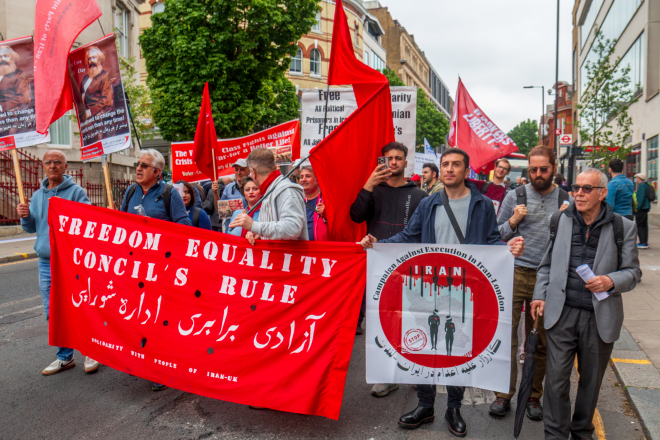
Many in the Iranian leadership are now dead but the Islamic Guards (IRGC), set up to protect the clerical state, are firmly in control. During the war thousands of Iranians were arrested on accusations of disloyalty to the regime and a wave of executions of political prisoners is taking place in Iranian prisons.
According to Bloomberg Iran has reconstituted its stockpiles of missiles and drones, possibly with Russian help. It currently holds about 75% of its pre-war reserves and has cleared much of the rubble from the entrances of bombed weapons dumps.
As one of the US-Israeli initial war aims was to destroy Iran’s weapon stocks, this is a further failure.
In Israel 35 people died during the war, mostly civilians, and 7,700 were injured. The continued existence of Iranian ballistic missiles and drones is a real threat to Israel, a country that Iran’s regime has regularly threatened to destroy.
The only force that can build a stable, long-lasting, democratic peace in the region is the working class.
For a secular republic and workers’ power in Iran!
For a free, contiguous Palestinian state alongside Israel!
For an end to these senseless wars!
Comments?We welcome replies, corrections and debate pieces. Contact us