
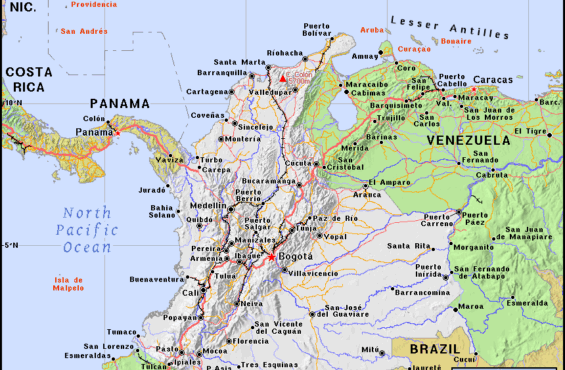
Far-right millionaire celebrity lawyer, Abelardo de la Espriella, has been elected president of Colombia (21 June 2026). De la Espriella won by a narrow margin, less than one point, against the left-winger Ivan Cepeda of the left wing Pacto Historico party.
In the first round of the elections (31 May 2026) Cepeda was polled to be in front. Second, the right-wing Paloma Valencia of the Centro Democratico party - previously led by former President Alvaro Uribe. Nonetheless, Abelardo de la Espriella has narrowly come out on top in both rounds. This election has been one of the closest in Colombian history. De la Espriella won by only 250,000 votes in a country of 53.4mn on a turnout of 63.6%. The turnout is high by Colombian standards.
De la Espriella is a far-right reactionary politician and a member of the Defenders of the Homeland party (Defensores de la Patria). He wants to rollback the 2016 peace agreement, opposes abortion, and plans to build mega-prisons taking inspiration from Bukele in El Salvador. De la Espriella in his own words has vowed to “disembowel the left” and views socialists, trade unionists, feminists, environmental campaigners and indigenous rights activists as foreign elements to be contained and potentially eliminated. Although some of his rhetoric was toned down during the election and in his victory speech. Prior to the presidential elections, de la Espriella rose to prominence as a celebrity lawyer defending paramilitaries, business leaders, and politicians accused of corruption.
The current president, Gustavo Petro, is not allowed to re-run for president as per the Colombian constitution. As such he backed Cepeda. Cepeda promised to carry on the politics of the outgoing president. Petro has overseen a rise in living standards in Colombia, has undone some of the rollbacks on workers’ rights that were implemented by the Duque and Uribe presidencies, and pushed for more environmental reforms. Cepeda’s party, Pacto Historico, has its main social base in the urban working-class and support from the main trade unions. Petro’s at least postured opposition to further oil and gas exploration has put him at odds with some of the trade union officialdom who have a collaborationist approach and align with bosses in that industry to oppose environmental restrictions. However, Petro has gone less far than he had promised prior to his election as president.
The main topic around the presidential election was the question of security and guerrilla violence. Violence has been significantly lower when compared to the years before the 2016 peace agreement - the homicide rate is 26 per 100,000 compared to 80 per 100,000 pre-2016. Nevertheless, this past year has been the most violent since then. It is estimated that around 27,000 people belong to some criminal organisation in Colombia. Colombia is the largest producer of cocaine. Cocaine production and trafficking lie at the heart of the violence that racks the country as organisations compete for drug production and distribution as well as other endeavours such as logging, mining, and facilitating local corruption. Recent violence has included the assassination of right-wing politician Miguel Uribe Turbay (no relation to Alvaro Uribe) back in summer 2025; the kidnapping of left-wing senator Aida Quilcué in February; multiple homicides and killings between dissident groups of the FARC, the ELN and others; and the largest forced displacement in Colombian history in 2025 when fighting between the ELN and Frente 33 (a FARC dissident group) resulted in 80 people dead and 60,000 displaced.
Cepeda mostly won votes amongst the urban working-class, afro-Colombians and indigenous people. De la Espriella generally did better in areas that have been traditionally politically conservative, like Medellin. In areas subjected to guerilla and gang violence the picture is mixed. In some regions, for example in areas bordering Venezuela de la Espriella did better and in others Cepeda.
Petro and by extension Cepeda have been criticised that the current approach has simply allowed organisations to expand and re-arm during the temporary ceasefires. The intended approach of “total peace”, as it is known, is to dismantle and disarm criminal and guerrilla organisations by offering them reduced sentences, the opportunity to retain part of their wealth, and the suspension of state military operations against. Many analysts argued that Petro implemented this scheme carelessly by announcing ceasefires without any protocols or monitoring which had been done when disarming, for example, the FARC. Some groups, like the ELN, claimed they never agreed to a truce. Now most of the original agreements reached by the government have either stalled or been abandoned.
De la Espriella vows to take a more strong-handed (“mano dura”) approach towards guerrilla and gang violence. He opposes Petro’s approach of negotiations with armed organisations and instead argues for a range of measures including building mega-prisons in forests, all-out military confrontation with organisations, and seeking US support to launch airstrikes on coca plantations. This program will be a disaster for peace in Colombia. It will likely result in more support for armed groups like the ELN which effectively govern large swathes of the country and more tit-for-tat violence as happened during Uribe’s presidency from 2002-2010. On other issues de la Espriella has vowed to allow fracking, make massive cuts to public spending including shrinking the size of the state by 40%. Again this will be a disaster for working people and effectively undo the gains made under Petro.
While Petro’s reforms have led to a real material improvement in people’s lives in Colombia this has not been enough to see off the rise of the far-right and reorganisation of the right behind de la Espriella. Some of this has been hampered by Pacto Historico not having a parliamentary majority. Had there been more of a break from and confrontation with multinationals, petrochemical companies, and the military that has been responsible for or facilitated paramilitary violence in the country, this may have galvanised the social movements that put Petro into power in the first place. The social and labour movement rebellions that broke out in 2019 and 2021 effectively backed off their pressure once Petro arrived on the scene. Had these factors been different this may have seen off de la Espriella’s win.
Some of the worst aspects of de la Espriella’s program might be blunted given Pacto Historico are now the biggest party in Congress. On a grassroots level, protests broke out in many cities following election results. While his victory is a major blow to the left, de la Espriella is facing a left that is better organised, more experienced, and more confident than before 2019 - the same left that organised the 2021 national strike that stopped the regressive tax reform by then right-wing president Ivan Duque.
Comments?We welcome replies, corrections and debate pieces. Contact us