
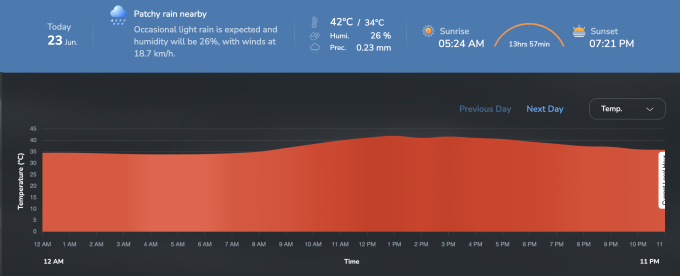
Pic: temperatures in New Delhi, June 2026
Summers in India have gotten longer and hotter. Average temperatures are now 40ºC between March and June. The toll on health and social life of global warming is growing.
Schools across Delhi and in about half of India’s 28 states have been ordered to close from mid-May until the end of June, when in many places the summer break starts. Hundreds of thousands of parents in India are struggling with managing jobs and children as lives are disrupted by prolonged school closures linked to the high temperatures. And as childcare disproportionately falls to women, it is women who are bearing the brunt. The majority of women are being forced either to stay at home or move into precarious, lower-paying work because they have to care for children during repeated school closures. This pushes some families closer to poverty and shrinks women’s social lives.
More than 90 percent of working women in India are in the informal sector, and the sectors carrying the greatest heat risks, agriculture, construction, street vending, domestic work are where women’s informal employment is concentrated. Some can lose as much as 60 percent of their income during the brutal summer months because their working hours are reduced by almost half, or they have to abandon their work.
The Lancet Countdown’s 2024 India data sheet estimated that India lost 181 billion potential labour hours to heat exposure in 2023 alone — 50 per cent higher than the 1990s average. In 2024, that figure rose to 247 billion, a record.
Working outdoors, in unventilated factories, or doing piecework, women face harsh conditions. Public health experts estimate that many more people die of heat-related causes in India than are reported by government agencies. While deaths can be recorded as heat-related when the causes are immediately identifiable, such as a heat stroke or a cardiac arrest on a very hot day, overworked doctors are not sufficiently trained to look for longer-term effects of heat stress. The UN states that women and children are 14 times more likely to die in climate emergencies than men.
Last week, officials in Mumbai restricted water access after the reservoirs dwindled to just 10% of capacity. Rain has begun but will not replenish the water supplies. nationwide rainfall has been almost 40% lower than the June average. This will further hit agricultural workers and food prices in the already inflation-hit region.
Comments?We welcome replies, corrections and debate pieces. Contact us