
This week's "reference point" is Marx's March Address of 1850, a follow-up to the Communist Manifesto of 1848.
In the Manifesto Marx gave us a synthesis of his political movement, between about 1843 and 1847, from philosophic radicalism to a new sort of worker-organising communism.
Others were moving the same way, if not as far or with the same depth of theorising. The 1840s were times of ferment. Famines, not only in Ireland, drove many of the urban poor to anger (and the rural poor too, though more of them to despair). The Chartists in Britain, the world's first organised workers' movement, burgeoned. There was a general strike in large parts of England in 1842.
Conservative, authoritarian regimes, dominated by land magnates, had been imposed on Europe after 1815. The bourgeoisie and sections described as petty bourgeoisie – small workshop operators and shopkeepers, doctors, lawyers, professors, students – had begun to crack those regimes in the 1830s, and were impatient to win civil liberties, at least for themselves.
In February 1848, the same month that the Communist Manifesto was published, revolution erupted in France and then across Europe. The exception, paradoxically, was in Britain, where the Chartists had a limp turnout for their long-planned 10 April 1848 demonstration and then went into decline.
The March Address acknowledged that the Communist League, for whom Marx had written the Manifesto, had been swamped by the upheavals of 1848-9. "Its members everywhere involved themselves energetically in the movement and stood in the front ranks of the only decisively revolutionary class, the proletariat, in the press, on the barricades and on the battlefields… [However] a large number of members who were directly involved in the movement thought that the time for secret societies was over and that public action alone was sufficient. The individual districts and communes allowed their connections with the Central Committee to weaken and gradually become dormant.
"So, while the democratic party, the party of the petty bourgeoisie, has become more and more organised in Germany, the workers’ party has lost its only firm foothold, remaining organised at best in individual localities for local purposes; within the general movement it has consequently come under the complete domination and leadership of the petty-bourgeois democrats. This situation cannot be allowed to continue; the independence of the workers must be restored".
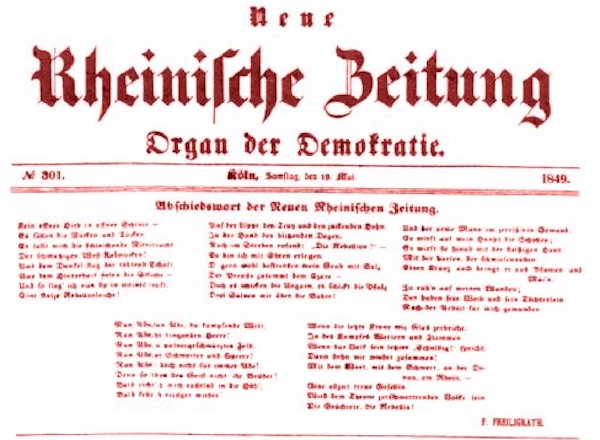
According to David Riazanov, we should read there a critical verdict by Marx on his own activity, which had centred on editing the Neue Rheinische Zeitung, a radical-democratic paper with increasing communistic content, from June 1848 to May 1849, when it was banned.
By March 1850 revolutionary tumult had subsided. Marx, Engels, and others, however, still refused to accept defeat. The March 1850 Address expected a new and more radical upsurge.
It would be led first by the democratic bourgeoisie. The League should be on their side against the reactionaries. But "instead of lowering themselves to the level of an applauding chorus, the workers, and above all the League, must work for the creation of an independent organisation of the workers’ party, both secret and open, and alongside the official democrats, and the League must aim to make every one of its communes a centre and nucleus of workers’ associations... Their battle cry must be: The Revolution in Permanence".
The "moderate" bourgeois liberals had hastened to declare the 1848 revolutions "completed" as soon as the kings and emperors had offered even limited constitutional monarchies. The liberals now wanted to stop disorder escalating "out of hand".
The democrats (then considered a different current from the liberals), wanted the revolutions instead to be "permanent" in the sense of continuing and deepening. The communists too, of course. And, warned Marx, the democrats too, if they gained the lead, would declare the revolution completed long before meeting the demands of the workers and urban poor.
Vladimir Lenin, according to David Riazanov, knew the March Address by heart. His tactic in 1904-6 (the oddly-named "democratic dictatorship of the proletariat and peasantry", a Provisional Government within a bourgeois envelope but pushing that envelope to the maximum), was near to a direct transposition of the politics of the Address. It, however, had a much more developed perspective on revolutionary mobilisation of the peasantry. The Address had nothing about the peasants, and in fact they played little role in 1848-9.
Leon Trotsky's revival of the slogan, "permanent revolution", in Russia, developed in 1904-6, was based on Marx's 1850 ideas, but went further, limning development to a workers' government by way of revolution in Russia linking up with revolutions in more industrially advanced countries.
The development of the working class in Europe in 1848 was weak compared to 1904-6, and Marx mostly instead aimed "at forming not the government party of the future but the opposition party of the future", and pushing the future "government party" to the maximum.
"They must check in every way and as far as is possible the victory euphoria and enthusiasm for the new situation which follow every successful street battle, with a cool and cold-blooded analysis of the situation and with undisguised mistrust of the new government. Alongside the new official governments they must simultaneously establish their own revolutionary workers’ governments, either in the form of local executive committees and councils or through workers’ clubs or committees, so that the bourgeois-democratic governments not only immediately lose the support of the workers but find themselves from the very beginning supervised and threatened by authorities behind which stand the whole mass of the workers".
By September 1850, Marx and Engels had concluded that the lull was more than a lull. The tumult was over for now. The revolutionaries must turn to long-haul organising. The Communist League split and then dispersed.
Marx criticised those who still talked about uprisings in the short term. "A German national standpoint was substituted for the universal outlook of the Manifesto, and the national feelings of the German artisans were pandered to. The materialist standpoint of the Manifesto has given way to idealism.
"The revolution is seen not as the product of realities of the situation but as the result of an effort of will. Whereas we say to the workers: You have 15, 20, 50 years of civil war to go through in order to alter the situation and to train yourselves for the exercise of power, it is said: We must take power at once, or else we may as well take to our beds.
"Just as the democrats abused the word 'people' so now the word 'proletariat' has been used as a mere phrase. To make this phrase effective it would be necessary to describe all the petty bourgeois as proletarians and consequently in practice represent the petty bourgeois and not the proletarians. The actual revolutionary process would have to be replaced by revolutionary catchwords…
"Some members of the League have called the defenders of the Manifesto reactionaries, seeking thereby to make them unpopular, which however does not worry them in the least, as they do not seek popularity".
The conventional story is that Marx then stepped out of active politics for over ten years to study in the British Museum instead. It is not really true. He continued active enough that when the First International was formed in 1864, the organisers saw him as the immediate choice for someone to represent German workers on its General Council in London.
He did, however, regard many of the radical efforts of the 1850s as flim-flam. He was not above weighing in on the squabbles from time to time, as with The Great Men of the Exile (1852) and Herr Vogt (1860), but perhaps it is a verdict on the political thinness of those years that few have taken those texts as important reference points for later politics.
He and Engels wrote analyses of 1848 and after, of which at least one (The 18th Brumaire of Louis Bonaparte, 1852) must rank as a reference point. After that, his major writings, such as Capital (published 1867, at the end of a series of reworkings starting with a would-be complete draft in 1857-8) would be the product of sustained effort to gain an overview of capitalism and its tendencies of development. On that basis, he would develop reference points going further again than the March Address.
The March Address is online at bit.ly/march-a. Audio version at bit.ly/march-aa. David Riazanov's Karl Marx and Friedrich Engels, a short biography with nevertheless a lot on 1847-52, is useful background. Workers' Liberty notes for study groups on the March Address: bit.ly/dp-march. §
Comments?We welcome replies, corrections and debate pieces. Contact us