
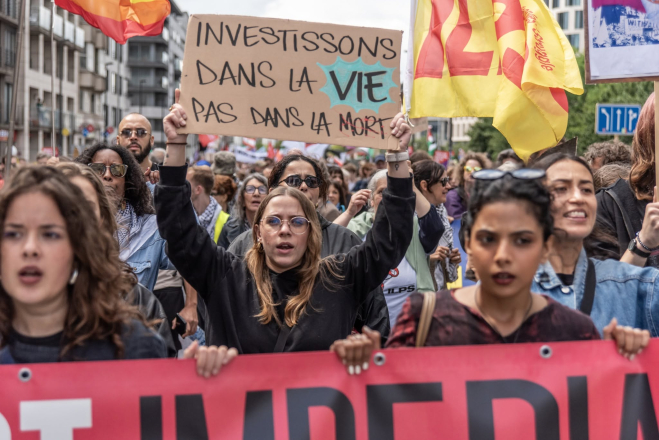
Dyonissis Zoes, a school teacher in Liège, Belgium, talked to Solidarity. Pic: Demonstrators in Brussels, 14 June.
School teachers in and around Liège, in Belgium, have been striking for weeks now against government cuts, and will continue to strike until the term ends on 4 July.
These cuts have been coming for two years, but now the two ministers in charge are saying they want to discuss and they're asking for a truce. It shows that if we organise together, they have to listen.
On 23 April, the government sent documents to the headmasters and directors of school on implementing the cuts, "pending approbation by vote".
The unions said it was going to be difficult to get people moving, because the spring holidays were coming. But a few teachers here in Liège, who had some experience with strikes to defend vocational schools, said: "We're not going to wait for the union, we're going to take charge this time".
We had everything planned before we got back to school on the Monday 10 May. On Monday some schools were already on strike, and by Wednesday almost all the schools of our city and the surrounding area were on strike.
It was not a little symbolic strike, as we sometimes do. It was a full-on strike with doors blocked and people on the pavement outside the schools to stop people going in.
The unions were surprised, but then said, well, now we have some arguments to go and talk to the government.
When you're a teacher and you're on strike, your boss saves money but you lose money. This time we organised so that 10% or 5% of teachers were explicitly striking, and the others could get their full salaries even though they weren't in school because they were blocked at the school doors.
We don't want the kids to go back to school for the exams that would usually happen now. There are external exams every year. They are quite easy, but if you fail you may have to repeat the year. We are saying that all the students should go on to the next year.
The strike organisation is very informal, lots of different people gathering in the room, not always the same people, but representing the different schools.We have Catholic schools, we have public schools, we have semi-public schools, and all those different networks are represented by people who are motivated and have energy that week. And then the next week there'll be different people with different opinions, so it's very organic, and that's why it's working out this time.
The tuition fees for colleges and universities are also going up, some of them eight fold, so lots of students have been with us on the streets defending their right to affordable tuition.
After the summer, we want to keep the action going. We want to force the powers in place to give more power to the teams and to the schools. People in offices in Brussels decide, and they're disconnected from the realities of the different cities and the different places where people are taught, and we need to have something that is based on a real consultation of the needs of the people there and the students.
In Brussels, they have only recently started teachers' general strikes, like we've been having for a month. I think because they're in Brussels, where the government is, they went the lobbying way, and with actions that were very visible in the media and on social networks. They thought it was their part of the solution, and honestly both were important.
These measures we've been striking against have been two years in the making. The regional government has now voted for some measures to save money on salaries. People didn't want to be the victims of these managerial decisions that are quite lazy.
As usual in Belgium, we have different layers of powers – federal, region, community - managing the same thing, and they're wasting lots of money on all these layers of power
The federal government right now is saving as much money as they can, because they want to invest more in the army - invest 2% of the GDP in, basically, American weapons every year. We also have the demographics against us, because fewer people are working-age, and more and more people in retirement.
The demographics are better in Flanders, but they're running low on tax money too, and so they're discussing raising VAT. There are school cuts going on in the Flemish region, but they are a bit lighter, and they are not cutting salaries. There have been two days of strike there, too, but it's less visible.
Comments?We welcome replies, corrections and debate pieces. Contact us