
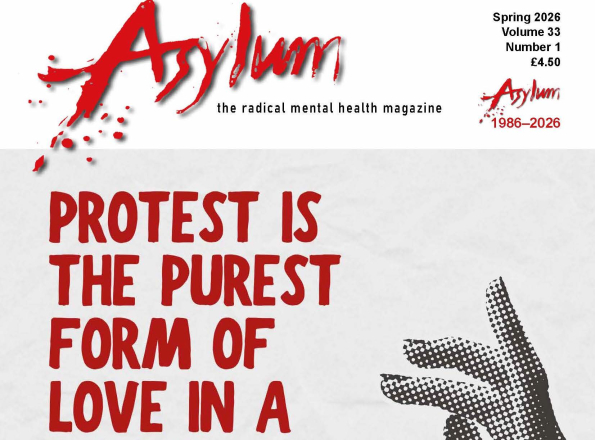
Asylum, the radical mental health magazine, is celebrating its 40th anniversary. Janine Booth spoke with its editor, Hel Spandler.
JB: Why and how was Asylum set up?
HS: Asylum started in Spring 1986, as the government was closing asylums and introducing ‘community care’. There was consensus that asylums were bad, but the UK had a right-wing Conservative government, so there wouldn’t be much community or care. It was as much about money, asylums were sold off and turned into luxury flats.
Some of Asylum’s founders were inspired by Trieste, a more collective, radical mental health initiative in Italy. We wanted to introduce these ideas in the UK, and promote collective provision and responsibility, rather than leaving people to their own devices.
JB: Tell us more about Trieste.
HS: Franco and Franca Basaglia and mental health workers and patients, wanted to close the asylums for more progressive reasons. Franco Basaglia was a Marxist and an anti-fascist, and in Trieste, they opened up the Asylum buildings to the community and created worker-patient cooperatives, with film showings, workshops and creative activities.
The book which helped inspire the Italian movement, The Institution Negated, has just been translated into English John Foot. He also wrote The Man Who Closed the Asylums about its history. Trieste still exists, although not in the same form, and is still a global flagship for progressive mental health initiatives.
JB: Asylum’s original strapline was ‘a magazine for democratic psychiatry’. What does that mean?
HS: The movement in Trieste was called democratic psychiatry, psichiatria democratica. It signalled our aspiration for mental health services to be more democratic, involving patients, workers, family members, friends and the public in decision-making.
JB: Asylum’s strapline is now ‘the radical mental health magazine’. Why the change ?
HS: We realised that the democratic psychiatry movement was still psychiatrist-led. We were criticised by some survivors who said that psychiatry can never be democratic. Also, mental health services are about more than psychiatry. ‘Mental health’ is a problematic term, but it's the term that people use, and it’s possible to have a radical take on it.
JB: Asylum covers the institutional mistreatment of people experiencing mental distress. Why?
HS: No other media does. When people with mental health conditions are covered in the media, it's either they’ve overcome their struggles or done terrible things. They are one of the most oppressed and marginalised groups in society and are more likely to be victims of abuse than perpetrators. But even otherwise progressive people still use ‘mad’, ‘crazy’ and ‘bonkers’ as terms of abuse. When survivors say what's happened to them, they're often not believed. It’s important that someone's standing up for them.
JB: Why is platforming service users important?
HS: They are not listened to in society, unless they endorse a particular narrative. New civil rights movements like the neurodiversity and trans movements are covered in the press, albeit not always positively, but few people even know about the survivors’ movement. Asylum platforms workers and activists as well as service users.
JB: The mainstream narrative is that mental health is an individual, medical issue, where people need to be treated or locked away. How does Asylum challenge that?
HS: By a multitude of voices putting forward alternative perspectives. By highlighting that while mental health conditions are felt personally, they are collective, and often relate to political, social, economic and environmental issues. For instance, there are links between poverty, sexism, transphobia, homophobia, racism and mental distress. The way that happens is complicated, and contributions explore that.
JB: Not everyone who challenges the mainstream narrative agrees about the alternative. Where does Asylum, and you personally, stand on that?
HS: We don’t promote or endorse any particular alternative, but we include a variety of perspectives and experiences. We don’t impose on people how they should understand their experiences either. There are huge debates about whether mental health problems are ‘illnesses’ or not and about the validity of psychiatric diagnoses. In the context of attacks on welfare claimants and people who are off sick, suggestions that mental illness is a myth, and mental health problems are overdiagnosed, has been weaponised. To me, what matters more is interrupting unhelpful narratives in a way that allows people to make demands on the state for better support services, regardless of how people describe or understand their experiences.
JB: Where do you think the socialist left is on the issue of mental health?
HS: The traditional left has been good at highlighting things like resourcing and workers’ rights. But I don't think they’ve understood more radical critiques from survivors. Workers’ and patients’ rights are tricky and sometimes they seem to conflict. Survivors often complain about the actions of mental health workers, such as forced treatment, sectioning, and not being believed. Sometimes what unions demand isn't helpful to patients.
The anarchist left has been more receptive to some of the radical ideas in Asylum.
JB: Why does Asylum include poetry and artwork?
HS: When I started reading the magazine, there was poetry and other creative stuff, but there were lots of long-winded essays. Articles might get in your head, but sometimes poems and images get in your heart. People experience the world differently and get messages differently. Some people like reading long reams of text, but some don't. There's a long history of patients and survivors getting across complex, critical messages in more creative ways, like cartoons. I recently wrote a chapter about single-panel cartoons in Asylum. We also include stories, both personal and fiction, and recent Asylum cover images have been like home-made placards you see on demos.
JB: What has Asylum achieved in its 40 years, and what do you hope it will achieve in the next 40?
HS: I guess it's created a community of people who write, buy and circulate the mag. Validating people’s experiences is a massive achievement. Whether it gets into the corridors of power is another matter. But it does get around. Our recent article on the dangers of Palantir in the NHS was circulated at a Unison meeting.
It’s an achievement to be still here after 40 years. Lots of things in this field are short-term.
There is nothing else like Asylum in the UK. People sometimes ask us how to set something up in their country. Last year in Kosovo, people set up a magazine, (Ç)mendje, in Albanian, directly influenced by Asylum.
In the next 40 years, I’d like to see new voices tackling new issues. Stop OxeVision, which campaigns to stop the use of CCTV cameras in psychiatric wards, took over an issue of Asylum last year. The Neuromancers are taking over the next issue. They are young neurodivergent people challenging society in wonderfully creative ways.
Asylum is open to new ideas. What matters to us is having an open discussion about radical mental health politics, not a preset agenda.
Watch the video of the full interview here.
The magazine's website includes sample articles and back issues.
To contribute an article, poem, photograph, artwork, or to tell Asylum about any issue you would like it to cover, email editors@asylummagazine.org
Subscribe: via PCCS Books. Suggest to mental health settings, trade union bodies or libraries that they subscribe. Attend the online launch of each issue.
Comments?We welcome replies, corrections and debate pieces. Contact us