
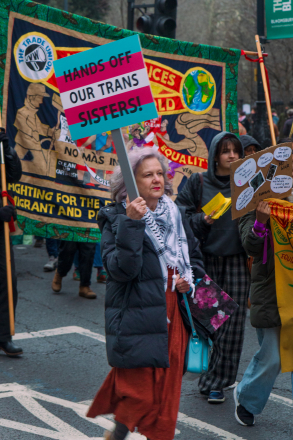
Mary-Ann Stephenson and John Kirkpatrick of the Equality and Human Rights Commission appeared before the Women and Equalities Committee 9 June. In a session focused on the new Code of Practice, a lot of the supposed reasoning, practicalities, and contradictions were unravelled by MPs.
Stephenson insisted that the “starting point of the code, as in the starting point of the Equality Act, is that people should be treated equally and fairly in a way that enables them to live with dignity”, and that single-sex services are only limited exceptions. Yet, when pressed on trans people’s access, she was clear that “where you are providing single-sex services or services separately, that needs to be on the basis of biological sex”.
Pressed on how sex can be proven, Stephenson accepted that “we do not have any documentation that reliably proves sex”. The EHRC cannot tell providers “check for this", or "check for that", "because that does not exist”. The Code fills this gap by telling workers to rely on “the individual’s physique or physical appearance, behaviour or concerns raised by other service users”. Asked by Nadia Whittome (Labour) what this actually means, “is it height, build, hairy legs, face shape?” Stephenson could not point to any legal requirement, but instead appealed to a “common-sense approach”. She gave the example of a woman in a pub toilet telling a drunk man, “you’re in the wrong room”, based on appearance.
Stephenson said, “what the law requires… is not that people should be judged on how well they perform masculinity or femininity… This is exactly about somebody’s sex”. But if there is no lawful evidence of sex, and service providers are directed to rely on “physique” and “appearance”, in practice, people are being judged precisely on how their bodies and presentation line up with gendered expectations.
A second contradiction: between the EHRC’s position that this will provide clarity and the Code’s vague tests. Christine Jardine (Lib Dem) asked, if a “biological woman” is challenged at the door, “how do we prove that we are?” Stephenson replied that “in most circumstances”, once the person speaks, “that is fine”, and that “we have operated for decades” with single-sex services on the basis that “the vast majority of people follow the rules”. Alex Brewer (Lib Dem) in response said: “it was common sense that women were far too emotional and sensitive to vote”. As a woman with short hair and a gender-neutral name, she also felt the CoP could affect her use of services. Given the litigious nature of various anti-trans organisations, she argued that providers “want to know exactly what using a common-sense approach would look like in practice”. Stephenson conceded that “maybe common sense is the wrong term”, but still offered nothing more concrete than proportionality and a restatement that no sex documentation exists.
The Office for Equality and Opportunity’s impact assessment warns that trans people, already at disproportionate risk of violence and sexual assault, could face increased danger with this code in place.
Stephenson replied that “there are certain elements of what we now understand the law to be that disadvantage trans people, compared to what they thought the law was”. Yet she insisted this is simply the law, that the Code is compatible with Article 8, and that “we also make very clear that [the Code] should not leave trans people without access to services”. The examples she referred to are non-binding and there is no concrete duty on providers to offer safe, workable alternatives when trans people are excluded from single-sex spaces.
The EHRC’s account of the Code as an explanatory document does not hold up to scrutiny. Stephenson argued that the Code does not “make the law” and that if any part of it is out of date, then case law takes precedence. But the whole political significance of the Code lies in how service providers, employers and public bodies will interpret and apply it. A statutory code will shape practice. When the Code authorises reliance on appearance, behaviour, and complaints from other users, it lends institutional backing to the likely discrimination the EHRC claims it will guard against.
The EHRC has also said that the code will avoid “expensive and time-consuming litigation”, but both Stephenson and CEO John Kirkpatrick said that key sectors such as policing and healthcare will need further guidance, and that they did not directly engage all major service providers while drafting. Kirkpatrick noted that they relied heavily on written consultations and on comments from government departments as service providers.
Comments?We welcome replies, corrections and debate pieces. Contact us