
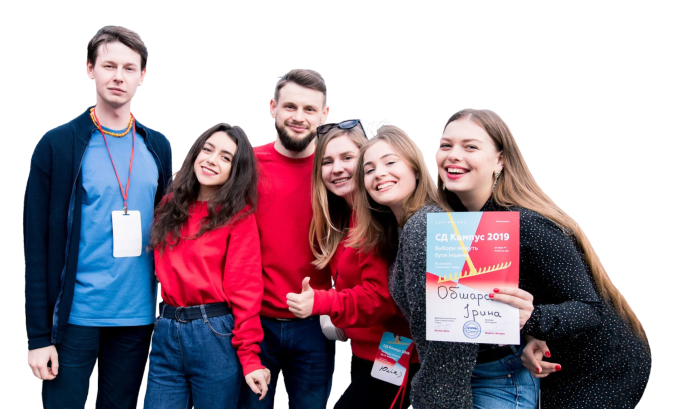
SD Platform members
Oleksandr Bulin and Karina Mokhammad, Social Democratic Platform, Kyiv, talked to the Workers' Liberty delegation visiting Ukraine in May 2026.
The SD Platform has branches throughout Ukraine, and also abroad. For example, in Warsaw, Brussels and, in particular, Berlin. In fact, we are the only political organisation in Ukraine with branches abroad. People join the groups abroad because they want to be in a community of like-minded people.
Displacement and migration have made it more difficult to maintain membership among students in Ukraine, but we are still active on university campuses here. Another problem with campus organisation is that student-grants in Ukraine are so low that a lot of students need to work while studying. Studying, working, and having a personal life does not leave a lot of time for politics.
We also have a sister feminist organisation, sister NGO that unites teachers and university professors & sister groups in Ukrainian trade unions, campaigning for better working conditions.
We promote political education, especially among young people. We have a 30%/70% ratio of theory and practice. Our education and training are always interactive, as opposed to giving people a lecture, so that people feel energised and motivated, and people have the freedom to take their own initiatives. We run annual Campus Forums. The last one was near Lviv on June 3-7, which united together 40 young Ukrainian and 11 Swedes — a major delegation of the Social Democratic Students of Sweden.
We have an annual conference which is open to all members, and at which we have discussions with speakers from sister organisations. Our website carries progressive politics and covers all currently importantly political issues, as well as explaining what kind of Ukraine we want to see.
Since 1991 (declaration of Ukrainian independence) there is no tradition of the political divisions and ideological parties which you have in Western Europe. Parties have been set up which are not based on ideology but are the personal projects of individual oligarchs, financed by them, and with the job of getting them and their supporters into the Verkhovna Rada (Ukrainian Parliament).
Socialism is a toxic word in Ukraine. We therefore try to avoid using the socialism naming and talk about progressive politics instead. Because of Ukraine’s historical experience, we need to distance ourselves from expressions with Soviet connotations.
Social democracy, for many people, is also a toxic word. Social democracy is associated with Victor Medvedchuk’s (now defunct) party. Medvedchuk was pro-Russian politician — Putin is even the godfather of his child – and eventually he ended up getting arrested and was part of a prisoners’ swap with Russia.
But there is a social-democratic tradition in Ukraine. You only need to look at Ukrainian banknotes. Lots people pictured on them were part of a social-democratic tradition. So, there is a social-democratic tradition here, and people need to know about it.
In line with belonging to a Ukrainian social-democratic tradition, we have built strong links with social-democratic parties in the Nordic countries, Germany and UK Labour Party. These are the most important but not only our allies. For example SD Platform is the associated member of the Progressive Alliance.
(For further information on this topic, see the article by Bohdan Ferens, the founding member of SD Platform, on the organisation’s website: “Towards a (re)birth of Ukraine’s social democracy”.)
Since the full-scale Russian invasion in February 2022 we have seen the development of a non-civic form of nationalism which involves a strong rejection of anything associated with Russia, and the development of a simplified liberal-economic narrative based on the idea that the market can solve everything.
We are against both of these political currents. We are for progressive politics. The market cannot solve everything.
The draft Labour Code, for example, is more about employers’ rights than about workers’ rights. Although the government wants to join the European Union, it is failing to promote EU standards of workers’ rights. We are campaigning for better workers rights and stronger trade unions.”
(For further information about the organisation’s analysis of Ukrainian trade unionism, see the article on the SD Platform website: “Trade Unions at a Crossroads”.)
There have recently been some street protests about migration into Ukraine. (Despite wartime restrictions, public protests are not prohibited. There have also been some protests, for example, about the proposed new Civil Code, and the earlier protests about scrapping the autonomy of anti-corruption organisations.)
But the anti-migrant protests have not been big. Maybe thirty people, including fifteen-year-old boys who probably don’t know what they are protesting about. The idea that Ukraine has an immigration problem is nonsense. Who would want to come to a country with a rock-bottom minimum wage and which is the site of the biggest war in Europe since the Second World War?
The war has led to some people moving in the direction of a far-right non-civic nationalism. But the numbers who take part in protests are small, and the protests have been organised through social media. We don’t know if Russia is behind this, using social media as has happened in other countries, but the pictures of people protesting about migrants, even if there are only 30 of them, work to Russia’s advantage.
Since independence we have seen the development of civil society and civil society organisations in Ukraine. But it has not been straightforward and continuous. They began to develop in Ukraine after independence in 1991, when there were still non-democratic tendencies in Ukrainian society. Funding from Europe and America allowed them to grow in the course of the 1990s and the early 2000s.
After the Orange Revolution (2004/2005) funding for civil society organisations declined as it seemed that democracy had been won. But then a new wave of support began after the Maidan and the Russian occupation of Crimea and waging war in the East of Ukraine (2014), only to decline again, in terms of American funding, after Trump’s re-election.
Popular protests like the Orange Revolution and the Revolution of Dignity (Maidan), and the response to Russian aggression, especially the full-scale invasion of 2022, have driven forward the development of Ukrainian civi society. People say that we now have a very developed civil society – but just compare Ukraine with, for example, Sweden. There is lots of work to be done.
(For further information about the organisation’s view of current Ukrainian civil society, see the article on the SD Platform website: “Ukraine’s civil society after four years of war”.)
Comments?We welcome replies, corrections and debate pieces. Contact us