
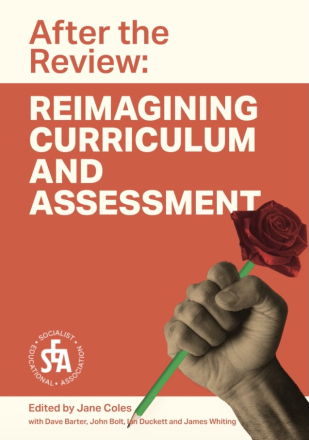
The latest addition to the Reimagining Education series published by the Socialist Educational Association is After the Review: Reimagining Curriculum and Assessment, edited by Jane Coles. I recommend it.
To fulfil its manifesto commitment, the government set up the Curriculum and Assessment Review (CAR) in 2024. The previous review of England’s National Curriculum ran from 2011 until 2014 and implemented Gove’s “reforms”. The CAR looked to modernise and broaden the curriculum and judge the testing system’s efficacy. It considered in particular the “attainment gap” between richer children and those poorer and/or with Special Educational Needs; how the curriculum might become more representative and inclusive; and whether qualifications post-16 might be improved.
The Review’s Final Report appeared in November 2025. A succinct overview of main findings is at bit.ly/CAR-r. A new National Curriculum based on the Report will go live from 2028 when, for the first time, academised institutions will be legally required to teach it.
Young people are increasingly disaffected from school. Teacher recruitment and retention remains in crisis. As John Bolt and Ian Duckett make clear in their contribution to After the Review, a very accessible collection of critical rejoinders published in book form by the Socialist Educational Association, the CAR Final Report is complacent and conservative. Its recommendations fall far short of what is needed.
Contributors to After the Review acknowledge the little good the Report contains even as they highlight its grave inadequacies and offer better alternatives. Astute comments from teachers begin the book: Gove’s curriculum has fostered shallow learning, alienated young people, sapped morale and damagingly constrained practice. Foregrounding practitioners’ voices is an important corrective to the way the CAR worked.
As Dave Barter notes in his contribution, most CAR panel-members were drawn from multi-academy trusts at CEO level and from the university sector. Trade unionists, teachers from non-academised schools, and members of subject specialist organisations were excluded.
Eighteen
The CAR Panel received written evidence from individual teachers and organisations, but there’s a world of difference between making a case on paper and arguing it as part of the decision-taking group. One reason why, as Dave Barter writes, education unions should consider affiliating to the Labour Party.
Eighteen concise essays make up the bulk of the book. They cover a range of educational concerns and subject-specialisms from Key Stages 1 through 5, and share a view of the curriculum as a space for young people to develop in educationally beneficial ways by engaging in worthwhile activities. Such a view, progressive and attentive to the learner’s personhood, is anathema to those for whom the curriculum is chiefly a device for transmitting authorised content.
I’ll spotlight a handful of essays to convey something of the book’s scope and stance.
Tony Eaude condemns the Review’s failure to build on the success of the Early Years Foundation Stage. He calls on teachers to see themselves as curriculum makers, and on senior leaders and school governors to support teaching which emphasises oracy, the arts and relational pedagogy.
Phonics
James Whiting is scathing about the DfE’s fixation with phonics teaching, and (in a separate essay) criticises over-specialisation at A Level and the defunding of International Baccalaureate and BTEC courses. Martin Allen weighs up the proposed V Levels (a post-16 qualification endorsed by the Review which Whiting has little time for) but comes down in favour of retaining BTEC and replacing A Levels with a general diploma.
Against the Report’s conception of teaching as delivery, Jane Coles and Maggie Pitfield declare teaching “an intellectually creative practice” (p.39). They decry the “deadening load” (p.41) which the Govian knowledge-centric approach imposes on young people. They note the Review’s blindness to enjoyment as an enabler of learning, and urge the importance of creativity across all subjects.
The creative dimension inherent in maths is celebrated by Hilary Povey. Creative and co-agentic maths teaching helps confirm in pupils and students that necessary sense of “trust in oneself as an author of knowledge” (p.85) and as someone who can “challenge, critique and decide” (p.85). Povey challenges the Review’s support for “ability” grouping, and critiques its faith in the value of instant factual recall and time-limited examinations.
Richard Reiser outlines the history of disabled children in school, sketches the political repositioning of disability in education and wider society, and urges support for the struggle for full inclusion. He is uncompromising about the damaging nature of the current testing regime.
In the final essay Diane Reay contends that the review merely attempts to refresh a tired system. She urges “investment in infrastructure, staff [and] students… [and in] trust, well-being, expertise” (p.105). She sketches the harm done to working-class pupils and students by the low level of UK welfare spending as a percentage of GDP compared with many European countries. Funding must shift away from the increasingly costly assessment system and the overbearing Ofsted inspectorate.
After the Review is a handbook of useful information and vital argument for all those campaigning for better curriculum and testing policy. Every staffroom needs a copy.
Comments?We welcome replies, corrections and debate pieces. Contact us