
While the theocratic-fascist regime in Iran is still standing, with power shifted towards its military-wing, the Islamic Guards (IRGC), the economy is in very serious crisis.
Under the cover of a separate ceasefire a connected conflict is playing-out in southern Lebanon where Israel continues to expand its occupation, demolish homes in dozens of Lebanese villages, and fight the Iran-aligned militarised Shia party, Hezbollah.
Israel now occupies one-fifth of Lebanese territory, or 2,000 sq km, and on 7 June the Israeli military ordered the evacuation of the major Lebanese town of Tyre.
Israeli troops continue to suffer casualties in occupied Lebanon even though they face a diminished Hezbollah, however now armed with fibre-optic drones.
On Monday 1 June Israel Katz, Israel’s Defence Minister, announced the intention to resume bombing Hezbollah strongholds in the densely populated southern suburbs of Beirut. Trump, alarmed that Israeli attacks might derail his attempts to patch together a deal with Iran, and against the background of Iranian threats to resume and widen the war, phoned Israeli Prime Minister Benjamin Netanyahu to tell him to call off the strikes.
Apparently Trump yelled at Netanyahu, calling him, “fucking crazy”, adding, “you’d be in prison if it weren’t for me”. Netanyahu faces a long-running corruption case, and Trump has repeatedly argued he should be pardoned.
That phone call and the fact Netanyahu called the Beirut bombing off reveals the real relationship between the US and Israel. Israel is a highly developed capitalist state with its own interests, but it is still subordinate to the US when their concerns clash.
Iran has threatened it might attempt to close the Red Sea to shipping by attacking boats attempting to pass through the narrow Bab al-Mandab Strait. Such a threat is not implausible as an Iranian ally, the Houthi regime based in northern Yemen, probably has that capability.
3,500 people have been killed in Iran, 3,400 in Lebanon, 118 in Iran and 26 in Israel.
In addition over 10,000 have been injured in Lebanon, 26,000 in Iran and nearly 8,000 in Israel.
Iranian officials claim the 40-day US and Israeli bombing campaign, which began on 28 February, caused $270bn of direct damage. Probably Iran is exaggerating the figures, but, even so, Iran’s total income for exports last year was only $45bn.
The war damage will take many years to repair.
The latest estimates for job losses in Iran caused by the war is: one million directly from infrastructure and plant destruction; two million indirectly caused by new sanctions, supply chain and power disruption.
Hojattollah Mirzaei, an Iranian academic and economist, estimates a further 3.5 to 4.5mn people will fall into poverty in Iran this year and believes Iran’s economy will shrink by at least 10%. Inflation, as it impacts on workers, is over 100%.
A sociological survey from Eghtesad News suggests that the Iranian “middle class”, estimated at 65-70% of the population in 2010, is now only around 50% of the population. In the same period 10% of wage workers fell into precarious, informal employment.
Executions
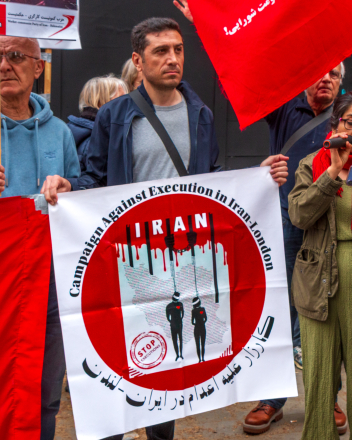
The economic misery in Iran, coupled by the very widespread hatred of the regime, makes new social crises inevitable. In an effort to repress and intimidate the population a new wave of executions is taking place in Iran’s overcrowded prisons. 40 political prisoners were hung between 18 March and 1 June.
Over the week beginning 1 June Iran’s internet began to partially re-open following nearly 12 weeks of almost complete, regime-orchestrated blackout. Immediately new video was posted of the anti-regime protests, the Dey Protests, in January 2026, when at least 7,000 pro-democracy protesters - and possibly as many as 30,000 - were shot or hacked to death by IRGC and Basij militia members. According to state officials 10mn people in Iran earn some or all their income on-line; all internet-related economic activity in Iran was prevented during the shutdown.
Iran appears to moving towards a Russian/Chinese model of internet service which is heavily state regulated.
The war has cost the US $27bn so far. Iranian drone and missile attacks have caused damage to over 20 US bases across the Middle East and the US has lost 13 troops, 381 injured, and has had 42 aircraft destroyed during the conflict.
The impact of the Iran war is very widespread. According to Al Jazeera 146 countries have increased petrol prices and the International Energy Agency describes the impact as “the largest energy shock on record.”
There is little open, visible progress towards a US-Iran peace agreement. And if an agreement is fudged and signed-off, it might well not hold.
Iran wants at least $24bn frozen assets, held by foreign banks and 60mn barrels of oil stuck on tankers trapped in the Persian Gulf by the US blockade, released. But that would only provide temporary relief.
More generally Iran wants the US-led sanctions regime relaxed and ended.
Trump trumpets that Iran says it does not intend to produce nuclear weapons. But of course it has often made that claim, and they are lying.
US President, Donald Trump, ignorant as always and mesmerised by American military power, failed to anticipate the effective closure of the Strait of Hormuz and the economic consequences that inevitably followed on.
Trump desperately wants the Strait of Hormuz opened to shipping and the semblance of an agreement with Iran, one that he is able to spin as a victory. Trump is caught between serious domestic pressure caused by a steep increase in petrol prices and the unwillingness to come to an agreement with Iran that compares badly to the Joint Comprehensive Plan of Action (JCPOA) deal US President Obama made with Iran in 2015.
Trump pulled out of JCPOA in 2018, denouncing Obama’s agreement which restricted Iran’s nuclear programme for a relaxation of sanctions.
Regular petrol now costs $4.22 per gallon on average in the US, up 40% from March, as the US closes in on November’s mid-term elections. Increases in the costs of living is now a major issue in US political life.
According to the Economist Trump’s approval rating has slumped to minus 25%, with 60% disapproving of his presidency. The latest opinion polls show 57% of Americans in opposition to the US war on Iran with only 36% in support. The Democrats are given a 75% chance of taking control of the House of Representatives in November and are now accorded a 51% chance of winning the Senate, too.
On Wednesday 3 June Trump lost a vote in the House which aimed to end the war on Iran. The House is currently Republican-led, and four Republicans joined the Democrats to vote against Trump. The Democrats denounce the war as “illegal and costly.”
No doubt Trump will ignore the vote, but it adds legitimacy and weight to the anti-war case in the US.
Comments?We welcome replies, corrections and debate pieces. Contact us