
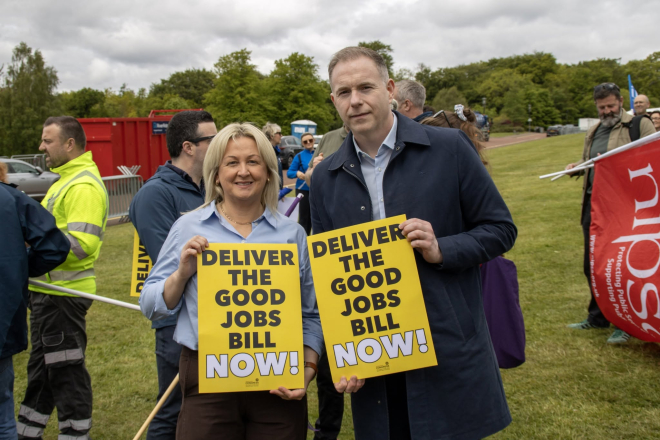
Trade unions are pushing for the Northern Ireland Executive to agree the Good Jobs Bill, which seeks to align with or improve upon workers’ rights in Great Britain and the 26-counties.
Employment law is entirely devolved to the Northern Ireland Assembly. NI workers used to have better rights in some areas than in Great Britain but, with the passing of the Equality Act 2010 and the Employment Rights Act 2025, divergence in employment law and the gaps in workers’ protections has significantly increased.
The proposed Good Jobs Bill, introduced by Sinn Féin Economy Minister Caoimhe Archibald, began life in a public consultation almost two years ago.
Some of the key provisions include a day-one right to a written statement of terms for all workers (not just employees), that fire and rehire practices will be automatically unfair (except in very limited cases), and an end to exploitative zero-hours contracts, replaced by a banded-hours model.
The Bill would also introduce a Code of Practice on the right to disconnect, helping employees maintain work-life boundaries.
Pushed Back
Employers have mostly pushed back on the proposals to introduce changes to trade union access and recognition, including e-balloting and lowering recognition thresholds.
Unions would have the right to request access to workplaces, including digital access. Employers will not be able to unreasonably withhold access.
The statutory recognition threshold would be reduced from 21 to 10 workers. The notice period for industrial action is already at seven days in NI, lower than the current Great Britain period of ten days (which was reduced from 14).
Unlike in Great Britain, however, no changes are proposed to broader protections from unfair dismissal, which have a one year qualifying period in NI, though flexible working would become a day-one right.
The Bill would also introduce enhanced redundancy protection for women returning from maternity leave and introduce paternity leave changes in line with Great Britain.
Executive Bills must first be agreed within the Executive then introduced the Northern Ireland Assembly. Despite widespread support from the public, the DUP blocked the bill at the Executive on 28 May, preventing it from going forward to the Assembly as an agreed Executive Bill for debate.
It cited (predictable) concerns and lobbying from business groups, posing the party as “pro-business”. This should not be lost on those workers voting for the party.
Unions’ concern is that delays could prevent the Bill being passed before the Assembly elections in May next year.
Despite this, in polling over 80% of people back key elements of the proposed Bill. In particular, 83% of people believe that workers on a zero-hours contract have the right to be offered a contract reflecting the hours they actually work.
TheBelfast Telegraph reported: “This is supported by more than nine in ten nationalists and Alliance voters, and seven in ten DUP and UUP voters.”
While business are opposed, 80% believe that everyone should be able to access a trade union in their workplace for help with employment issues such as requesting flexibility.
Again, it was reported: “This proposal is supported by 99% of SDLP, 96% of Sinn Fein, and 92% of Alliance voters along with six in 10 DUP and UUP voters.”
The Bill, of course, could go further. Gerry Carroll, the People Before Profit MLA, rightly said that “this can fairly be characterised as a ‘catch up’ bill, rather than an effort to genuinely end exploitation and oppression in the workplace. A majority of the proposals are designed to make sure workers in the north benefit from the same basic protections recently introduced - or soon to come into force - in Britain.”
He called it “a missed opportunity to shift the balance of power away from bosses and towards workers, and establish the conditions for sectoral collective bargaining. Unions should be empowered with robust rights to access and organise workplaces, and workers should be allowed to engage in solidarity and secondary action.”
That said, the Bill is a modest step forward and introduces much-needed alignment with standards in Great Britain and on the island of Ireland.
Unions should keep up the pressure for the Bill to be passed before the next elections – and fight to go further.
Comments?We welcome replies, corrections and debate pieces. Contact us