
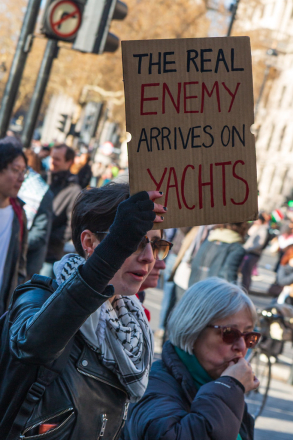
The top ten per cent in Britain own 43% of all wealth, according to the latest figures from the Equality Trust.
The top 0.1% in the UK own 9%, double their share in the early Thatcher years.
Nine per cent seems not that much. But the top 0.1%, and the top 10%, own a much bigger part of the wealth that brings power - financial wealth, and ownership of companies.
Even among the “next” 20% who are much more well-off than average readers of Solidarity, most of the wealth is “personal”, their own houses and pension rights.
The statistics bounce around from year to year as share prices vary, but the constant is that a small minority control the means of production, the factories, the equipment, the offices, the software systems and databases.
Luxuriate
They luxuriate in income from property, while the majority scrape by income from selling our labour-power.
With top income-tax rates lower now, since Thatcher and even since Osborne, the rich take more of their income in the form of “salaries” for being bosses. CEOs in top firms, according to the latest report from the High Pay Centre, are now on an average of £6.2 million a year.
That’s not a wage. It is a pay-out, awarded by your cronies on the “compensation committee”, for being in command of the means of production.
The rich may also get multiple pay-outs for being “non-executive directors” of big firms, a post which pays around £80,000 from each firm for attending meetings and reading reports for maybe two or three days a month.
Yet politicians wail about “the benefits bill” taking too much.
Benefits
As it happens, working-age benefits are fairly level. The Labour government increased Universal Credit a bit this year, but its real value remains very diminished.
Housing benefit, and the housing benefit element of Universal Credit, remain limited to a maximum of the Local Housing Allowance, frozen since 2024 while rents have risen, so many claimants have to cover rent out of benefit payments designed to cover food, energy, clothing, etc.
The only element of benefits rising markedly is state pension payments, thanks to the “triple lock” introduced by the Tories in 2010 in a (successful) bid to get the votes of the elderly. That means there are many fewer elderly people dying from cold in the winter: there were over 100,000 in 1950-1. But old people relying on the state pension are still poor.
The root issue behind the claims that there is “not enough money” for the NHS, for schools, for social care, is the inequality of wealth.
The working class, the people who produce everything, live by selling our labour power to those who own and control the means of production.
They pay us roughly a going rate for our labour power - a fairly comfortable “living wage” for some, scanty for others. They control the much greater value that our labour-power yields when put to work. They become rich and powerful from that surplus value.
Dribs and drabs of the surplus value can be clawed back from them to finance public services, but only by class struggle.
Wealth tax
The big business magazine The Economist is worried about calls for a wealth tax, and publishes many articles claiming it won’t “work”.
Actually, Spain, the Netherlands, Switzerland, and Norway all have wealth taxes. France still has one, though in 2017 Macron cut its scope. Denmark’s right-wing Social Democrat leader Mette Frederiksen scraped through her country’s recent general election by promising one.
Wealth taxes are workable, and they can make a difference at important margins.
It’s true they are limited. As with the very high rates of income tax for very high incomes which the UK had from World War Two through many years of Tory government until Thatcher, beyond a limit they can be evaded.
As long as the billionaires and multi-millionaires command the heights of wealth and power, they will never allow themselves to be salami-sliced from those heights by incremental taxes. They will find ways round it.
The differences at the margins are important. To go beyond that, the working class needs to take back control over the value-added we produce, that is, to seize the major means of production. All of those, after all, were produced by our labour.As the masthead of Solidarity puts it, “social ownership of the banks and industry”.
Comments?We welcome replies, corrections and debate pieces. Contact us