
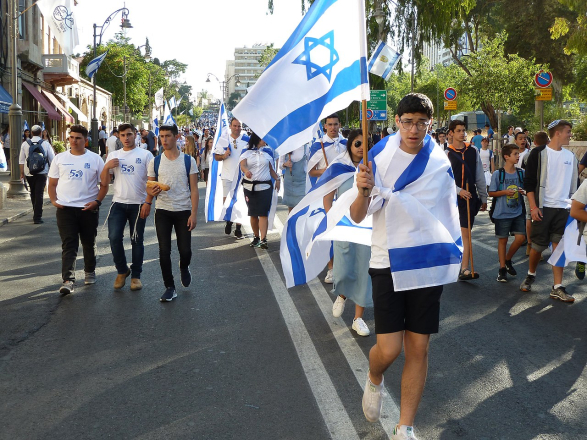
On 14 May, a Solidarity Guard organised by Standing Together, a binational (Palestinian-Jewish) left-wing social movement active in Israel, mobilised to defend Palestinian residents, homes, and businesses from the Jerusalem Day “Flag March”. The event is organised annually by far-right settlers to terrorise Palestinians and celebrate the occupation of East Jerusalem.
Asya Adar, a Solidarity Guard organiser, spoke about the mobilisation. This speech is transcribed from Instagram:
“My name is Asya Adar, and this land is my home. For the last two years, I’ve been an activist with Standing Together. In the past year, I’ve led the movement’s Solidarity Guard, which organises protective presence in the face of extremist violence within Israel and the West Bank.
“This week, we were in the Old City in Jerusalem during the Flag March, a celebration that is essentially organised far-right violence in the Muslim Quarter, with the backing and support of the authorities. Two years ago we were roughly 20 activists on Jerusalem Day, a year ago we were 50 activists, and this year, we were more than 200 activists — in a massive action of solidarity and protective presence.
“Nothing inspires more hope than solidarity. And because of that, nothing scares Kahanists, Jewish supremacists, and settler terrorists — including those who are in the government — more than Jewish-Palestinian solidarity. The only way we can continue living on this land, without terror, without a forever war, the only way to create a reality of prosperity, of functioning public services, of safe streets… the only way to move forward is together.”
Standing Together is also campaigning to demand increased social provision for Palestinian communities. Underfunding of services, a result of successive Israeli administrations treating Palestinians as second-class citizens, has allowed organised crime groups to grow, leading to a violent crime wave. Standing Together wrote:
“Palestinians citizens of Israel are being killed by organised Palestinian crime groups at an average of nearly one a day. One human being is killed almost every single day due to this epidemic.
“We were in Jadeidi Makr to protest this unbearable and terrifying reality as part of our Resilience campaign against violence in Palestinian communities. Crime groups feel comfortable murdering citizens across the country because they believe they won’t face consequences.
“Palestinian communities across Israel have been denied police protection and state services, while being subjected to oppression and aggressive political persecution. The situation cannot go on like this. We demand protection for Palestinian communities and an end to this bloody reality.”
Gaza
In Gaza, the situation for residents remains bleak. Israeli military violence continues, with the Israeli army currently occupying around 60% of the territory. The enclave’s two million residents are crowded into the remaining 40%. A former national security advisor to Netanyahu, quoted in the Financial Times, said he expected Israel to maintain a permanent presence in Gaza, in order to occupy a “buffer zone” of between one and two kilometres within the border. 828 people have been killed since the October 2025 ceasefire.
The so-called “Board of Peace”, established as part of the deal brokered by the US that nominally ended Israel’s war, says it faces a vast funding shortfall and cannot deliver its commitments to reconstruction. Not a single temporary home has been built inside Gaza for the millions of displaced people, many of whom remain in tent camps. Only 30% of basic emergency relief needs are being met.
Commentators suggest the Board’s funding shortfall stems in part from Arab and European states’ reluctance to provide finance, concerned about the Board’s lack of a viable plan for governance or development towards a Palestinian state, a supposed aim of the peace plan. Nine countries promised £5bn in aid at the Board’s first meeting. Only around £17 million has actually been received, plus an additional £74 million ringfenced to fund the police force. According to figures in theGuardian, the funding amounts to roughly £1.30 for every £75 pledged.
Recent municipal elections in the West Bank and Gaza were swept by candidates loyal to the Fatah leadership, the secular-nationalist political party which leads the Palestine Liberation Organisation (PLO). Elections took place only in one district in Gaza, the first elections of any kind held anywhere in Gaza since 2007. 13 out of 15 seats were won by Fatah-backed candidates, with two seats won by independent candidates widely seen as aligned with Hamas. Turnout was low, at 23%. Turnout in the West Bank was 56%.
Occupation
A study by the Financial Times has shown that Israel has occupied new territory equivalent to around 5% of its 1949 borders since 7 October 2023. This amounts to around 1,000 sq km, around half of which is in Lebanon. A vocal faction within the Israeli government wants Israel to permanently occupy more Lebanese territory, establishing a new border along the Litani River, which runs up to 30km further north than the current frontline. Israel has also militarily occupied territory within Syria.
Advocates of aggressive territorial expansion have a variety of political motivations. Some claim the policy is necessary to protect Israel from paramilitary opponents such as Hamas and Hezbollah. Others see seizures of land, along with the campaign of settlement expansion and state-backed terror in the West Bank, as part of a political project to establish a “Greater Israel”. Within this latter group, some leading figures have explicitly messianic-eschatological motivations.
Knesset elections
Elections for the Knesset (Israeli parliament) are due to take place by 27 October at the latest. There are indications they may take place considerably earlier; on 20 May, the Knesset approved a bill to dissolve the parliament, normally a precursor to an election being called. Parliamentarians will now have to agree on an election date.
Opinion polls indicate Netanyahu’s current governing coalition will not win a majority in the elections. The main opposition bloc will be “Together”, an alliance between the liberal Yesh Atid party led by Yair Lapid, and a far-right pro-settler party led by Naftali Bennett. The two leaders were the co-heads of Israel’s last anti-Netanyahu coalition government, which was in office from June 2021 to December 2022.
“Together” may not be able to form its own coalition. Even if it does, it will probably bring no significant easing in the oppression of the Palestinians. Bennett, who comes from a Religious Zionist background, is politically committed to the current regime’s existential hostility to Palestinian sovereignty and statehood.
Following an internal primary, the electoral slate of Hadash, a left-wing party led by the Israeli Communist Party, will be headed by Yousef Jabareen, a Palestinian academic who previously sat in the Knesset from 2015-2021.
Comments?We welcome replies, corrections and debate pieces. Contact us