
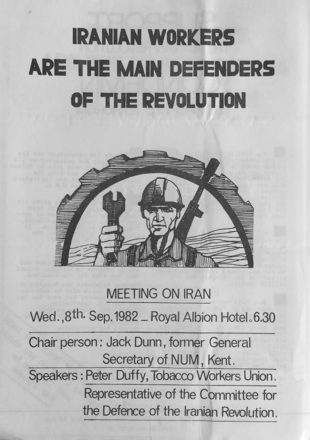
The Committee for Defence of the Iranian People’s Rights (CODIR) – once called the Committee for the Defence of the Iranian Revolution – has a checkered history. That history is, in turn, rooted in the history of the Tudeh Party.
The Tudeh Party (Iranian Communist Party) was founded in 1941 during the British-Soviet occupation of Iran. From the outset, it was a slavishly Moscow-loyal party.
The Soviet Union, it claimed, was “the world’s most progressive nation”. While nominally demanding total nationalisation of the Iranian oil industry, the Tudeh Party also called for extraction rights in Northern Iran to be granted to the Soviet Union – in the name of “socialist solidarity” and “anti-imperialism”.
After the 1953 coup which deposed Prime Minister Mosaddegh the Tudeh Party was brutally repressed. Its underground organisation was crushed, and many of its most prominent members were imprisoned and executed.
After the overthrow of the Shah in the February Revolution of 1979 the Tudeh Party re-emerged from illegality. But, in line with Soviet foreign policy, it backed the thoroughly reactionary regime established by the Ayatollah Khomeini.
The latter, claimed the Tudeh Party, represented a bulwark against US imperialism. The February Revolution, it claimed, had put Iran on the “non-capitalist road of development”. Islam, according to the party’s main theoretician, Ehsan Taban, was “the ideology of the anti-imperialist revolution”.
Despite Khomeini’s attacks on women’s rights, workers’ rights, freedom-of-speech rights, and the rights of Kurds and other national minorities, the Tudeh Party was unwavering in its support for the Islamist regime. In fact, it positively collaborated with it.
The Tudeh Party newspaper carried slogans in support of Ayatollah Sadegh Khalkhali – at the very time when he presided over tribunals which sentenced anti-regime socialists to death. When pro-Khomeini students occupied the US Embassy in Tehran, the Tudeh Party hailed the event as anti-imperialist and accused those critical of it (from a leftist point of view) of treason.
The Tudeh Party went even further. It denounced socialist critics of the regime as counterrevolutionary. It provided the security forces with the names of socialists who had not thrown in their lot with the ayatollahs. And when the regime carried out mass executions of its political opponents in 1981, the Tudeh Party supported the bloodbath.
According to Mohsen Milani (“Harvest of Shame: Tudeh and the Bazargan Government”), the party even denounced Amnesty International’s criticisms of the mass executions as “blatant interference in Iran’s internal affairs”.
Then, in early 1983, it was the turn of the Tudeh Party itself.
The party was banned. Its leaders were arrested and imprisoned. Many of them died during interrogation to secure forced confessions. Eventually as many as 10,000 members of the party were imprisoned. Hundreds of them were executed in 1988, when the regime carried out a further and even bigger wave of mass executions than in 1981.
State media broadcast ‘confessions’ by the imprisoned party leadership in which they variously confessed to treason, subversion and “horrendous crimes”, and praised the superiority of Islam and the Islamic government over Marxism-Leninism.
Tudeh Party leaders publicly dismissed the politics which they had espoused for decades as having been falsely based on Freemasonry, secularism, liberalism, and the influence of Marxists linked to imperialism and Zionism.
The Tudeh Party was far from being a lone voice on the left in its admiration of the February Revolution. The Fedayeen Majority took the same position and collaborated closely with the Tudeh Party, with the same fatal consequences.
On a more intellectual level, Michel Foucault – the founding father of French Theory, which subsequently spawned Critical Theory – hailed the 1979 Revolution as better than the French Revolution and the October Revolution combined (while, of course, keeping quiet during his visits to Iran about the fact that he was gay).
The International Marxist Group, forerunner of today’s Anti-Capitalist Resistance, opposed Khomeini and denounced the politics of the Tudeh Party. But it too was carried away with the supposed ‘anti-imperialist’ essence of the February and engaged in idiot-optimistic fantasies about the future course of events:
“Today. we are told, there is an almighty backlash against his efforts (i.e. the Shah’s efforts top modernise Iran) with reactionary Moslem leaders capturing the sentiment of the masses to institute a religious code of life. But nothing could be further from the truth! … If anyone tried to substitute that code for the democratic and social demands of the masses in Iran today, they would soon get short shrift.” (Emphasis in original.)
The record of the Tudeh Party in the years immediately following the 1979 Revolution helps explain why the Iranian diaspora today is generally right-wing and pro-monarchist: When Khomeini came to power, Pahlavi supporters fled the country – and lived; Tudeh Party members, by contrast, returned to Iran – and died.
The history of the Tudeh Party also helps explains the history of CODIR.
According to its website, CODIR was “established in 1981 by a group of British labour and trade union activists in collaboration with Iranian democrats living in exile in the UK.” But this is only half-true.
At the time of its inception, in line with Tudeh Party policy, the initials CODIR stood for: Committee for the Defence of the Iranian Revolution. And the “Iranian democrats living in exile in the UK” who helped create it were Tudeh Party members who had fled Iran under the Shah.
CODIR operated as the UK mouthpiece of the Tudeh Party and its support for the crimes of the Islamist regime.
As Rowena Abdul Razak puts in her (often factually accurate, but consistently politically illiterate) article “Activism in Isolation: The Tudeh Party of Iran in British Left Discourse During the Long 1980s”:
“The establishment of the Committee for the Defence of the Iranian Revolution (CODIR) in 1981 was another significant cornerstone for solidarity for Iran in Britain. Established by British labour and trade union activists in coordination with the Tudeh and other Iranians in exile in the United Kingdom, CODIR was instrumental in supporting the Iranian revolution's socialist cause (sic).”
But when the regime turned on the Tudeh Party in 1983, CODIR flipped. While the name of its magazine remained the same (“Iran Today”), the initials CODIR changed overnight to: Committee for Defence of the Iranian People’s Rights.
Attempts to cover up the origins of CODIR have necessarily resulted in some bold attempts to rewrite history.
In a 2006 interview, a leading member of CODIR claimed: “We have worked hard to expose the reactionary nature of the regime ruling Iran and have argued against the idea that the current regime has any kind of progressive potential.”
In fact, for the earliest years of its existence, and in line with Tudeh Party policy, CODIR did attribute a progressive potential to the regime: It was anti-imperialist, and it had set Iran on the road of non-capitalist development.
According to an article published in the “Morning Star” (paper of the Communist Party of Britain) in 2017: ““CODIR has vehemently opposed the Iranian theocratic regime for over 30 years. It has consistently opposed the imprisonment, torture and execution of political activists, women and trade unionists over that period.”
CODIR had certainly condemned the Iranian regime “for over thirty years” prior to 2017. The problem is that prior to those “over thirty years” it had been the mouthpiece of a political party which collaborated with the regime in imprisonment, torture and execution.
The same criticism applies to a later article about CODIR, published by the “Morning Star” in 2023: “Since its founding more than 40 years ago, CODIR has campaigned for peace and human and democratic rights in Iran, and for the release of all political prisoners.”
The Tudeh Party today is only a shadow of its former self. And Soviet Stalinism, of which it was always just a mouthpiece, has collapsed.
But pointing to the record of the Tudeh Party and CODIR as apologists for the Iranian clerical regime is not just a matter of putting the record straight about something that happened over forty years ago (which the Tudeh Party has yet to be called to account and apologise for).
Despite the demise of the Soviet Union and the collapse of the Tudeh Party, their sham ‘anti-imperialism’ has continued to influence and shape what sections of the left say today – including about Islamism and Iran.
Consistent with his overall Stalinist politics, Ehsan Taban had argued in 1982 that Islam was “the ideology of the anti-imperialist revolution”. By 1994, a variation of the same argument had been taken up by the would-be Trotskyists of the Socialist Workers Party. According to the late Chris Harman:
“Far from being direct agents of imperialism, Islamist mass movements have taken up anti-imperialist slogans and some anti-imperialist actions which have embarrassed very important national and international capitalist interests (e.g. in Algeria over the second Gulf War, in Egypt against ‘peace’ with Israel, in Iran against the American presence in the aftermath of the overthrow of the Shah).”
As Eva Illouz puts it in “8th October: Genealogy of a Virtuous Hatred”:
“Islam and the left have begun to develop strategic and intellectual affinities which have been described as ‘Islamo-leftism’ and as ‘Islamist left radicalism’ [although Illouz herself rejects those terms]. … This new interpretation of Islam succeeds in concealing the fact that Islamism can simultaneously be a reaction to imperialism and a murderous ideology.”
This pseudo-anti-imperialism also skewers how sections of the left – and CODIR itself – approach the current situation in Iran. CODIR calls for solidarity with the workers and women of Iran. But, in practice, this is blended out by a (justified) hostility to US intervention.
CODIR’s initial statement on the war in Iran, endorsed by a dozen British trade union general secretaries, for example, made no mention of solidarity with Iranian workers and the key role which Iranian workers have to play in bringing down the regime (although the statement did find space to claim that Israel was behind the US bombing of Iran).
A more recent CODIR article, written by John Ross (formerly of the International Marxist Group, but now, after a detour through the carnage of post-Soviet Russia, resident in Chinese academia) argues that the real issue of the moment is that Iran allegedly faces an existential threat from Israel:
“Israel’s policy has been, where it is unable to help create governments favourable to itself, to attempt to disintegrate and weaken them – as shown in Iraq and Syria. Israel, judging it unlikely there will be a compliant Iranian government, has long sought to disintegrate that country. Therefore, Iran faces an existential threat from Israel.”
(It seems that Ross does not view the Iranian regime’s installation of a Countdown Clock in central Tehran – counting down the days to the destruction of Israel on 21st September 2040 – as a sign that Iran might have some existential-eliminatory leanings of its own. Ross would also benefit from speaking to Iranian Kurds about existential threats.)
CODIR’s criticisms of the Iranian regime are further limited by its curious silence about Iran’s support for Russia in the Ukraine war.
Since the Russian full-scale invasion of 2022, Russia has fired over 59,000 Shahed drones at Ukraine. The drones were initially exported to Russia and then assembled there. But supply could not keep up with demand. An Iranian-Russian $1.7 billion joint venture was then established in Tatarstan, for mass production of Shahed drones in Russia itself.
Given CODIR’s opposition to “illegal and unjustified military attacks” on Iran and its “vocal (opposition) against any form of foreign intervention in the internal affairs” of Iran, one would expect CODIR to condemn the regime for collaborating in Russia’s imperialist war against Ukraine.
But it refrains from doing so. And it is easy to see why. CODIR operates in tandem with the Putin-apologist Stop the War Coalition: “In recent years CODIR has worked closely with the Stop the War Coalition (STW)”
Swapping the Kremlin and the Tudeh Party for STW is hardly much of an advance. (Especially given the fact that when the current leaders of STW were still in the Socialist Workers Party, they backed Iran, in the name of ‘anti-imperialism’, in the latter stages of the Iran-Iraq war.)
CODIR began life as the British mouthpiece for collaborators with the Iranian clerical-fascist regime. Today, it is no longer guilty of that. But the sham anti-imperialism which ‘justified’ the line taken by the Tudeh Party between 1979 and 1983 continues to shape and distort CODIR’s politics and campaigning.
Comments?We welcome replies, corrections and debate pieces. Contact us