
Part of the socialist case against the US-Israeli bombing campaign against Iran was the likely terrible impact on workers, women and the poor. The external intervention has left the Iranian working class in a desperate position, while the fascistic, Islamist dictatorship remains in place and has been able to ramp up repression against regime opponents.
At least two million workers are now unemployed in Iran following the 40-day US-Israeli bombing campaign, as a wave of lay-offs has rolled across the country. Worker-activists believe that 1.1mn building workers have lost their jobs, and Mikail Sedighi of the Construction Workers' Guild claims that 80-90% of sites have stopped all work.
The bombing of two major steel plants means that rebar prices have doubled, putting future construction projects in doubt.
Factory closures are reported country-wide: 700 textile workers in Borujerd; 900 in Neyriz; in Rasht 2,000 have lost their jobs in two months; up to 100,000 are now unemployed in industrial Khuzestan.
Many workers who are still formally employed have either received no wages or have had their pay cut.
Destruction of industrial plant and infrastructure, and the disruption of supply chains and unavailability of raw materials is leading to a second wave of lay-offs. A shortage of industrial paint means that 100,000 have lost their jobs in the car industry because there is no paint to complete car production.
The Iranian regime has shutdown internet access to prevent workers and young people sharing information and so understanding their situation, and to stop regime opponents organising. Connectivity is still down at 1-4% of normal levels. The Minister of Information has previously stated that 10mn people rely on internet access to make a living and many of those, disproportionally women, have now lost their main or only source of income.
Vulnerable
One of the most vulnerable groups of workers in Iran is Afghan migrants. There are over 4mn Afghans in Iran, of whom 1.4mn are undocumented. The informal jobs that many depend on have dried up and many are now destitute.
Basic foods, goods and services have surged in price by up to 200% over the course of the 40-day US-Israeli war. In March the Supreme Labour Council set the cost of a "subsistence basket" for a family of 3-4 people at 45mn tomans (a toman is ten rials), following the bombing that cost has jumped to 71mn tomans.
The US dollar-Iranian rial exchange rate now stands at a new low: $1 to 1.9mn rials.
Last year the minimum wage for a family of three was worth $170 per month, today, with depreciation that minimum wage is worth only $120.
Prices for agricultural production have also multiplied. The price of a 50kg sack of potassium fertiliser has increased ten-fold, to the equivalent of $40. Iranian rice farmers typically need six sacks per hectare. Urea prices have also rapidly increased in price.
Increased fertiliser prices are directly linked to the Israeli bombing of the two major petrochemical centres in Iran at the start of April. Both sites were taken off-line following the air strikes.
According to the Iranian dictatorship 60,500 units of housing were damaged by war, including 46,000 in the capital, Tehran. By the end of the war 3.2mn were displaced.
The workers and Iran's poor have suffered terribly from the US-Israeli bombing and the terror, damage and unemployment which it caused. Consequently the working class is now weaker than before the war. The clerical-fascist regime has retained power and has been brutally stamping on all manifestations of opposition.
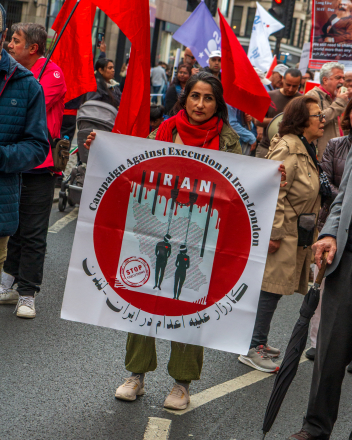
The Iranian Islamist dictators executed 21 political prisoners over the course of the war. Nine were convicted in rigged courts of participating in the mass, anti-regime protests in January. Over the three days, 8-10 January, perhaps 20,000 people were shot down or hacked to death by regime militias and security forces, and at least 53,000 were arrested.
The Iranian state knows that the majority of Iranians want the regime's overthrow and they have put their militias on the streets to arrest and intimidate. The regime is willing to let the population suffer so it can pursue its reactionary goals.
The Iranian working class remains central. It is the only social force which can rid Iran of the current dictatorship and replace it with something much better.
The Iranian workers need our solidarity. They don't need US bombing.
Comments?We welcome replies, corrections and debate pieces. Contact us