
For many years now, anyone who has picked up The Socialist, newspaper of the Socialist Party (SP), will have seen demands such as for “a new mass workers’ party, based on the trade unions on a socialist programme.”
In real life the SP may have enough leverage to help disaffiliate Unite from Labour. It is not credible that it could then create a new workers’ party in its place.
The problem is evident in a recent issue of The Socialist (#1366, 8 May). Its preview of CWU conference begins with the industrial crisis facing Royal Mail and BT workers, but quickly shifts from industrial strategy to the CWU’s relationship with Labour. It argues that Starmer’s Labour has created a “political vacuum” now being filled by Reform, and says the CWU should stop being “limited to supporting” Labour candidates and instead back candidates supporting CWU policy, ultimately through the SP’s “new party”. (In fact CWU conference voted to stay affiliated).
This is confused. On 7 May lots of fed-up Labour people didn’t vote, or voted Green, or in some areas voted Reform. That is not a “vacuum” of people waiting for Sharon Graham or CWU leader Dave Ward to declare a new party so they can vote for it.
Reform’s growth can be answered not by disaffiliation from Labour, but by building a combative rank-and-file response to restructuring in the post and telecom. That is what can pull union members attracted to Reform back towards working-class solidarity and pose a class-struggle alternative to reactionary politics more generally.
Defending
The Socialist also does not explain why building a rank-and-file fight could not also be used to push Labour Party towards defending working class interests. It notes that the CWU won Labour conference support in 2022 for renationalising Royal Mail but implies that the government’s failure to act proves the effort was futile.
The better conclusion is that the fight must be renewed, both inside Labour and inside the union. The union has done almost nothing in recent years to promote renationalisation. The answer is not disaffiliation, but for unions to use the power they still have: at Labour conference, on the NEC, and in local parties.
The SP’s demand is in fact a reiteration of a failed strategy. Since 2011 it has treated its electoral initiative, TUSC, as a proof of concept for a new workers’ party, “raising the banner for what kind of stand is needed.” (Before that it had the “Campaign for a New Workers’ Party”).
TUSC
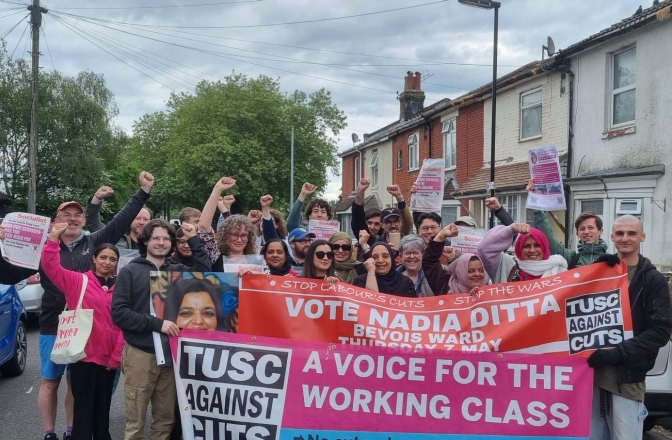
Few have flocked to this banner. TUSC stood around 300 candidates in May’s local elections, but trade-union support remained largely confined to SP union activists. Candidates mostly did even more poorly than in the past, often with around 50 votes. Some candidates did better. In Southampton Bevois, TUSC’s strongest result reflected years of community campaigning by a well-known local candidate. Dave Nellist’s reasonable vote in Coventry still draws on his profile as a former Labour MP. TUSC does not reveal a constituency of trade unionists straining to fill a “vacuum” created by Starmer. On 7 May people “fed up” with Labour “from the left” overwhelmingly voted Green, or didn’t vote, rather than voting for TUSC.
So the SP may succeed in weakening the union link with Labour, but without building anything in its place. Unite remains one of Labour’s largest affiliates. In April, a slate supporting the general secretary, Sharon Graham, won a decisive majority on Unite’s Executive Council. The SP was strong in that slate. Graham is close to the SP, which also has members in pivotal positions in Unite’s staff. The SP the largest organised group in the pro-Graham bloc. They may be able to use their influence to disaffiliate Unite from Labour, but such a triumph would draw most of its support from Unite members who favour apolitical trade unionism, or even like Reform. It will lead away from a new workers’ party, not towards it.
The potential pitfalls are illustrated by The Socialist itself. In March (#1359), it reported a Lancashire SP member winning support at a GMB reps’ meeting for a motion backing disaffiliation from Labour. But the article gives no indication that the meeting was equally committed to the second half of the SP’s formula, building a new trade-union-based socialist party. The SP may win support for the negative demand to break from Labour among members frustrated, apathetic, or even drifting towards Reform, and in doing so lead them away from rather than towards a positive socialist alternative.
Strategy
Disengagement is not a political strategy. A union strategy should aim to force Labour to represent workers more clearly, not abandon the field to MPs, councillors and officials even less answerable to organised labour.
Moreover, the SP never explains why a new union-backed party would not reproduce Labour’s existing problem: domination by trade-union bureaucracy rather than rank-and-file control. Without deeper democratisation of the unions themselves, why assume the outcome would be different? If the unions were politically mobilised enough to create a new socialist party, wouldn’t they already, long before, have been mobilised enough to make a fight inside Labour?
Disaffiliation may sound militant. In practice, it risks leaving organised labour with even less leverage than it already has. The task is to build rank-and-file power, force unions to fight politically, and make Labour answerable to workers, not walk away from the field. §
Comments?We welcome replies, corrections and debate pieces. Contact us