
In some ways, Labour’s abysmal performance in the Scottish Holyrood election was even worse than its performance in the Welsh Senedd election and the English local authority elections.
The Scottish National Party (SNP) had been in power for 19 years. During that time it has presided over a collapse in educational standards, an NHS long since unfit for purpose, rocketing homelessness, job cuts in universities throughout Scotland, record levels of drug deaths, and real-term cuts in the funding of local authorities.
As a party, the SNP has suffered a succession of scandals, internal conflicts over personalities and politics, and membership resignations. The most vitriolic attacks on the SNP during the election campaign came not from its party-political competitors but from former members.
The fall in membership, the decline in morale, and Swinney’s lacklustre leadership were reflected in the SNP’s often low-key campaigning at street level.
An added gift for Labour during the election campaign was the decision of the Daily Record to effectively call for a Labour vote (by prominently running anti-SNP articles) and the explicit call by the Sun newspaper to vote for anyone but the SNP.
A more tangible gift was the “substantial six-figure donation” which Scottish Labour received from two Scottish billionaires. Scottish Labour’s election campaign was better funded than any other previous campaign, and better funded than that of any other party.
And yet the SNP easily won a fifth term in office, winning 58 out of Holyrood’s 129 seats. Labour (down four seats from the 2021 election) and Reform tied second with 17 seats each (and Reform fell just 264 votes short of winning a further seat). The Greens and the Liberal-Democrats both won an additional six seats (giving the former 15 seats and the latter ten), despite the Greens’ discredit from their 2021-4 coalition with the SNP.
The Tories, who had been the opposition in the last parliamentary session, achieved their worst vote ever in Holyrood elections, slumping from 19 seats to twelve.
Easy Win
Despite its easy win, the SNP won six seats less than in 2021. Its share of the constituency vote was 38%, its lowest since the 2007 election. With only two exceptions, its share of the vote fell in every constituency. The SNP recorded its lowest vote, lowest vote share, and lowest tally of seats since 2007.
The lack of enthusiasm for the SNP – and its opponents – was also reflected in the overall turnout for the election: down to 53%, the lowest of the last three Holyrood elections, and ten points lower than in 2021. In some Glasgow seats – those with the highest levels of poverty – the turnout was even lower, at around 43%.
Scottish Labour did not lose anywhere near as many seats or votes as Welsh Labour. And its loss of four MSPs was nowhere losses in English local authorities. What made Scottish Labour’s performance so bad was that it could and should have won the election.
Instead, it maintained its Holyrood tradition of winning less seats and a lower share of the votes (even if, this time, only marginally) than in the preceding election.
First and foremost because of the Keir Starmer factor.
In the 2024 Westminster election Scottish Labour won 37 seats, compared with just one in 2019. Its share of the vote increased from 19% to 35%. That upsurge in support was destroyed by Starmer’s subsequent record in power. Anyone who did any door-knocking for Labour during the election campaign can confirm that.
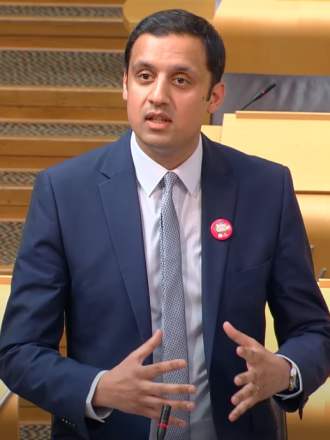
Scottish Labour leader Anas Sarwar tried to neutralise the impact of the Starmer factor by advocating that he resign. But a one-off speech to a press conference was never going to be enough to rescue Scottish Labour from the deadweight of Starmer.
Secondly, because Scottish Labour ran an utterly inadequate campaign.
Scottish Labour’s “strategy” after the 2024 general election effectively amounted to doing little or nothing (other than making speeches in Holyrood criticising the SNP), based on the assumption that the SNP bubble had finally burst and that SNP voters would return to their supposedly “natural” home in supporting Scottish Labour.
Scottish Labour vaguely promised change – it would change bad things into good things – but that was not sufficient to motivate voters to switch back Labour, especially after the negative experience of Starmer’s equally insipid promise of change.
Thirdly, because of the weakness of Scottish Labour as an organisation.
Unlike in England, there was no “Corbyn influx” into Scottish Labour. In that sense, there has been no mass desertion of members following Corbyn’s replacement by Starmer. But there has been, and continues to be, a long-term decline in the membership size and level of activity of Scottish Labour.
There are no longer any Labour Party branches in Scotland, only all-member Constituency Labour Party meetings – far less well-attended than when they were delegate bodies, sometimes struggling for a quorum, and often with a turnout in which councillors (and family and friends) constitute a majority of attendees.
The SNP election campaign was certainly weak on the ground. But the same applies to the Scottish Labour campaign as well.
Like members in England and Wales, Scottish Labour members received Starmer’s post-election e-mail in which he failed to acknowledge his responsibility for last Thursday’s debacle.
But Scottish Labour members also had the misfortune to receive an e-mail from Anas Sarwar informing them, as if they did not know already, that “today’s results are not what we wanted or worked for.”
Absent from the e-mail is any suggestion that Starmer should now resign – as advocated by Sarwar himself during the election campaign.
This underlines the fact that Sarwar’s call for Starmer’s resignation was no more than an electoral gimmick. It also highlights his refusal to draw the necessary consequences from the election defeat: That he and Jackie Baillie should resign as leader and deputy leader of Scottish Labour, along with Starmer. §
Comments?We welcome replies, corrections and debate pieces. Contact us