
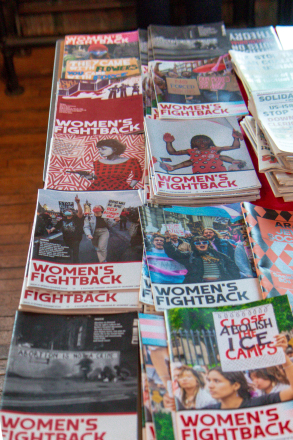
Women’s Fightback
We have moved from having one primary editor to an Editorial Board model for producing Women’s Fightback, aiming to give more comrades the chance to contribute to producing the magazine. The Editorial Board is still new, but has now produced several issues of Women’s Fightback. Alongside producing upcoming issues, over the next year the Editorial Board will aim to develop its processes for producing the magazine (aligning the magazine schedule to coincide with important dates, formalising style guides and similar resources, working out the best ways to involve comrades outside of the Editorial Board), which should make it easier to produce new issues, allow more time to be spent on higher-level/longer-term planning, and ultimately lead to a better quality magazine.
The fraction will lead a group-wide discussion on the purpose and name of Women’s Fightback. The magazine is seen to be part of a project of building a socialist women’s movement. More recently, it has expanded its remit to report on gendered and sexual oppression more broadly. Some comrades have reported that the name of the magazine is prohibitive to selling, on the basis that it can be perceived as trans-exclusionary. On the other hand, dropping ‘women’ from the name could be seen to be giving ground to transphobes, who do not consider trans women to be women. The magazine’s content about sexual oppression, which often includes gay men, is arguably inappropriate in a magazine named Women’s Fightback. These considerations have sparked some debate in the fraction, which we believe should be given due attention by the group as a whole.
Book Clubs
We have regular socialist feminist book clubs in London, Manchester, Sheffield and Edinburgh. In London, Manchester and Sheffield, attendance has remained steady or grown and all now have a layer of contacts around them. Edinburgh is co-ordinated by a non-member, which means it is more limited as a vehicle to introduce contacts to our wider politics. It is nevertheless a good thing that it is happening in our name.
Due to a lack of organising capacity, the online book club – despite there being moderate demand for its continuation – has stalled. The online book club is arguably less useful for our purposes, as there is minimal opportunity to talk to individuals and recruit them to wider activity. The Leicester book club has also fallen into inactivity. Comrades in the city intend to relaunch it in due course.
The London book club has existed for almost a decade, and while by some measures it is successful (it currently has a steady attendance and regularly attracts new people from across the capital; it hosts interesting and wide-ranging discussions), we are yet to recruit from it.
In London instead of doing whole books for book club we are going to experiment with a few suggested readings (essays, articles etc) on a particular topic.
The reasoning for this is 1) our comrades don't have to expend a lot of time reading additional whole books outside other reading 2) we can better direct discussion into particular political questions. It gives us a bit more work collating readings. We will review in six months."
A renewed push, involving members from across London branches, to build and attend the book club, and use it to initiate contact work, is needed. If by next conference it still hasn’t borne fruit, we should consider whether it is the most valuable use of members’ time, and whether we should “hand over the keys” to book club regulars to organise instead.
Producing reviews of the books discussed in book clubs for Solidarity and Women's Fightback remains our aim.
We have some new, impressive comrades in our ranks, in part as a result of the book clubs. Our constellation of book clubs have also been successful by way of deepening and broadening our socialist feminist politics.
Reproductive rights
The new Crime and Policing Bill - pending its approval by the House of Lords [this may have happened by the time of conference] - will stipulate that pregnant people will no longer be open to prosecution for ending their own pregnancy. This is the most significant abortion reform since 1967, but it is still limited. Abortion remains a criminal offence. The Bill does not change the abortion time limit; nor the grounds on which abortions are provided; nor the requirement for two doctors’ signatures; nor legal restrictions on telemedicine. It will also remain the case that anybody, including a medical professional, who assists a woman in obtaining an abortion outside the law would be open to prosecution. This has significant implications for safety and access. Our view remains that abortion should be freely available and accessible as early as possible, and as late as necessary.
A more wide-reaching amendment to the Bill, which sought to repeal the Abortion Act, remove abortion from the criminal law, and protect medical professionals assisting with abortion at all stages of pregnancy from prosecution, was not heard. It had not gained the support of abortion providers or widespread support amongst MPs because they believed it was “too much, too fast”, and there was little to no organising amongst the left or labour movement to shift this view. Many on the left have falsely celebrated the successful amendment as the decriminalisation of abortion. This is inaccurate. Unfortunately, this all means that further abortion reform is unlikely in the short-term, making it harder to mobilise people around the issue.
Nevertheless, our activity remains useful, especially in a context of the growing far right, which has reproductive rights and bodily autonomy in its crosshairs. For example, Nigel Farage has said that he wants to reduce abortion time limits. He has also appointed James Orr as Reform UK’s head of policy; Orr is a radical, evangelical fundamentalist who opposes abortion at any stage and for any reason. The Reform candidate in the Gorton and Denton by-election has said that he will impose a tax on women for not having children. It is important that we continue to highlight the links between the right’s anti-migrant racism, transphobia and misogyny, and to oppose the religious right, which is becoming more visible in universities and communities.
Sheffield branch leads a Right to Choose group which campaigns on reproductive rights, in particular countering anti-abortionists, including 40 Days for Life. This activity is building a broad group, including bringing in many potential contacts. In February, South West London branch organised a demonstration – backed by the local Trades Council – in support of abortion rights in Brixton, another target for 40 Days for Life. [One sentence report forthcoming]
Workers’ Liberty sent delegates to the 2025 Abortion Rights AGM, and proposed that Abortion Rights produce and circulate a motion for Labour Party Women’s Conference, and organise a fringe and lobby. This passed, but Labour Party Women’s Conference was subsequently cancelled, following the Supreme Court ruling in April 2025. It is our assessment that Abortion Rights was not making any meaningful moves to enact this policy, in any case. The lethargy of the trade union movement primarily, and the limitations of Abortion Rights secondarily, pose a significant challenge - but it remains our view that, by virtue of having most TUC-trade unions amongst its affiliates, Abortion Rights has the potential to be a useful vehicle for reproductive rights organising. We did not attend the 2026 Abortion Rights AGM, but will assess whether this is useful activity going forward.
Sex work
Workers’ Liberty supports the decriminalisation of sex work and believes sex workers’ ability to form unions and organise together for safer working conditions is central to fighting exploitation in the sex industry. The ability of individuals to leave the sex industry, or to report sexual violence when it occurs in the workplace, rests on a number of things, including: the decriminalisation of sex work, an end to the hostile environment and opening up of legal and safe routes for migrants into the UK, and the availability of other well-paid, flexible work, adequate benefits, and decent housing.
There now exists a Sex Workers’ Union in the UK, a branch of the Bakers, Food and Allied Workers Union. The Sex Workers’ Union has achieved significant wins in a number of strip clubs, where they are more able to organise by virtue of them being legal workplaces; but has also been organising sex workers operating on online platforms, with some success. The union, through its sister organisation Workers for Decrim, is seeking support for decriminalisation from the wider trade union movement, a drive which we are well-placed to help with.
Will will seek to get motions in support of the decriminalisation of sex work and proposing affiliation to Workers for Decrim passed through trade unions where we have members.
Sex education
We support mandatory sex and relationship education in schools. We think it should be extended to include more sex positive, diverse content. Consent should be seen as part of broader principles of treating people with basic respect and dignity.
Online misogynist influencers promoting violence against women and girls and are having worrying impact on boys and young men’s attitudes and behaviour;
Many young people do not have access to fact based, progressive ideas about sex and gender;
Some children face sexist, homophobic, and transphobic attitudes at home.
Schools and colleges are an important line of defense against this. The right threaten sex education, even as it exists now. There is an increasing campaign against LGBT+ books as well as those on race and sexism, in schools and libraries.
We will campaign in the labour movement for children and young people to have access to education and information about sexuality and gender diversity.
Socialist feminist demands to take forward
The fraction has started to develop a series of transitional demands, initially in discussion at IFF, which, working alongside contacts and other campaigners, we will expand, refine and use to guide our campaigning.
Comments?We welcome replies, corrections and debate pieces. Contact us