
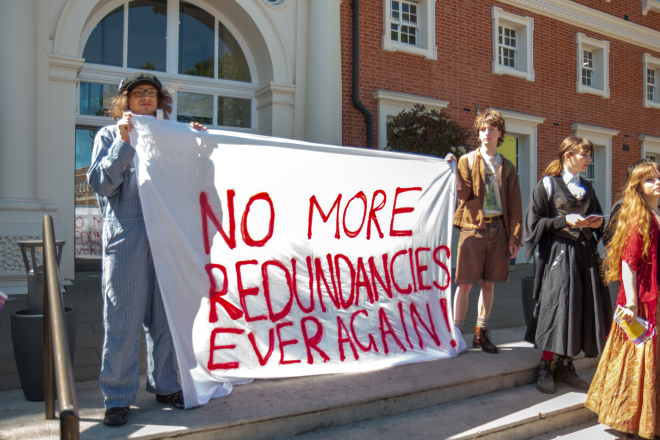
The situation in the education sector is varied but in no place is the situation improving, the period of unbridled growth in the sector is, if it was not already clear, over. Since the last conference a majority of HE institutions have faced cuts to staffing and courses, with some areas of the Humanities and Arts facing complete closure on multiple campuses Further pressure comes from Labour’s immigration policy, which will lead to a significant reduction in international students attending UK universities. In Further education, both six forms and colleges are under enormous pressure with funding nowhere near what it needs to be, and a long running dispute in FE colleges winning very little. In HE on most campuses, UCU branches have settled for deals which at best can be described as a stay of execution. It is now the case that at the central London universities that the majority of, or at least a significant minority of students are international. Students on the whole are worse of than they have been before, with frozen maintenance loans and thresholds meaning more and more students are working longer hours to support their studies.
On a national level, there have been some very small moves on tuition, with the reintroduction of a very limited number of maintenance grants for a small number of courses. Thresholds remain the same and tuition fees are rising, and the proposals on the table are that they will rise each year at least in line with inflation. There is no organised campaign for free tuition.
Anti Cuts
At a number of universities around the country there are anti-cuts groups, with our comrades being central to the work in Sheffield, and having made contact with the Students and Workers Action Group, an anarchistish group of students in Leicester, there are surprisingly few student campaigns. We are in the process of writing to UCU branches, and to activist and left groups on campuses where cuts are falling, promoting the work that we have done in Sheffield and the comrades in Leicester.
In Newcastle at Northumbria, staff are in dispute over attacks on pensions, our student group there is central to the work of student facing propaganda about the dispute. Previously we were central in creating a students anti cuts group.
The national picture is patchy at best. NUS is a moribund organisation. The attempt to set up a new national student movement from the back of TWT seems to have gone nowhere. Labour Party students have very little activity, where we have comrades involved, Sheffield, we are making interventions. Your Party Youth and Students was set up in the preconference period of Your Party, it claims over 100 members. Membership is a free association, after demonstrating YP membership and student/age confirmation, criteria is 16-30 or a student. So far there is little activity, and what there is, is predominantly online in Discord. The movement of separate groups of students that sprung up as a result of both October 7 and in response to war on Gaza has stalled and stuttered. We found, as has been discussed before, these groups quite quickly ossified into the worst of the absolute antizionist politics that is so pervasive on the British left.
Where we are active and involved in broad campaigns we need to be sure that we are open about being AWL Students, that we make sure that we have papers and other literature with us on demos, and are visibly AWL students in the campaign. It is important that we don’t become assimilated into broad work losing our political identity.
Fraction
Student fraction has not met as regularly as needed, and has suffered from poor regular attendance. This has affected our ability to coordinate work. We have in place now a committee for the fraction which should help to guide and shape the work of the fraction leading into the summer term, and setting up for autumn.
Where we have success, in Newcastle in particular, we have achieved this from a combination of regular AWL activity, and being the only show in town. At Sheffield we are involved in broad work as well as explicit AWL Activity.
Wherever possible we should be aiming to continue regular awl activity on and around campus. We have a regular sale outside of Birkbeck and on student on campus. We were in the process of setting up a student society when the Students Union underwent restructure which put all student activity on hold. In the last academic year we ran SC as a candidate in the election for Education Officer. We ran SC as a propaganda candidate, we lost, gaining 34 of a total 108 votes.
The student fraction committee will be central in organising and developing the work of the fraction. We plan to hold at least one more student day school this academic year, along with in fraction educational series on core Marxist texts.
By the time we discuss this document in the last preconference meetings, and at conference itself the academic year will, for students, mainly be over. Very little student activity takes place on campus in the summer term. Where we do have comrades still around, we will continue to run a skeleton of meetings, targeting at Birkbeck, postgraduates who continue in their courses over the summer months.
In the coming academic year, it is important to have first taken stock of where we are. Political life has in part returned to campus, this remains limited and patchy, with no national movements to speak of.
Socialist Students, the youth wing of the socialist party has fallen to 80 members, in the last year they had claimed 200 at their conference. The RCP remain the largest group on campuses, yet their activity is more in line with their time as SA, with it focused on internal educational meetings, and wild, ultra left propaganda. They appear to have a high turn over and churn of membership, new member figures against their national figure appear to support this.
Palestine continues to be a focus of students organising on campus, with no real focus other than BDS motions and campaigns focused particularly on ending links with Israeli Universities. Counter to this, in Sheffield, we are organising for a FOST student Chapter. Where we can, with contacts, spread this work to other campuses we will do so. We will also seek to get Students Unions to agree positive policy on working with, and twinning, with Student chapters of Standing Together in Israel.
We have recruited in both Newcastle, Sheffield and London, although here not directly through student work. We hold meetings regularly on campus in Sheffield, Newcastle and Birkbeck. We will continue to do so in the next academic year, the fraction will produce term cards, advertise and promote out meetings in advance of the beginning of term.
We expect there to be further cuts coming at universities over the coming term and next academic year, now included in this are moves at the post ’92 institutions around pensions. Where we have students, we will engage in and initiate campaigns against cuts, in solidarity with staff fighting cuts to pay, jobs and pensions. Where possible we will organise meetings and agitate for campaigns against cuts, in Sheffield we will keep the anti-cuts coalition work going.
On NUS, we will not campaign against disaffiliation, however, when the politics of disaffiliation is as recently focused on absolute antizionism, we will argue and intervene against that, and not limit ourselves to standing idly by. Where possible, such as on anti-cuts, we will work with and seek to organised student groups together.
The fraction will seek to build a ‘rank and file’ type strategy for students organising on campus, for both local and national interventions. We will organise day schools throughout the year, looking at the lessons of the student movements that we have historically been involved in.
The far right on campus is not currently a major concern, with there being tiny pockets of activity in formerly strong outposts for conservative societies, Warwick being the outlier here. Comrades should pay attention to local developments, taking contacts along to antifascist actions locally to develop the political work. In Sheffield we have comrades involved in the local araf committee. Bringing that work onto campus will be useful organisationally and for developing students politically.
On fee compensation, our default position is not to call for compensation owing to lost teaching days as a result of strike action. Where it has been applied on a mass scale, such as at goldsmiths in the past, it has not made much, if any impact to the struggle against cuts. Limited political slogans around fee compensation may be possible and we will assess on a case by case basis, whilst maintaining our default position.
As is longstanding policy we will continue to advocate and encourage members, supporters and contacts to take up jobs that allow them to play an active role in the trade union movement following on from education. Priorities should be discussed with the incoming NC and Industrial organisers. To that affect we will also hold meetings near the end of term around the ‘Organise at Work’ pamphlet.
Comments?We welcome replies, corrections and debate pieces. Contact us