
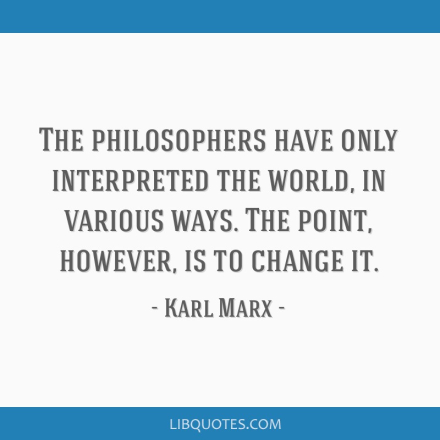
From this issue of Solidarity, we will be running an article each week on an item, or items, from a list of basic Marxist texts, with the aim of encouraging and providing helpful material for discussions and classes on those texts in Workers' Liberty local groups.
We start with the Theses on Feuerbach and The Poverty of Philosophy. Study notes for these are on the Workers' Liberty website here (Feuerbach) and here.
The French revolution of 1789-94, or strands within it, set running, for the first time in history, continuous streams of democratic, radical, and socialist politics which flow to this day.
The innovation of Karl Marx and Frederick Engels was to connect socialism with democratic and class struggles, and with an understanding of history as being shaped by economic development and class struggles.
Karl Marx had been a philosophy student and a democratic journalist. Moving to Paris from late 1843 to early 1845, he met organised socialist workers for the first time. Revolution was brewing across Europe, and would explode in 1848.
The workers won Marx over. He became a communist, which then mostly meant revolutionary socialist, in contrast to those who hoped for socialism from the good will of the ruling class. He became enthusiastic for the philosophy of Ludwig Feuerbach, a former star student of Hegel who had turned atheist and communist. In August 1844 he established a working relationship with Engels, who had moved to communism faster than Marx.
The French government expelled Marx from Paris in February 1845. He went to Brussels. There, Marx and Engels wrote further efforts at self-clarification, and moved towards more political activity. In June 1847 they would join the Communist League, a London-based group mostly of German political exiles, for which they would write the Communist Manifesto.
In November 1844 Marx and Engels had written a Feuerbachian communist critique of "soft-left" German philosophers, The Holy Family. In it, they defended Pierre-Joseph Proudhon, the best-known figure then in French socialism, with whom Marx had discussed in Paris. In Brussels they moved beyond both Feuerbach and Proudhon.
Engels did "contact work" with Feuerbach, trying to draw him into the Communist League. Feuerbach, however, withdrew to rural seclusion, and joined the German Social Democratic Party only after reading Marx's Capital volume 1, published in 1867.
Feuerbach's politics came from a radical critique of religion (his Essence of Christianity, 1841, was translated to English by Mary Ann Evans [George Eliot]). He saw communism as a matter of replacing love of an imaginary projection, God, by real human love of each other.
Marx and Engels became critical of the semi-religious character of Feuerbach’s concept of what was to replace religion, his "cult of abstract humanity". They came to see him as converting the term “communist”, which “in the real world means the follower of a definite revolutionary party”, into a moralising category.
According to Marx himself, writing later, "the salient points of our [his and Engels' new positive] conception were first outlined in a scientific, although polemical, form in my Poverty of Philosophy," written in winter 1846-7.
There, Marx settled accounts with the whole school of thought following Hegel and positively outlined his working-class and democratic version of communism.
It makes things more difficult for modern readers, but was unsurprising at the time, that Marx did this via a criticism of Proudhon.
Proudhon did write in 1848 that "the proletariat must emancipate itself without the help of the government".
But Proudhon did not mean emancipation through class struggle. He meant that the workers should organise themselves into small workshop groups and trade between the groups. He claimed that by doing that "they would soon have wrested alienated capital back again... become the masters of it all... without the proprietors being despoiled..."
Proudhon's view seemed daft to Engels in September 1846, when, from Paris, he wrote to Marx in Brussels: "the workers here, they who can't keep six sous in their pockets to visit a marchand de vin on the evenings of their meetings, propose to buy up toute la belle France with their savings..."
But in its time, a time where in France in particular industry was dominated by tiny workshops, it had wide influence among radical-minded workers.
The Philosophy of Poverty, the book by Proudhon to which The Poverty of Philosophy was a retort, is a vast, rambling, eccentric scrawl. It starts, for example, not with poverty but with a long and cryptic disquisition about God.
A letter by Marx to Pavel Annenkov, written as he started writing The Poverty of Philosophy, and published with it in all modern editions, crisply sums up the gist of Marx's argument.
Marx felt obliged to start Poverty of Philosophy with a critical analysis of "constituted value", Proudhon's idea about how to set prices so that the workshop groups in the future society would trade with each other fairly and without exploitation. That first chapter is obscure to modern readers, and not very important to study, since Marx came back to the idea (in the guise of "labour money") more crisply in later writings, including in Capital.
Marx went on to demolish speculative "philosophy of history": "The struggle between these two antagonistic elements comprised in the antithesis constitutes the dialectical movement... The fusion of these two contradictory thoughts constitutes a new thought, which is the synthesis of them. This thought splits up once again into two contradictory thoughts... M. Proudhon considers economic relations as so many social phases, engendering one another, resulting one from the other like the antithesis from the thesis..."
Marx proposed instead attention to "the real, profane history of men [meaning, women and men] in every century and to present these men as both the authors and actors of their own drama". "Mr Proudhon provides a phantasmagoria which he has the presumption to present as a dialectical phantasmagoria. He no longer feels any need to speak of the seventeenth, eighteenth or nineteenth centuries, for his history takes place in the nebulous realm of the imagination and soars high above time and place. In a word, it is Hegelian trash, it is not history".
And in real history, he wrote: "It is the bad side that produces the movement which makes history, by providing a struggle". The investigation of current (capitalist) society must be about more than denouncing its "bad sides". Communists must go beyond "see[ing] in poverty nothing but poverty" to "seeing in it the revolutionary, subversive side, which will overthrow the old society".
Marx criticised teleological thinking, what he calls "providential history", the idea of history as determined by a purpose.
His section on strikes and combinations of workers was epoch-making in the history of socialist thought. In the first place, he upheld wage battles against socialists who scorned them as ineffectual trifling. In the second place, he argued that they could help develop a conscious, self-aware, organised workers' movement combatting not only low wages but also capitalist class rule.
"In the struggle, of which we have noted only a few phases, this mass becomes united, and constitutes itself as a class for itself. The interests it defends become class interests. But the struggle of class against class is a political struggle".
Thus, working-class struggle had an inbuilt potential to develop from elementary resistance to the bosses into "the creation of a new society... the abolition of every class".
Comments?We welcome replies, corrections and debate pieces. Contact us