
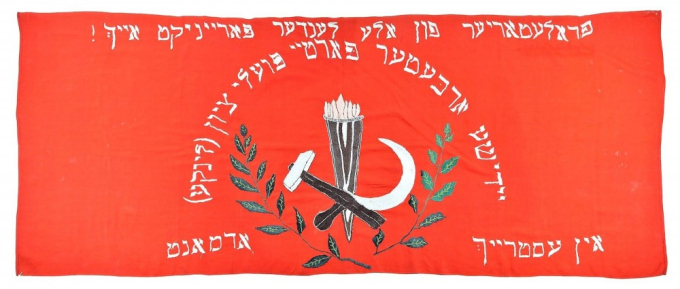
Three letters from Trotsky to Nathan (Poale Zion), 1932-3
16th March, 1932
Dear Comrade!
I read your letter with great interest. Only second-hand information about the evolution of your party has reached me. I myself never had reason to occupy myself more closely with the problem of Palestine and, in particular, with the role played there by Poale Zion, and the main difficulty for me is the fact that, unfortunately, I cannot read the ancient-Jewish language nor the modern-Jewish one. Which of these two languages does your party use in Palestine? In which language are the basic documents of the party written?
Do you have any documents which set out in a systematic manner the disagreements of the various fractions and groups within the workers movement of Palestine and, in particular, within your own party? If you could indicate – or, better still, send – to me that kind of documentation and materials, I would be very grateful to you. Perhaps you and your closest comrades could send me even short, but the most significant, extracts from programmatic and polemical works. If time does not allow you to do so, I would ask you to note the most important sections in the Jewish text with a pencil and I would try to obtain a translation here.
At present I cannot promise to say anything about the questions of controversy in the immediate future. At the moment I am finishing the second volume of “The History of the Russian Revolution”. After that I will be moving on to a book about the world economic and political situation. An elaboration of the questions of the Middle East will, of course, be included in this book. For me right now, it is a matter of preparing and classifying the most important materials.
To say something to any degree definite about the politics of the proletariat in Palestine is, of course, not possible other than on the basis of a study of the economy of Palestine in combination with the national groups. I am currently unarmed in this respect as well. What is the situation with regard to this in Palestine itself? At what level are the economic, social and national statistics? If you can give me the necessary information in this respect, I can subscribe to the most important economic-national-statistical publications.
You write that, together with a group of comrades, you have been following the works of the left opposition with interest for a long time. If you need any of the books or magazines of the left opposition, I am, of course, ready to be of assistance. In any case, I will ask the comrades in Berlin to immediately send you my small book about the situation in Germany which has only just been published.
Your letter does not ask me any particular questions. It really comprises a list of a whole series of questions which arise for any active participant in the workers movement in Palestine. As already stated above, I could not give you an answer now to the most concrete questions, nor to the questions which are of the greatest practical interest to you. I can approach them only gradually, step by step, proceeding from the general to the particular. I emphasise once again that I ask you to display patience. I will await your letter with interest.
23rd May, 1932
Dear Comrade!
Urgent work and a whole series of secondary circumstances have prevented me this time from immediately replying to your letter of 14th April. In the meantime, I have sent you several copies of the Jewish newspaper published by the American League (the organisation of the left opposition). Today I’ll send you the most recent issues. It might be of interest to you to get in touch with the editors directly. I will be very glad to hear your opinion and the opinion of other Palestinian comrades about this paper. Unfortunately, I do not have the possibility of forming an independent opinion myself.
You ask about my attitude towards the policies of the Soviet government in the Jewish question. It is very difficult for me to answer this question in such a general form. This is because in its Jewish policies, as in any other policies, the most heterogeneous elements intersect with one another: the general methods of the workers state, the zigzags and inconsistencies of the centrist fraction, the terrible bureaucratism, etc. You would need to simply formulate your evaluation as concretely as possible, as it is very possible that in this sphere I have missed a lot of what you have paid attention to. In any case, I would like you to formulate your questions more concretely.
Within the framework of the general decay of capitalism there occur, and will continue to occur, very complicated and contradictory processes of both an economic and political character. I do not know if you have had the opportunity to acquaint yourself with the polemic between Lenin and Bukharin concerning the drafting of the party programme (1918-19). Bukharin took the position that once the epoch of imperialism and social revolution had commenced, then the sole slogan had to be: dictatorship of the proletariat. Today the Italian group Prometheo (Bordigists) takes approximately this position. But Lenin demonstrated that imperialism is the completion and crowning point of an economic process which today still lives in front of us in different countries, and even in one and the same country in the expression of its different stages. At the end of the day, the resolution of all problems reduces itself to the dictatorship of the proletariat. It is precisely for this reason that there cannot be any other conception for our epoch than the theory of permanent revolution. But in different countries the road to the dictatorship of the proletariat has different starting points and different stages. In this respect the question of democratic slogans takes on a great significance. By chance, today I came across a letter about the question of democratic slogans which I wrote a year and a half ago. I attach it to this letter. Perhaps you will find in it an oblique answer to the question which you ask me in your letter.
The Spanish opposition numbers over a thousand members. It publishes a monthly theoretical magazine and a political weekly. The opposition might be a lot stronger if it there had been any serious core at the beginning of the revolution. But it fell to different individuals to begin where there was almost empty space, whereby not a few mistakes were made. I find it difficult to say anything about the strength of the official party. The Soviet press has referred to nearly ten thousand members. More critical voices speak of two to three thousand.
I will instruct the comrades in Berlin to send you my last pamphlet “The German Revolution and the Stalinist Bureaucracy” in the Russian language. (The pamphlet has also been published in other languages.)
You can write letters to this address: [blank space – trans.]
For the time being I limit myself to these lines. I hope that the correspondence does not break off at this point.
12th December, 1933
Dear Comrade Nathan,
I did not reply to your last letter. Since then much water has flowed … and during that time Palestine has been the arena of powerful events. Both the fascist coup in Germany and the Arab-Jewish struggle in Palestine represent new and very clear confirmations of the fact that the Jewish question cannot be resolved within the framework of capitalism. I do not know whether Jewry will reestablish itself as a nation. But there can be no doubt that only the proletarian revolution can create the material conditions for the existence of Jewry as an independent nation. There is no “no-one’s” territory on our planet, or almost not. The creation of a territorial basis for Jewry is only conceivable – whether it be in Palestine or in another place – by way of the movement of great human masses. Only victorious socialism will be capable of carrying out such tasks, on the basis of voluntary agreement or on the basis of an international court of arbitration. The dead-end of German Jewry, like the dead-end of Zionism as well, is inseparably linked to the dead-end of capitalism. Only in the clear consciousness of this linkage can Jewish workers find insurance against pessimism and despair …
You probably know that our small group (the former left opposition) has started out on the road of new proletarian parties and a new International. I hope that you have read the last issue of the bulletin. In any case, I am sending you a copy. What is the attitude of your organisation on this question?
I do not know if you are aware that the youth organisation of the Dutch Independent Socialist Party is convening an international conference of revolutionary youth at the end of January or in February. The organisations taking part in it will mainly be ones striving to create a new youth International. But the conference is also open to those organisations which have not yet set out on the road of a new International. Do you not think that your youth could take part in this conference. I will, in any case, ask that you be sent the relevant documents.
Is it true that the crisis hardly finds reflection in Palestine?
I will be very grateful to receive some lines from you and to find out about the mood of the Palestinian workers.
With sincere comradely greetings,
Comments?We welcome replies, corrections and debate pieces. Contact us