
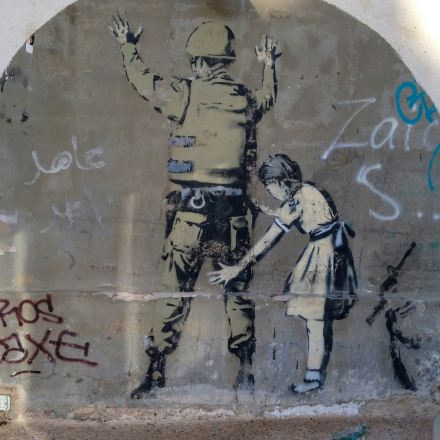
On Thursday 16 April, hundreds of Palestinian and Jewish protesters in Tel Aviv demanded an end to settler terror and occupation in the West Bank. The protest was called by the Peace Partnership, a coalition of left-wing, anti-occupation, and peace groups, including Combatants for Peace, Breaking the Silence, Peace Now, left-wing political party Hadash, and the left-wing binational (Palestinian-Jewish) social movement Standing Together.
Following another recent spike in settler violence, Israel’s security cabinet passed a directive setting out stronger actions against “nationalist crimes”. But the Tel Aviv protest rightly drew the link between settler terror and state policy, with slogans including “The terror and hatred are generated by the government”. Numerous Israeli politicians have stated explicitly that the aim of the regime in the West Bank is to “kill”, “bury”, or “erase” prospects for a Palestinian state, via road construction, settlement expansion, and displacement. An old adage says that war is merely politics carried out by forcible means; armed settler gangs carrying out pogroms against Palestinian villages are prosecuting a war in support of government policy.
Standing Together wrote: “Settler violence is happening across the West Bank every day with full backing of our government and it has reached the highest number since recording began. We cannot allow this to continue! We’re mobilising our society and raising a voice against this unbearable reality and building the power to end the occupation for good.”
Amin Amara, a Palestinian leader of Standing Together, said: “We’re in Tel Aviv protesting against settler terror. Every day we see settler terrorism, we the army protecting the settlers who commit terrorist acts against Palestinians. This reality can’t continue: a reality of wars, a reality of settler terror in the West Bank, a reality where the Palestinian people in the West Bank and Gaza are being slaughtered. We must put an end to this [...] We’re forced to take the streets. We’re here in Tel Aviv, Arabs and Jews, to raise our voices.”
Yael Agmon Nacht, an Israeli Jewish activist in Standing Together, said: “We’re here, Jews and Palestinians, protesting against the settler terror that is happening across the occupied West Bank with full support from our government. Palestinians are being attacked by settlers daily, beaten inside their homes, their houses burned, their cars smashed, and their communities terrorised. Let’s be clear, they’re being ethnically cleansed. This reality is insane and cannot continue. There is another way, a way of real Israeli-Palestinian peace, and we need to build the political power to get there. For all of us, we must end the occupation.”
On the same day, 16 April, US president Donald Trump announced a 10-day ceasefire in Israel’s war on Lebanon. Although Israeli prime minister Benjamin Netanyahu said the ceasefire represented an opportunity for a “historic peace agreement”, some reports indicate the ceasefire was essentially imposed on Israel by the US, with more hawkish elements in the Israeli government frustrated at being unable to continue the destructive bombing campaign that has seen major devastation to civilian infrastructure, with millions displaced and thousands killed.
Occupy
Israel has declared its intention to occupy territory between its own northern border and the Litani River, 18 miles into Lebanon, by establishing a military-controlled “security buffer”. Direct negotiations between Israel and the Lebanese government have commenced.
A pause of any length in the ongoing destruction and slaughter is preferable to its continuation. But a 10-day ceasefire imposed by the USA is not “peace”. It simply freezes the situation. The first step in any meaningful peace agreement must be the complete withdrawal of Israeli troops from Lebanon. The Lebanese people have a right to self-determination, free from occupation. A peace agreement must also facilitate reconstruction and resettlement for those displaced by Israeli bombing. However, the likelihood of the current Israeli government providing aid to fund that reconstruction is next to nil.
Hezbollah, the Shi’a Islamist paramilitary party backed by Iran, which is Israel’s military opponent in Lebanon, is a deeply reactionary force. Many Lebanese leftists rightly see Hezbollah as a proxy for Iranian regional imperialism. A former member of the Lebanese National Resistance Front, a defunct coalition of secular-nationalist militias, including some shaped by Stalinism and Maoism, was recently interviewed in the US-based left-wing magazine Jacobin. They said: “Why do [Hezbollah] need long-range missiles? We quickly understood that Iran’s agenda is to dominate the region. Their weapons are used in Syria, Iraq, and Yemen [...] They became a regional army [...] Hezbollah’s slogan is that they are a resistance against Israel. But it is a cover.”
But as long as Israeli militarism and occupation continues, causing devastation and displacement in Lebanon, Hezbollah will remain able to consolidate a social base by presenting itself as the resistance.
Longer term, a genuine peace will require democratic upheaval in Israel, to win a government committed to peace with its neighbours, and which aims for secure sovereignty within its own borders rather than pursuing territorial expansion and occupation beyond them. An Israeli government that waged a campaign of regional peace, mutual recognition, and reconciliation would do more to undermine clerical-fascist Islamist forces such as Hezbollah and Hamas, which seek the destruction of Israel, than a militarism that vainly seeks to “destroy” movements which take root in the conditions of oppression and devastation the current Israeli regime has imposed.
Report
A new report from the United Nations and European Union estimates that reconstruction efforts in Gaza will cost more than £50 billion. It says that 60% of Gazans lost their homes, with 370,000 homes destroyed. 1.9 million people, around 80% of the entire population, were displaced during the war, with many people displaced multiple times. 50% of Gaza’s hospitals remain non-operational. The Gazan economy shrunk by 84% during the war. The report suggests £19.5 billion is required over the next 18 months to restore essential services.
The report says the “minimum conditions” required for reconstruction are “a sustained ceasefire and adequate security”. It calls for an increase in humanitarian aid, and free movement between Gaza and the West Bank.
Despite the nominal ceasefire in Gaza, the Israeli army has continued attacks. Nine-year-old Saleh Badawi was shot and killed in Gaza City on Thursday 16 April. There is little evidence of sustained civilian reconstruction efforts, with some reports suggesting Israeli forces are building permanent military placements.
Representatives of Hamas, the Islamist paramilitary party that ruled Gaza prior to Israel’s assault, recently met US officials to discuss the implementation of the US-brokered “Peace Plan” that ushered in the current ceasefire in October 2025. According to an article in theNew York Times, Hamas officials have said the movement is prepared to give up stocks of automatic rifles and small arms belonging to its police force and other security services. The US and Israel want Hamas to disarm more fully and speedily.
On 25 April, the first elections in 20 years will take place in Gaza. Due to the devastation caused by the war, elections will only take place in one municipality, Deir al-Balah. Around 70,000 people are registered to vote, a tiny fraction of the 930,000 who were eligible to vote during the previous municipal elections scheduled for 2021 but ultimately postponed. The elections are part of municipal elections taking place across the occupied Palestinian Territories, including the West Bank, and are administered by the Palestinian Authority, the semi-state run by Fatah, a secular-nationalist party which leads the Palestine Liberation Organisation (PLO). Following a decree issued by Mahmoud Abbas, the President of the Palestinian Authority, in January 2026, some municipalities have religious quotas, with allocated seats for Christian and Muslim candidates.
Participation in the elections requires adherence to the PLO charter, meaning Hamas cannot participate. Hamas previously won elections in Gaza in 2006, then fought a bloody civil war against Fatah to drive it from Gaza and establish one-party, authoritarian rule.
Comments?We welcome replies, corrections and debate pieces. Contact us