
A Russian dictator intends to conquer his smaller neighbour. He mistakenly believes his invading army will meet little resistance — welcomed with open arms even — and any fighting over in a week or two. A puppet government will then be installed and a glorious victory celebrated.
Yet things don’t turn out as they are supposed to. The nation being invaded puts up an unexpectedly determined fightback inflicting far greater casualties on the invading army than its own forces suffer.
Though that sounds like a description of Vladimir Putin’s “special military operation” against Ukraine, it would also be a pretty apt when applied to USSR dictator Joseph Stalin’s 1939-40 assault on Finland, which became known as the Winter War.
Winter Warriors
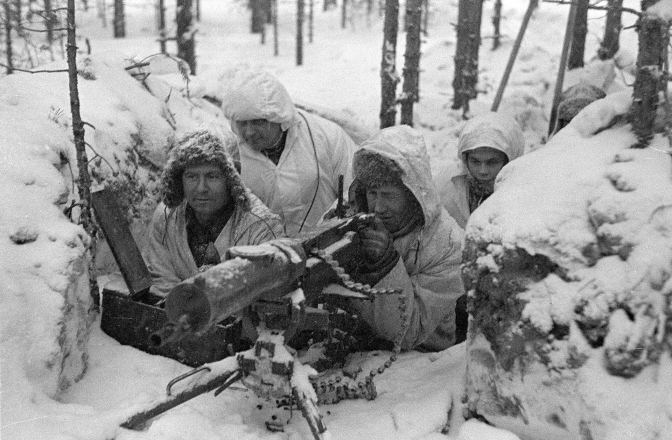
The Winter Warriors, a critically acclaimed novel by French writer Olivier Norek, bases its narrative on events that occurred in the four months of war after Stalin invaded Finland on 30 November 1939. Stalin’s High Command expected a walkover against a poorly armed neighbour whose population numbered only 3.7 million. So confident were they that a brass band formed part of the invasion force, expecting to play in the Red Army victory when it reached the sea half way up the Finnish coast. By February, though, Stalin’s soldiers had only managed a 10km advance into Finland.
Simo Hayha, who became famous for his skills as a sniper, is the main protagonist in Norek’s book. By following the actions and tactics of Simo and his companions, we get an idea of what it was like fighting in temperatures rarely hovering above -35ºC. We also learn how hopelessly unprepared the invading army was when coping with such conditions and the challenging terrain the Finnish countryside presented.
The invasion took place at the tail end of the notorious purge of the “Red Army”, part of the Great Terror Stalin unleashed from 1936. The military lost swathes of capable officers to bullets in the back of their heads, courtesy of Stalin’s secret police executioners, the NKVD.
On paper the Red Army had monumental advantages over the Finns. 2,500 tanks to the Finns’ 30. 2,800 guns to their opponents’ 500. 2,000 aircraft against 114. The Finns had as many artillery shells in total as the Russians could fire in a single day. Then Russia had inexhaustible manpower. Its invading force of 425,000 was drawn from an army of 4.5 million.
Basics
The Russians lacked some important basics necessary for fighting in heavily forested countryside in deepest winter, things like skis and white coats to camouflage themselves against the snow. The many anti-tank guns they brought were useless against an enemy with no tanks. In short order, those weapons were captured and put to use against their own tanks.
The Red Army advanced in convoys on roads with forests on either side. It was an ideal opportunity for the unseen enemy to ambush them. Soviet soldiers wearing dark brown uniforms presented easy targets in what was a classic example of asymmetric warfare.
The Stalinist regime’s historical neglect of the needs of ordinary soldiers was another factor. No proper clothing. Lack of food and fuel. Countless troops simply froze to death. Among the most tragic episodes in Norek’s book is a description of Soviet soldiers sent across ice-bound lakes, only to have the ice give way from under them. In the days that followed Finnish soldiers would come across their corpses sticking up out of the ice like frozen statues.
Limitless
Just like Putin today, Stalin didn’t care about their plight when he could draw upon a limitless supply of cannon fodder. If they retreated, station a firing squad behind the lines to mow them down. If the Finns beat some units in battle, shoot some of the units’ commanders.
When hostilities ended in March 1940, there were 400,000 Russian dead or wounded, with Finnish numbers put at 70,000. Finland’s manpower was far from limitless, so their government reluctantly accepted dictated peace terms. 6,000 Russian PoWs were handed over, and in true Stalin fashion 400 were executed and most of the rest sent to the Gulags.
The Finns got very little outside help in their struggle — some planes gifted by Sweden and 12,000 foreign volunteers. A charity concert in Paris, with Edith Piaf the headlining act. Donations from celebs of the day like Greta Garbo, who stumped up $5,000 — a gift not a loan!
Britain and France promised to send troops, but were already at war with Nazi Germany and found it logistically impossible to get to Finland.
Hitler was of course Stalin’s ally at the time — a fact that today’s tankies don’t like to be reminded of — and had joined the Führer in dismembering Poland. The disastrous performance of the Red Army in Finland confirmed Hitler’s belief that the purges had been so damaging that he could mount a successful invasion and destroy the Soviet Union.
Leon Trotsky was a few months away being murdered by one of Stalin’s assassins. Despite his belief that the USSR was a “degenerated workers’ state”, and his arguments that “defence of the USSR” should guide Marxists, he opposed the invasion of Finland, arguing that it alienated Finnish workers and workers worldwide.
Stalinist expectations that the workers and peasants of Finland would welcome the Red Army as “liberators” assumed that they were unaware of the Finnish Operation of the NKVD (1937-38) — a mass arrest, execution and deportation of ethnic Finns, which resulted in the killing or disappearance of anything between 8,000 and 25,000 of them. Not wishing to meet a similar fate, Finnish workers, including leftists such as Olavi Siippained, sided with their own bourgeoisie.
Although the way the economy is organised in Russia has changed since Stalin’s time, some things remain the same. It is once again ruled by a ruthless dictator who represses dissent and murders political opponents. And Great Russian Chauvinism directs it foreign policy.
Engels, Lenin, and others described Russia as the prison house of nations. Ukraine today doesn’t want to be in that prison house any more than Finland did back then or does now.
Comments?We welcome replies, corrections and debate pieces. Contact us