
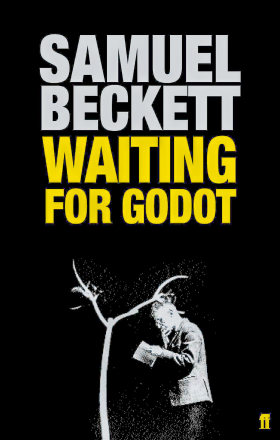
Playwright Samuel Beckett was born 120 years ago, on 13 April 2026. Renowned for, amongst many other works, Waiting for Godot, Beckett was a key figure in the modernist movement of the twentieth century and challenged many of our ideas about what theatre actually was or could be.
Although born in Ireland, Beckett established himself in Paris, where he spent most of his life. It was in the City of Light that he met James Joyce and the two became good friends. There is a suggestion that Beckett got the idea for the title of his most famous play from prostitutes working the back streets of the district of Paris where he lived. “Waiting for Godot” was their standard reply to queries such as “How’s business?”
Godillot is also French slang for a boot (boots feature in the play). As far as I know Beckett never explained why he chose the name.
The play was first performed in 1953 in Paris, with the subtitle A Tragi-Comedy in Two Acts, and created a sensation (there was a radio broadcast in the previous year of a shortened version).
At one level WfG is easy to summarise: Two men, Estragon and Vladimir, who appear to be down and outs, are waiting for someone called Godot who never turns up. That’s it.
It is never clear who Godot is, nor why they are waiting for him. At the end of the play they are still waiting. Audiences tended to respond enthusiastically to the play. Not everyone was bowled over; one critic wrote that he’d “rather be waiting for Lefty than waiting for Godot”, referring to the 1935 agit-prop play about a New York taxi drivers’ strike by Clifford Odets (but Lefty doesn’t turn up either!)
In a National Theatre poll in 1998, WfG was voted the most significant English language play of the twentieth century. There was a notable performance in 1953 in a prison near Remschied in Germany. The inmates loved the play; the idea of waiting… and waiting was not exactly an alien concept for them. It was later, as is well-known, performed in San Quentin.
For reasons I can only guess at, Beckett never approved of women playing the roles of Estragon and Vladimir, although a number of productions have featured female actors.
Beckett may appear to be the epitome of the detached “avant-gardist”, but his plays often show a deep concern for the underdog, those on the margins of society. During the Nazi occupation of Paris Beckett could have played safe and kept his head down. As a citizen of a neutral nation he would have been left alone.
He chose otherwise. He helped the French Resistance and, in danger of being arrested by the Gestapo, he had to flee Paris to the very relative safety of Vichy.
Other works by Beckett include Krapp’s Last Tape. When I was student in the Drama Department at Bristol University in the mid-1980s I contemplated performing this one-man play. On reading the script several times I was struck by its intensity. An old man plays tapes from his youth and talks to himself. He is alone onstage for about fifty minutes with his old-fashioned reel to reel tape recorder. Although I was what was euphemistically called a “mature” student (older than some of the lecturers), the play called for someone much older who had accumulated more baggage, often painful, in his life than I had. In the end I baulked at the prospect, feeling that I couldn’t do the play justice. Looking back I now regret that choice.
Notable performances of this sad and moving play are easily accessed online but I would recommend having a good stiff drink, or two, ready at the end. Currently the Royal Court is putting on Krapp’s Last Tape, featuring Gary Oldman, but I understand all tickets are sold out.
In 1936 Beckett applied to attend the Moscow Film School, at that time headed by Sergei Eisenstein. Unfortunately, Eisenstein never received the application as an outbreak of smallpox in Moscow disrupted the postal service, and the letter was lost.
Beckett’s one venture into film-making was a short screenplay, Film, in 1965 featuring the former star of silent film comedy Buster Keaton who utters only one word in the film’s thirty minutes running time. It was directed by Alan Schneider and the cameraman was Boris Kaufman (younger brother of Dziga Vertov, the original Kino Eye).
Recordings of Film and Beckett’s many plays are available online and there are some excellent performances to choose from. Whether or not Beckett had quite the influence on modern drama that he is often credited with, is something I don’t feel qualified to judge. There is no doubt however that he was a ground-breaking writer of prodigious imagination and talent and still worthy of our attention today.
Comments?We welcome replies, corrections and debate pieces. Contact us