
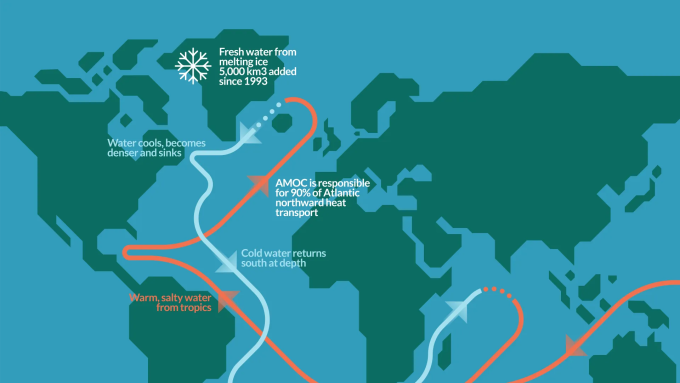
New research has found the Atlantic Meridional Overturning Circulation (AMOC) is slowing and approaching collapse at a much faster rate than previously anticipated. AMOC collapse would be a catastrophic, global climate tipping point resulting in an abrupt changes in planetary conditions, irreversible in human time scales and triggering further tipping points in Earth systems.
For the last 12,000 years the AMOC has been a key component of Holocene-era climate system. Warm surface water from the tropics flows northwards, warming Europe and the Arctic, where it cools and descends, returning to the tropics along the ocean floor. This “oceanic conveyor belt” moves at a rate of one cycle every 1,000 years, and has played a key role in creating the stable climatic conditions necessary for settled agriculture and the past 11,000 years of human development.
The AMOC is running at its slowest rate in 1,600 years and its slowing further. The reason is that the poles are warming faster than the tropics. That reduces the temperature gradient that drives AMOC. The slowing means that more rainwater accumulates on the surface, diluting the denser salty water, which then slows the sinking of water in the polar regions.
Both dynamics create self-sustaining feedback loops and beyond a tipping point the processes becomes irreversible.
Estimates
Scientists now think the AMOC tipping point could be passed at any moment. The best estimates are for it to come around “mid-century”.
Even AMOC weakening will have profound climate impacts. AMOC collapse is likely to be the first abrupt and catastrophic climate jolt of the Anthropocene. Measures to cut carbon emissions and so increase the chances of avoiding that collapse are urgent.
In Europe, AMOC collapse would mean much colder, drier winters. For the UK, the collapse of the AMOC would mean sub-zero winters for three months of the year in London, with temperatures as low as -20ºC. Scotland will freeze for more than five months a year. Polar sea ice will extend down to Norfolk.
At the same time, the planet would generally be warming, and so summers would be hotter that they are at present. The drastic climate change would significantly affect our ability to grow food. Some studies suggest Britain would lose 80% of arable land. Every region of the globe will be affected.
In North America, AMOC collapse would cause more extreme storm weather and add up to a metre of sea level rise, threatening major US cities, such as New York, Dallas, Boston, and Miami. In Africa, AMOC collapse would reduce rainfall, causing widespread drought. AMOC collapse will move the tropical rain belt southwards, affecting the monsoon-dependent regions like India and Sahel. Studies suggest we could lose more than half of the land currently used for growing wheat and maize, crops which currently provide 30-35% of the global calorific intake.
AMOC collapse is further linked to 45% of other tipping points. Research from Potsdam Institute for Climate Impact Research has found AMOC collapse will flip the Southern Ocean from carbon sink to carbon source, adding an extra 0.2ºC of additional global warming.
Future
At the start of the 21st century, Earth system tipping points were considered as high-impact but low probability events for the distant future. Difficult to model, they were generally left out of official climate models and ignored for the purposes of major climate negotiations. It was assumed until recently that no tipping points would occur prior to 4ºC warming.
Only in the last ten years, since the 2015 Paris talks, has scientific attention shifted and brought tipping points into sharper focus. The current consensus has shifted as a result of these findings and is extremely alarming.
Some irreversible changes are already locked in, and current trends indicate warming substantially beyond 1.5ºC. We are currently at 1.4ºC warming, and CO2 emissions are rising rather than falling. Other tipping points include coral bleaching, Amazon dieback, and the collapse of polar icesheets. We will discuss them in future articles.
However catastrophic the prognosis, we can have no faith in the ruling class to take the necessary action. Dire warnings over many decades have left them still increasing carbon emissions. As Marx says: “Capital that has such good reasons for denying the sufferings of the legions of workers that surround it, is in practice moved as much and as little by the sight of the coming degradation and final depopulation of the human race, as by the probable fall of the earth into the sun. In every stockjobbing swindle every one knows that some time or other the crash must come, but every one hopes that it may fall on the head of his neighbour, after he himself has caught the shower of gold and placed it in safety. Après moi le déluge! [After me, the flood] is the watchword of every capitalist and of every capitalist nation. Hence Capital is reckless of the health or length of life of the labourer, unless under compulsion from society.” (Capital, vol. 1, ch. 10)
We can have no hope of avoiding these tipping points so long as the Earth’s natural resources and all our heavy machinery is owned as private property and exploited for profit. Social control of the means of production is the only way to avoid catastrophe and the only way to minimise the suffering of the catastrophes that are already locked in.
Currently the world’s three billion wage-workers are set to work in ways that drive us ever faster towards Earth system tipping points, whilst we suffer the many hardships and humiliations of exploitation. Through organisation and solidarity the international working class has the strength and interest to put an end to this madness. Only through social control of the means of production can we redirect production away from Anthropocene enhancing efforts and towards efforts that restabilise the climate, halt biodiversity loss and make the necessary adaptations to the environmental conditions that are already locked in. Only through social control of the means of production can we distribute increasingly scarce resources equitably and adapt to the environmental convulsions. The first step to winning social control is to orient the workers’ movement to this alarming new reality and win the argument for the ecological necessity of socialism.
Comments?We welcome replies, corrections and debate pieces. Contact us