
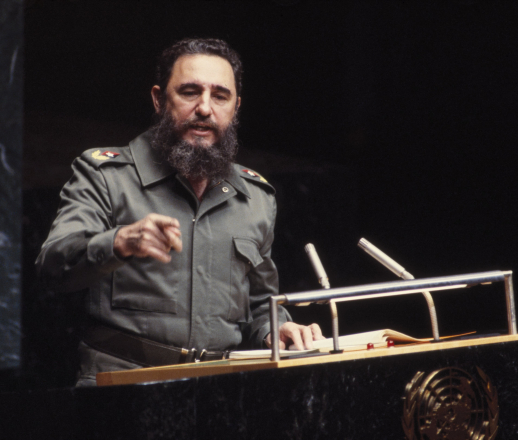
Martyn Ahmet’s article in Solidarity 761 dealing with my report on Cuba in 759 was thoughtful and interesting. He calls for a critical yet ultimately supportive orientation towards the government in Cuba.
Ahmet points to the campaign to reduce illiteracy in the 1960s and asks “what sort of “capitalist” country” would carry out such wide-ranging reforms? A short answer would be, one like Tanzania or Libya from the 1970s, Algeria from the 1960s, or India from 1947, all longer but starting from much worse illiteracy and poverty. Stalinist countries have certainly done impressive literacy drives.
The reform programme of the 1960s in Cuba was not carried out on the basis of mass mobilisation which the Castro government was forced to keep up with, but rather by an authoritarian government implementing policies which enjoyed popular support. This does not mean that mass literacy campaigns or expropriations of American plantations were bad, but we should be clear-eyed about what was happening in Cuba.
Bonapartism
Bonapartism is a useful lens through which to think about the Castro government, as Samuel Farber does in detail in Revolution and Reaction in Cuba, 1933-1960. The Castro government was not seeking to be a better steward of capitalism and the existing order than the capitalists themselves were able to be (which is how Farber characterises Batista). But it was about implementing a new managerial form of rule over Cuban society. There was often popular support; but not independent working-class organisation.
The Castro government ultimately prevailed, against Batista, but also against independent working-class organisation. For instance, the dictatorial measures taken at the Tenth Trade Union Congress in November 1959 were not just about ensuring the unions had a pro-Castro leadership, but about transforming these organisations into structural loyalty, under government control.
There are different conditions which working-class movements find themselves under and different orientations they might take to other social forces, but, if there is no independent working-class organisation, then the result is not socialism.
One of the chief problems facing Cuba today is the US embargo, in operation since 1960, which bars US businesses and citizens from trade with Cuban interests (with exceptions from time to time, now tightened), and the recent partial blockade (stopping other trade with Cuba).
The purpose of the embargo was to weaken Cuba, and of the current partial blockade to bring down its government via inflicting hardship on ordinary people; it is the duty of socialists everywhere to oppose it. Ahmet finds fault with my article for only acknowledging it and not treating it as “determinative” for the situation Cuba is in today.
The embargo and the blockade are far from the sole causes of the economic problems in Cuba. The government is run in a heavily bureaucratised manner, which prioritises the lifestyles and control of a privileged caste over the vast majority of the population. Cuba’s rulers are in very difficult circumstances, but that cannot oblige us to stop siding with Cuba’s workers against them.
Self-determination
Socialists should be consistent defenders of the right to national self-determination, which in the case of Cuba means opposing US attacks, calling for an end to the blockade and embargo, and defending the Cuban people’s right to decide their own form of government without US interference. Hal Draper wrote about this same issue during the early years of the Castro government.
“The right of Cuba (or any other country) to self-determination has absolutely nothing to do with whether we or anyone else approve of its government. This is, as we said, a democratic demand even under an undemocratic government. We would like to see the Castro regime overthrown by the Cuban people in favour of a regime of socialist democracy, but this task cannot be contracted out to American imperialism, which is interested only in installing a regime subservient to world capitalism.”
That doesn’t mean supporting the Cuban government against its own people. Its collapse would be beneficial to the US, but we can’t just write a plus where the US government writes a minus. There is a third camp here.
Ahmet argues that socialists should be “defending the historical gains of a revolution under siege while supporting struggles to deepen participation and accountability”.
I do not agree that the system in Cuba is imperfect but basically going in the right direction. I do think that socialists should oppose the siege on Cuba (currently largely economic but with the potential to become more explicitly military under Trump), oppose imperialist encroachment and privatisation in Cuba, and support struggles within Cuba for democracy. You could say that is not a million miles from what Ahmet calls for. But it is a different perspective.
Solidarity
What does this look like in practical terms? What could a genuinely independent and socialist form of solidarity work with the Cuban people look like? It does not look like the recent Nuestra America flotilla which largely served to bolster the prestige of the government — the Cuban activist Yasmani Castro responded that participants “should have at least walked through Central Havana and Old Havana one night during a blackout”.
People in Cuba are angry at the conditions that have been forced on them, and are directing the anger not just at the US but their own government.
Earlier in March there were protests in Morón where protesters stormed the Communist Party headquarters. In their report on the protests, the anti-Stalinist revolutionary socialist organisation Comunistas Cuba call for opposition to the blockade and the Díaz Canel government and support for the independent working class in Cuba.
How can we relate to these protesters and socialists? We should not tell them to set aside their struggles because they might weaken the Cuban state in the face of the US. Thankfully they wouldn’t listen to us if we did.
There have been talks between senior Cuban politicians and the Trump administration, and at the time of writing a Russian tanker carrying 100,000 tonnes of crude oil has been able to enter Cuban waters unhampered. It is the job of socialists to fight against the predatory circling around Cuba by the US, and to support working-class and socialist forces in Cuba, including against their own government.
Comments?We welcome replies, corrections and debate pieces. Contact us