
This is an article from the website of Resistance United, an organisation which is part of the Trotskyist tradition in Taiwan.
The article assumes that readers in China are already familiar with the current mainstream political parties in Taiwan, which are the ruling Democratic Progressive Party (DPP), the main opposition Kuomintang (KMT), and the third-party Taiwan People's Party (TPP). Following the 2024 elections, the DPP holds the presidency, while the KMT is the largest party in the legislature, with the TPP holding a key swing-vote position.
• Democratic Progressive Party (DPP - Green): The current ruling party, led by President Lai Ching-te. It is known for its center-left, pro-sovereignty stance, emphasizing Taiwan's identity as a distinct entity from mainland China.
• Kuomintang (KMT - Blue): The main opposition party (often called the Nationalist Party). It historically supports closer economic ties with Beijing and advocates for a warmer relationship with the PRC, holding the most seats in the legislature as of 2024.
• Taiwan People's Party (TPP - White): A relatively new, third-force party founded by former Taipei Mayor Ko Wen-je. It positions itself as an alternative to both the blue and green camps, focusing on pragmatic policy, though it often aligns with the KMT in legislative opposition to the DPP.
The 2024 elections resulted in a split government where no party secured an absolute majority in the 113-seat Legislative Yuan, with the KMT holding 52 seats, the DPP 51, and the TPP eight. In 2025, the KMT and the TPP used their majority to transfer central government budget to local government budgets (where the KMT control many districts). This provoked a mass campaign to remove around 30 KMT legislators from office using a recall mechanism in the constitution. This is referred to in the article below.
Two curious points about this article, which is otherwise insightful and informative:
1. It starts with Stalin’s definition of a nation, rather than Lenin’s or Trotsky’s.
2. It does not mention the fact that Taiwan was colonised by Japan for 50 years from 1895 to 1945. (unless that is also assumed to be common knowledge amongst readers in the PRC)
Questions and Answers on the National Question in Taiwan — A Reply to a Marxist from China.
Resistance United, 25 Feb 2026
Recently, following the publication of our article ‘What Does Peace in the Taiwan Strait Require? What Is the True Shield of Taiwan?’ on our website, we received a heartfelt letter from a reader—a friendly exchange from a young idealist in China. In this letter, our correspondent identifies himself as a Marxist and raises numerous questions regarding cross-strait relations and the Taiwan issue. We have written this article to address the queries of this young friend and, in doing so, to present and explain our views to a wider audience.
Q1: From your point of view, are Taiwanese people a ‘nation’?
A1: There is no doubt that the people of Taiwan now constitute a nation.
We define a ‘nation’ as ‘a stable human community formed historically, characterised by a common language, a common territory, a common economic life, and a shared psychological disposition manifested in a common culture’. In any case, a nation is not determined by genes or blood ties, nor by ancestral origins, and certainly not by language. It is a product of a specific historical phase, a process shaped by the long-term interaction of specific material conditions (such as the four ‘commons’ mentioned above).
What truly forged a common language among the inhabitants of Taiwan was the mass migration from isolated villages to major cities. This movement was facilitated by the construction of roads and railways, enabling interconnected travel. A shared commodity market economy emerged, facilitating the exchange of goods and the establishment of economic ties and a social division of labour. Through the collective experiences of various groups shaped by the passage of time, and within the collective memory—shaped by the combined influence of the media, compulsory education and widespread literacy—a shared psychological disposition (national character) was also formed. All of this occurred primarily after the Kuomintang fled to Taiwan.
This was not a simple, linear process of development.
Looking back at history, the evolution of the original inhabitants of the island of Taiwan from viewing ‘Taiwan’ as a geographical identity to identifying with it as an ‘national’ identity was the result of the historical process outlined below; it had a beginning and a lifespan.
It was the Cold War; it was capitalist industrialisation and large-scale urbanisation on the island of Taiwan; it was the collapse of the legitimacy of a ‘white’ (free) China and the political transition towards attempts to ‘put down roots’; it was Taiwan’s democratisation and localisation movements; it was the long period of separation between the two sides of the Strait; and it was the complex trajectory resulting from the interaction of capitalism on both sides (shifting from rent-seeking and cooperation towards competition and confrontation) , the US-China rivalry and Taiwan’s calculations for maximising capitalist interests, and the marked disparity in the balance of power between the US and China—all of which have collectively fostered and shaped Taiwan’s national identity as it stands today.
It is worth adding that the widespread adoption of the internet and the proliferation of social media have also accelerated the formation of this sense of national identity. Of course, those opposed to this established identity are also actively employing modern means of communication in an attempt to hinder and reverse it.
It will continue to evolve; it is neither immutable nor eternal. It is a process.
Q2: As far as I am aware, the residents of Taiwan once identified themselves as Chinese. Why has this changed?
A2: Before the inhabitants of the island of Taiwan were moulded into a Chinese identity by the Kuomintang’s party state-controlled education system, some of them had regarded themselves as subjects of the Emperor, or as subjects of the Qing Dynasty, or as Han Chinese seeking to overthrow the Qing and restore the Ming, or perhaps as Han Chinese oppressed by the Dutch.
Yet for the far greater number of residents across the island of Taiwan, in an era when printed newspapers and broadcast media did not yet exist or were not widespread, when the only means of transport were on foot, by ox-cart or by hand-pulled cart, and when the majority of the population was illiterate, the vast majority did not possess what is termed ‘ethnic identity’. He knew his clan, tribe and village community; he knew his parents and his surname; he knew the common names of his own village and neighbouring villages; and, based on linguistic similarities, he knew which people spoke a language similar to his own and which did not, labelling them with general terms. Yet he would never have considered that another person living in a fishing village in a coastal region far away shared the same ‘Taiwanese or Chinese national identity’ as himself.
It can therefore be said that for the inhabitants of the island of Taiwan to develop a specific sense of national identity, certain material conditions must first be in place; in any case, these conditions did indeed begin to take shape during the era of Kuomintang party-state rule. The Kuomintang regime, having fled from China to Taiwan, invoked the names of ‘China’ and the ‘Chinese nation’ to consolidate its own legal and moral legitimacy, and to ensure that its anti-communist strategy could achieve ‘unity between the military and the people’. It was therefore necessary for them to instil a sense of Chinese identity in the residents of the island of Taiwan. This was indeed illusory; yet, under the influence of political propaganda, party-state education and police state rule, a significant proportion of the island’s inhabitants did indeed regard the residents of mainland China as ‘ethnic compatriots’ in both their understanding and their affections.
This sense of strangeness and alienation represents the divide between the ‘red’ and ‘white’ Chinas.
However, with the further development of capitalist industrialisation, alongside Taiwan’s own democratic and localisation movements, the combined forces of politics, economics and culture eventually consigned the ‘white China’ to the grave, whilst ‘Taiwan’ began to take shape and grow its own limbs upon the corpse of that white China.
This is why, even today, although Taiwanese national identity is regarded as the dominant form of identity among the residents of Taiwan and Penghu, ‘Republic of China identity’ has left its mark. Such a resurrection based on a borrowed corpse cannot be without traces. Here, the historical development of different ethnic groups on the island of Taiwan has also exerted its influence; whilst the four ‘commonalities’ certainly hold true, beyond these commonalities, each ethnic group retains its own distinct historical memories and contexts. The so-called ‘local Taiwanese’, ‘mainlanders’ and ‘indigenous peoples’—these groups have, in fact, experienced many divergent histories since the Kuomintang’s retreat to Taiwan.
However, time and assimilation have blurred those differences. Fifty years ago, origins from different mainland provinces were a prominent and pressing political and social issue; today, it is not easy to identify such differences among those around us. Indeed, following democratisation, discrimination and divisions based on provincial background have been largely resolved through integration and the passage of time. They have become more subtle and less overt, no longer as clear-cut or tangible.
As things stand, the prevailing consensus among residents of Taiwan and Penghu is that their national identity is Taiwan, and that the name of their country is either ‘Taiwan’ or ‘Taiwan, Republic of China’. Meanwhile, middle-aged and elderly residents of Kinmen and Matsu generally identify as citizens of the Republic of China, and regard the country’s name as the Republic of China.
This consensus is likely to shift in the future. Its future trajectory will be shaped by Taiwan’s own development and the evolution of US-China tensions.
Q3: Amongst the residents of Taiwan, is there an ideology and political movement known as ‘Taiwanese nationalism’?
A3: Historically speaking, ‘Taiwanese nationalism’ has exerted a profound influence on the democratisation movement and social movements, and has also deeply shaped Taiwan’s social development and political evolution. For most Taiwanese people today, however, ‘Taiwanese nationalism’ does not feature in their lives as an overt ideological identity or political movement, but rather is woven into their daily lives and ‘common sense’ as a complex, habitual and implicit set of notions and affiliations. Put simply, for most Taiwanese people, there is no serious or actively engaged sense of Taiwanese nationalist identity or political movement. Yet Taiwanese nationalism subtly permeates their daily existence.
In addition to the influence generated by the ‘four commonalities’ mentioned above, the curriculum set by the education authorities, policy support for specific trends arising from the development of popular culture, covert political propaganda on social media linked to major domestic current affairs, and the CCP’s long-standing campaign of cultural intimidation and military threats against Taiwan, are all gradually shaping a form of Taiwanese nationalism that is both covert and seamlessly integrated into everyday life.
During major domestic elections and several mass political movements over the past decade or so, the overtones and rhetoric of Taiwanese nationalism have become increasingly apparent to the public. Examples include the so-called Sunflower Movement, the movement against the new curriculum guidelines, the campaign in solidarity with Hong Kong’s anti-extradition movement, and the recall campaigns [1] (from the successful removal from office of Han Kuo-yu [KMT Mayor of Kaohsiung, in 2020] to the Mass Recall campaigns [launched in 2025 in response to the KMT/DPP majority opposition in the legislature voted to transfer budgets from central to local governments, many of which were KMT-controlled]. In the election campaigns of Democratic Progressive Party politicians, however, the hues and perspectives of Taiwanese nationalism are primarily revealed through propaganda methods that are more covert and more readily accepted by the general public.
Looking back over the past fifty years, there has indeed been a clear and distinct political movement centred on Taiwanese nationalism. For some of those who participated in the democratisation movement, the ideological beliefs of Taiwanese nationalism were once vibrant and deeply held. However, for the majority of ordinary Taiwanese people, a serious and actively engaged form of Taiwanese nationalist identity and political movement holds little appeal; indeed, it is often met with indifference, alienation, or even hostility. This spectrum is also reflected in attitudes towards unification versus independence.
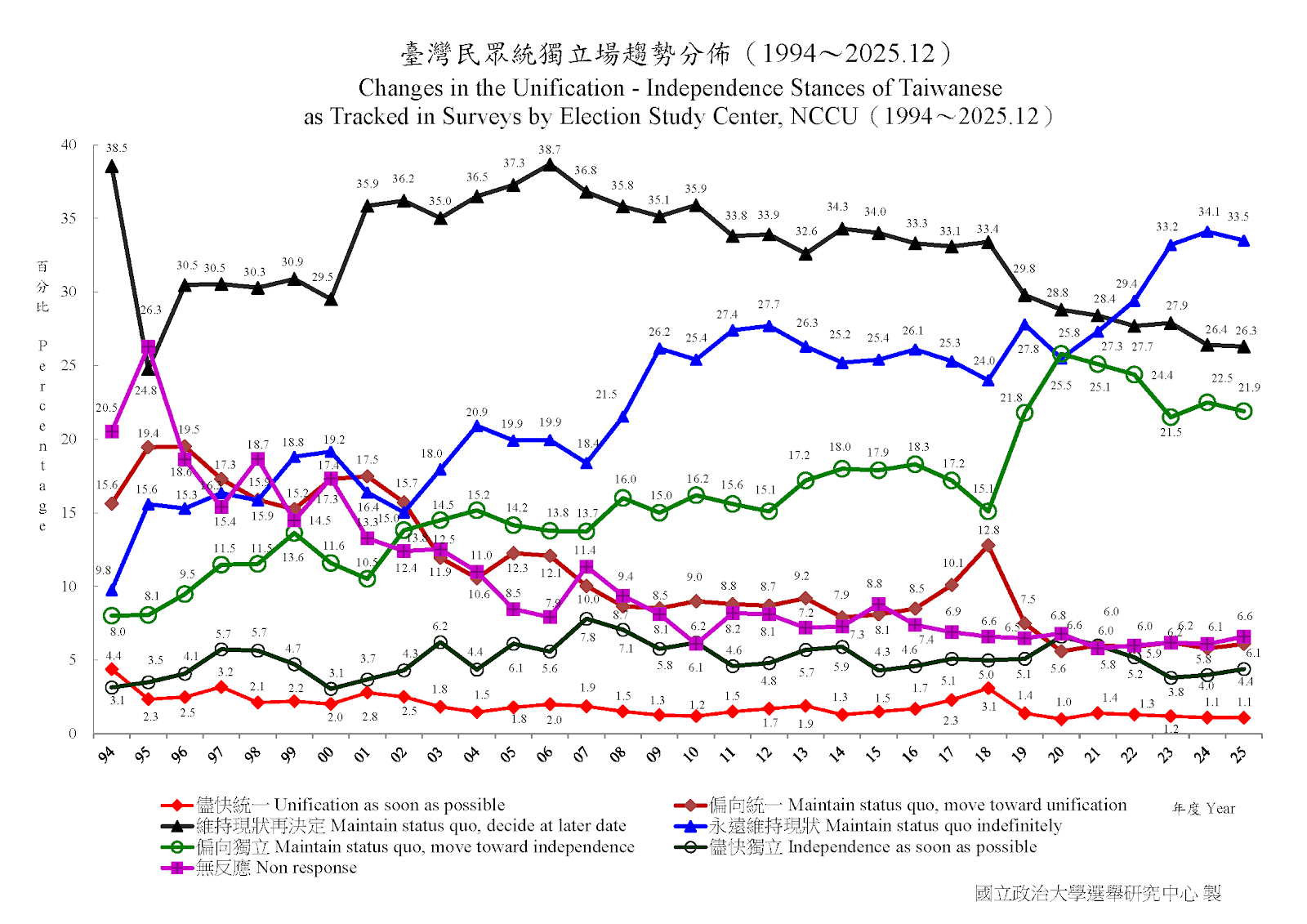
Whilst identifying as Taiwanese is certainly the mainstream consensus, when it comes to the issue of unification versus independence, the view that the status quo should be maintained is equally the mainstream consensus. What does maintaining the status quo entail? It means accepting and acknowledging (or being forced to accept) the legitimacy of the Republic of China in Taiwan; it means being unwilling to pay the (extremely heavy) price to establish a Republic of Taiwan; it means not wanting to become part of the People’s Republic of China; it means wishing to retain the existing political system and way of life; it means living a good life and avoiding crossing the ‘red lines’ imposed on Taiwan by the Chinese Communist Party; and it means preserving peace – all of which remain recognised and supported by the majority.
The Taiwanese national character is pragmatic and utilitarian. At a time when capitalism on both sides of the Strait allowed each to get what they needed and enjoyed harmonious relations, and in an era where moving westwards into China was seen as offering boundless business opportunities and ample chances to get rich, the vast majority of ordinary Taiwanese people, from the elderly to the young, regarded Taiwanese nationalism and ‘Taiwan independence’ as the heretical cults of social outcasts. The Kuomintang, which espouses a Chinese identity, embraces Chinese culture, and fervently supports cross-strait integration and a pro-China policy, had garnered overwhelming support.
However, ass US-China relations moved towards confrontation and the spillover economic dividends of China’s rapid growth dried up, and as cross-strait capitalism shifted from cooperation and integration to competition and mutual squeeze, many Taiwanese began to embrace a Taiwanese identity, turning towards pro-American and anti-Chinese sentiments (not merely anti-Communist), and ‘Taiwan independence’ began to garner greater emotional and ideological support from more people (though by no means was this translated into practical action or active political conviction). The DPP’s genuine majority rule began when the cannon fire of US-China confrontation rang out; this is no coincidence.
This development has also provided certain professional politicians and political schemers with right-wing Taiwanese nationalist leanings with greater opportunities and a wider platform. By exploiting the tense standoff between the governments on both sides of the Strait and stoking hostility and misunderstanding among ordinary people on both sides, they seek to gain greater political traction and profit-making opportunities from the situation. Of course, there are even more examples of such political opportunists within the ranks of nationalists in China.
It cannot be denied that on both sides of the strait, there are groups of people who, under the guise of ‘patriotism’ and ‘nationalism’, stir up hatred and misunderstanding between ordinary citizens of the two countries in order to secure business deals and government contracts. This explains why the Democratic Progressive Party has been able to hold power at central government level for twelve years, and may well secure a fourth four-year term in the future.
However, the Chinese Communist Party’s escalating campaign of verbal and military intimidation against Taiwan has heightened the risk of cross-strait conflict. This, in turn, has fostered a tendency among Taiwanese people to advocate for the restoration of cross-strait relations, the easing of cross-strait tensions, and even the pursuit of a balanced approach by appeasing both the United States and China. This explains why the Blue (Kuomintang) and White (Taiwan People's Party) camps enjoy such a solid base of public support.
Yet whether pro-US and anti-China or seeking to appease both superpowers for equilibrium, the cross-unification/independence and cross-party consensus of public opinion remains focused on preserving peace. Within this overarching goal of maintaining the existing peace, differences between parties and unification/independence stances manifest as divergent views and methods on ‘how to preserve the existing peace.’
For the Taiwanese people as a nation, ideology is a tool, not an end in itself. Seeking fortune and avoiding misfortune, pursuing advantage and shunning detriment, aligning with the prevailing trend, and acting in accordance with circumstances – practical assessments of life's fortunes exert a powerful ‘macro-level guidance’ over their choice of tools.
On the whole, the people of Taiwan are very ‘clever’. The division of public opinion on the unification-independence issue and the sharp divergence over the means of maintaining the existing peace certainly ensure that the three-party rivalry between the Blue, Green and White camps in Taiwan’s political landscape will never cease. However, it also means that the current superpowers, China and the US, cannot truly and completely dictate Taiwan’s future and the evolution of its situation. Such confrontation and division provide Taiwan with a geopolitical security buffer and a degree of autonomy.
Overall, Taiwanese are remarkably ‘astute’. The fractured public opinion on unification versus independence, coupled with sharp disagreements over the means to preserve the existing peace, inevitably perpetuates the relentless partisan rivalry between the blue, green, and white camps in Taiwan's political landscape. Yet this very division prevents the current superpowers, China and the United States, from fully dictating Taiwan's future trajectory and evolving circumstances. Such confrontation and fragmentation afford Taiwan a geopolitical safety buffer and a degree of limited autonomy.
Q4: What does ‘Taiwan independence’ entail? How much support does this proposition enjoy among the Taiwanese populace?
A4: Among those who claim to support Taiwanese independence or lean towards supporting it, the same two words [four characters] are interpreted in vastly different ways.
Among the majority who support maintaining the status quo, if they lean towards Taiwanese independence, this often implies ‘maintaining the current situation where the Republic of China (ROC) and the People’s Republic of China (PRC) are not subordinate to one another’, refusing to allow Taiwan, Penghu, Kinmen and Matsu to become part of the People’s Republic of China. For a significant proportion of this group, Taiwan and the Republic of China have long been equated. Rather than being inclined towards independence, it would be more accurate to say that this group strongly opposes cross-strait unification and wishes to preserve the status quo (separate governance across the strait).
Among those who explicitly support Taiwanese independence, a significant portion also aligns with the above perspective. This is perhaps because they accept and recognise the legitimacy of the Republic of China’s rule over Taiwan and the current status quo. Alternatively, with the development of democratisation and localisation, they have gradually come to regard the Republic of China government as the legitimate representative of national sovereignty.
However, a crucial factor that cannot be overlooked is that the Chinese Communist Party’s verbal and military intimidation of Taiwan, coupled with the escalating military standoff, has also served to suppress support for Taiwanese independence. On the one hand, this has driven more people in Taiwan to reject cross-strait unification and advocate for maintaining the status quo (where the two sides are not subordinate to one another). At the same time, regarding true Taiwanese independence—replacing the Republic of China with the Republic of Taiwan—they hold positions ranging from opposition to sympathy; in any case, they do not support it, as this could potentially lead to war. The majority do not wish to go to war for the sake of ‘establishing an independent Taiwan’. If, today, the prospect of Taiwan’s independence were no longer subject to military threats from the Chinese Communist Party (or if such threats failed to constitute an effective deterrent), and if China’s national strength continued to wane to the point where it was powerless to intervene, then replacing the Republic of China with the Republic of Taiwan would swiftly gain majority support and be put into practice. Perhaps those who firmly support Taiwan’s independence are hoping for precisely such a moment to arrive.
As for the small minority within this group, the Taiwanese independence they advocate signifies not merely that the two sides of the Strait are not subordinate to one another, nor simply a refusal to allow Taiwan to become part of the People’s Republic of China; it signifies, moreover, replacing the Republic of China with a Republic of Taiwan and abolishing the Republic of China.
Therefore, for the majority, Taiwanese independence simply means maintaining the status quo and opposing cross-strait unification. Whilst the number of supporters advocating for the establishment of a Republic of Taiwan and the abolition of the Republic of China has certainly grown, they remain a relative minority within society. As for what the social and political systems of a Republic of Taiwan might look like, this is perhaps no longer a question worthy of serious discussion today. For, given the current situation, it is entirely impossible for the people of Taiwan to embark on the path towards establishing a Republic of Taiwan, unless a ‘major upheaval unprecedented in cross-strait relations’ were to occur.
Q5: If ‘Taiwan independence’ were to mean war, then in your view, would the Taiwanese populace be more concerned with independence or with peace? If it were a matter of choosing between the two.
A5: This issue requires clarification. In practical terms, the Republic of China government governing Taiwan, Penghu, Kinmen and Matsu does indeed exist independently of the People's Republic of China government.
However, under the ‘red lines’ drawn by the Chinese Communist Party, the ‘red line’ of ‘Taiwan independence’ implies the establishment of the Republic of Taiwan.
Therefore, what the CCP is currently concerned about is not whether it exercises de facto control over Taiwan, Penghu, Kinmen and Matsu, but whether the people within the jurisdiction of the Republic of China and the ruling party of the Republic of China government choose a political course of action that would seriously threaten the CCP’s nationalist authority and the legitimacy of its regime—namely, the establishment of a Republic of Taiwan.
As we have observed, whilst the CCP undoubtedly regards cross-strait unification as a strategic development goal, it still views peaceful unification as the optimal solution, reserving military force as a last resort to be used only when absolutely necessary. Should full-scale war break out across the strait, China itself would be plunged into a massive economic and political disaster, or risk becoming mired in a protracted quagmire of war—neither of which would serve the CCP’s primary objective: the maintenance of its ruling status and the sustained rise of its comprehensive national power.
The logic is quite simple: for the CCP, if one day its comprehensive national power were to significantly surpass that of the United States in all respects, then sovereignty over Taiwan, Penghu, Kinmen and Matsu could naturally be secured from the United States without bloodshed. Sovereignty over these territories is a ‘cherry on top’ of any potential victory for China in the Sino-American confrontation, rather than a decisive factor in its success or failure.
Should the regime rashly attempt a military adventure and forcibly unify Taiwan by force, the risks would be far too great. Economic sanctions, international isolation, military intervention by multiple nations, or even a protracted war of attrition and fiscal black hole akin to the Russia-Ukraine conflict— would yield uncertain gains against forseeable risks. Such consequences could prove unbearable, potentially leading to the collapse of the Party and the nation itself.
We still assume that the CCP’s governing leadership retains a degree of rationality. We believe that unless Taiwan takes a path that seriously threatens the CCP’s legitimacy and nationalist authority—namely, the immediate declaration of independence and the establishment of a sovereign state; or unless the entire population is thoroughly subjugated to a culture of capitulation and intimidation under military threats— then there is no possibility that the CCP would ‘be forced to send troops to attempt unification militarily’ or ‘achieve unification by militarily subduing the enemy without fighting’.
Put simply, if Taiwan does not move towards independence and statehood in the current circumstances, and if society as a whole does not succumb to capitulationism or bow to the CCP’s intimidation, then ‘military unification as a last resort’ will remain merely a tool of domestic political propaganda and a policy statement for the CCP, rather than a national policy put into practice.
This is why we say that the people of Taiwan are very ‘clever’.
Peace is, of course, what the people of Taiwan value most, but they also wish to preserve their existing way of life and maintain the status quo; they do not wish to become part of a regime ruled by the CCP. The people of Taiwan want both peace and their ‘current de facto independence’. This was also evident in the last presidential election, where candidates from all parties had to emphasise their commitment to defending peace, yet there was clearly no consensus on what the primary means of defending peace should be.
Maintaining peace is a cross-party consensus, a consensus that transcends class divisions. If we were to make a subjective judgement, the people of Taiwan are, first and foremost, most concerned with peace. It is simply that there is no unified opinion on how to maintain peace; in our view, this lack of unity is a good thing, as if there were a unified stance, the risks might tip heavily in one direction.
Among Taiwanese people aligned with the pro-American, anti-China camp, one consensus viewpoint merits attention and consideration: ‘We do not wish to join forces with China in opposing the world’s most powerful nation—the United States’. This sentiment has gained even greater traction following the recent display of America’s comprehensive national power and its aggressive posture in plundering the world. For instance, the arrest of Maduro by the US did not provoke outrage amongst the people of Taiwan; rather, it led them to marvel at America’s might and further solidified their conviction that they must align themselves with their ‘big brother’, the United States.
Throughout the US-China confrontation to date, the economic growth and spillover benefits from the conflict that Taiwanese capitalism has reaped have caused support for this stance to rise steadily over the past few years.
‘Whoever wins, they side with. Whoever is powerful, they support.’ This line from a film aptly describes the people of Taiwan amidst the US-China strategic competition.
Q6: What is your position and stance on the issue of Taiwan's nationality and the cross-strait relationship?
A6:On the issue of national self-determination, we maintain that the residents of Taiwan, Penghu, Kinmen and Matsu under the rule of the Republic of China government have the right to determine their own future destiny. Marxists have always supported the right to national self-determination. However, we will state our position honestly: under the current circumstances, should the ruling party of the Republic of China government place ‘Taiwanese independence’ on the actual political agenda, this would indeed pose a serious threat to the Chinese Communist Party’s nationalist authority, forcing the CCP to no longer treat military unification merely as political rhetoric for intimidation and propaganda, thereby causing the risk of war to rise sharply and potentially become a reality. Unless, that is, there is a major upheaval in China’s internal and external conditions, rendering the CCP either incapable or unwilling to employ ‘ultimate measures’ to uphold its domestic legitimacy and political authority in cross-strait affairs.
However, we also acknowledge that if, in the future, the people of Taiwan and the ruling party of the Republic of China were to demonstrate—in the face of the CCP’s military threats—a clear and overt lack of willingness to resist, as well as a lack of military self-defence capabilities, this would make it more likely that the CCP would resort to military adventurism in order to consolidate its domestic ruling authority. Naturally, this would mark the beginning of a colossal global catastrophe.
Under the current circumstances, if the people of Taiwan place greater value on maintaining the existing peace and are unwilling to be ruled by the CCP, then they must neither recklessly challenge the CCP's nationalist authority (by pursuing Taiwanese independence) nor choose complete submission to its military intimidation. In short, they must find a way to ensure that the CCP does not perceive an urgent necessity to strike, nor be allowed to conclude that it can achieve its strategic goal of unifying Taiwan through military means easily and at minimal cost.
Calling for class solidarity across the Strait and a united stand against war remains the foremost task; this is a cause that all internationalists and socialists who yearn for peace and oppose imperialism will undertake.
However, in the worst-case scenario—should military conflict across the Taiwan Strait prove unavoidable—the people of Taiwan must strive, in the lead-up to such a crisis, to build autonomous trade unions and strengthen economic activity.
This will establish safeguards to protect grassroots communities and economic security in the face of a military crisis, ensuring that society as a whole possesses the capacity to withstand the impact of war and does not collapse overnight under its weight.
Even if military conflict does not erupt, the above measures will help to improve labour rights and workplace conditions in Taiwan, and serve to reduce the likelihood that the Chinese Communist Party, should a domestic governance crisis erupt, would attempt a military adventure of ‘unification by force’ to consolidate its repressive rule. (Of course, this cannot entirely eliminate the threat of such a military adventure).
Of course, the Taiwanese bourgeois government’s mistaken decision to purchase more weapons from the United States is also tantamount to paying a protection fee to Taiwan’s suzerain—the United States. In the absence of a powerful class solidarity movement, labour organisations and a workers’ party, under the current circumstances, regardless of which political party is in power, Taiwan will have no choice but to follow the path of ‘preparing for war to defend Taiwan’ by allowing the Taiwanese ruling class to procure massive quantities of arms from the United States. As long as the CCP's mix of propaganda and military intimidation towards Taiwan persists, and ordinary people and grassroots communities on both sides of the strait cannot mount a genuinely powerful anti-war movement, Taiwan's future will inevitably follow the path of ‘arming itself to the teeth’.
Just as the Democratic Progressive Party government has allocated an unprecedented defence budget, this will undoubtedly crowd out funding for social welfare, education and other areas in the long term, whilst also fuelling bellicose right-wing nationalist sentiment.
The people of Taiwan must recognise that unless we take the correct course of transnational anti-war solidarity, these practical difficulties will become shackles and constraints on grassroots unity across the Strait, leading us towards a future of heightened tension—unless, that is, the world has already bid farewell to the capitalist system of the survival of the fittest.
Even though the practical challenges are complex and daunting, we believe that the weapons and technology acquired by Taiwan in exchange for its ‘protection fees’ should not become pawns in the power games of imperialist powers, nor should they be reduced to instruments of slaughter that cause the senseless sacrifice and bloodshed of ordinary people on both sides of the Strait.
Instead, they should serve as tools for Taiwan’s grassroots communities and ordinary people to protect their existing democratic rights, the relative peace they enjoy, and their lives and property. Should tensions across the Taiwan Strait continue to escalate, we also hope these weapons and technologies will be controlled by Taiwan's grassroots movements and workers' organisations to protect the people themselves—not the interests of the privileged elite or hegemonic powers; not to become the meat grinder of proxy warfare, as witnessed in the Russia-Ukraine conflict.
However, to realise such aspirations, Taiwan’s grassroots communities and ordinary people must possess independent and robust self-organisation to defend their own interests and well-being.
Naturally, the matter is not so simple. Taiwan must find ways to maintain and enhance its significance within the global economy. This is one of the critical factors in preventing Taiwan from becoming expendable fodder in imperialist rivalries. Should Taiwan lose its current pivotal position in the world economy, the damage to the world from Taiwan becoming a battlefield would be greatly diminished. This would embolden both sides in the Sino-American confrontation to use Taiwan as a theatre of war with even greater audacity.
In addition to this, and most crucially, we must emphasise the following:
"Ultimately, what we regard as most crucial is that ordinary citizens and grassroots populations across Taiwan, China, and the United States develop a steadfast, profound anti-war conviction and a shared commitment to safeguarding existing peace. This cannot be achieved by the ordinary people and grassroots of any single nation or region alone; it requires transnational, international solidarity. It is not merely a matter of opposing the warmongering tendencies and war fever in public discourse; we must also prevent and counter any potential warmongering politicians and political parties.
In the hypothetical scenario of a Taiwan Strait conflict, ordinary citizens and grassroots communities across these three nations would bear the heaviest burden – foremost among them Taiwan and China, followed by the United States. Even the distant war in Ukraine has made the bills and livelihoods of ordinary Americans more difficult and strained; how much more so for Taiwan, which plays a key role in global supply chains? Over the past few years, attempts by the EU and the US to isolate Russia have forced ordinary people in both the EU and the US to pay a higher price for inflation and face harsher living conditions. The cost of completely isolating China, the centre of global manufacturing, will be far greater still.
Ordinary people and the grassroots communities of Taiwan and China may indeed find themselves in different nations and geopolitical camps, but they must never take up arms against one another. We should all speak with one voice to oppose our respective governments and leaders firing the first shot or adopting a belligerent stance.
What truly concerns us are the daily necessities of life – the rice, oil, salt, soy sauce, vinegar and tea; employment, education, and the present and future of our livelihoods; sustenance, clothing, shelter, transportation, recreation, and the cycle of birth, ageing, sickness and death. We seek to live with peace of mind and abundance, to possess dignified and honourable freedom. We reject the numbing of life's deficiencies and emptiness through the stimulants of nationalist fervour and infantile fantasies of war.
The ‘Shield of Taiwan’ that ordinary Taiwanese and the grassroots population use to safeguard peace has a crucial component that is often overlooked by the Taiwanese people—indeed, one might say it is the most important part: the vast majority of the 1.4 billion people on the mainland who simply wish to live well, look after their families and children, and who likewise regard bellicose ‘Little Pinkies’ as lunatics.
In forging Taiwan's shield, ordinary Taiwanese and grassroots citizens must strive to harness this largest and most potent ally. Together, we must safeguard existing peace and prevent the Taiwan Strait from becoming a battlefield.”
Therefore, we sincerely appeal to you, our readers in China: please join us in upholding the existing peace, opposing the potential risks of war across the Strait, and refusing to allow the people on both sides to face each other in battle. The greatest force capable of stopping the CCP’s political and military intimidation of Taiwan has always been you; your pacifism and anti-war stance can serve as the best shield for peace across the Strait.
[1]. The term 罷免運動 (Bàmiǎn Yùndòng) refers to recall movements in Taiwan, which are grassroots or political campaigns aimed at removing elected officials from office before their term expires. Taiwan's legal framework since 1947 allows for the recall of various officials, including the President, Vice President, legislators, and local leaders.
Key Context and Major Recall Movements - Recall movements have become a significant part of Taiwan's democratic landscape, particularly following amendments to the Public Officials Election and Recall Act in 2016, which lowered the thresholds for initiating and passing a recall vote.
How the Process Works - According to the Central Election Commission (CEC) of Taiwan, the recall process generally involves three stages:
Proposal: A certain percentage of voters in the district must sign a proposal.
Endorsement: A larger percentage of voters must sign to officially initiate the recall vote.
• Vote: A public vote is held. For the recall to pass, the "agree" votes must outnumber "disagree" votes and meet a minimum turnout threshold (currently 25% of the total eligible voters in that district).
"Appendectomy Project" (割闌尾計畫, 2014): A major civil movement following the Sunflower Student Movement that targeted specific legislators (mostly from the Kuomintang or KMT) who were perceived as being too subservient to then-President Ma Ying-jeou's policies.
Han Kuo-yu Recall (2020): The most high-profile recall in Taiwan's history, where Han Kuo-yu, the KMT Mayor of Kaohsiung, was successfully removed from office. This marked the first time a major city mayor was recalled in Taiwan.
Recent Trends (2024–2025): There have been subsequent waves of recall attempts targeting both KMT and Democratic Progressive Party (DPP) legislators as political polarization has intensified. For instance, recent reports mention large-scale recall campaigns against various legislators that were ultimately unsuccessful in reaching the required vote count.
Comments?We welcome replies, corrections and debate pieces. Contact us