
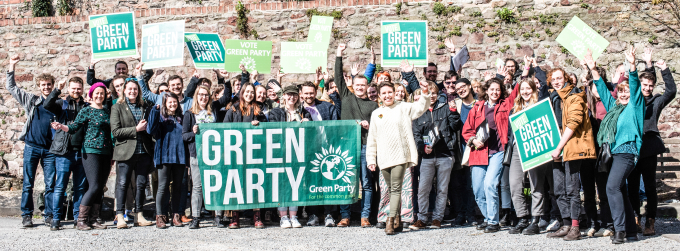
The Green Party Spring Conference on 28 March now has a near-final agenda. The “Zionism is Racism” motion, which has been heavily backed on the Green Party left, but “treats mainstream Jewish attachment to Israel [however critical] as a moral stain” remains on the agenda. A series of amendments point more towards the politics expressed in the “Peacebuilding in Israel-Palestine” motion and should be voted for, but the whole thing should be voted down, if it is reached, however amended.
Backers of a “leave Nato” motion are certainly motivated by opposition to the current Green Party policy in support of Ukraine, but the “reform Nato” position should be voted down. A motion to strengthen Green support for Ukraine has many worthy points and should be supported, but, as with the policy of the Ukraine Solidarity Campaign, it overpraises sanctions and ignores their downsides. In any case, it is unlikely to be heard. Motions are prioritised, and then those down the list drop off the agenda, which allows limited time for debate on motions. The main left caucus in the Greens, Greens Organise, has made no recommendations on prioritising, nor pushed any motion apart from unofficially pushing the “Zionism is Racism” one.
Of the two motions submitted on Iran, one has the general Stop the War Coalition position, “No war on Iran” (without criticism of the theocratic regime). “Justice, Not War, for Iran” is better, with some support for the protesters inside Iran.
Ecology
It might appear quirky that very few of the motions relate to climate or ecology. Oddly (see Solidarity 758) the GPEW approach to ecological issues is not particularly radical or comprehensive. It includes little discussion about what workers and workers’ struggle can do on the environment. One motion calls for affirming the Greens as an ecosocialist party, but with no sense that this means a focus on the working class. A motion supported by the Green Party Trade Union group, however, does seek to get the party to engage more seriously with trade unions, and a useful amendment calls explicitly for support for strikes and workers’ struggles.
A motion to end gender-based blanket bans in sport is worthy of support. It is the only motion on the agenda on trans rights. Its perspective on inclusion and on breaking down barriers to trans participation in sport is surely the right one.
A number of motions attempt to address some of the Greens’ anti-science bias and propose tentative support for nuclear power and research, for fluoridation, and some scope for animal testing. These are all worthy of support.
The surge in membership of the Greens leaves it with structures, committees, and ways of organising are designed for a much smaller organisation. Some of the democratic reforms proposed at this conference go some way to address that.
However, Green Party policy-making remains labyrinthine, filtered through working groups and committees, without the structure familiar in the labour movement of local branches debating and submitting motions.
Comments?We welcome replies, corrections and debate pieces. Contact us