
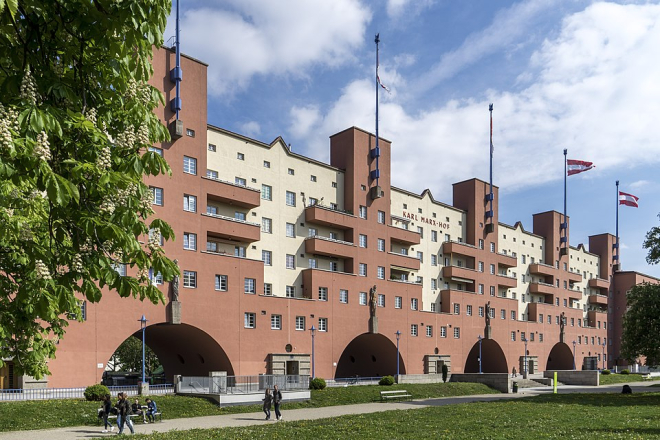
Vienna is held up as an example of best social housing practice. In this article I will explore that claim.
After World War One, Vienna faced a severe housing crisis. Under Social-Democratic leadership, the city launched an ambitious programme of public housing known as the Gemeindebauten.
Between 1923 and 1934, the city built roughly 60,000–65,000 municipal flats in hundreds of new housing estates, funded through progressive taxes including levies on luxury goods and high rents. These complexes often included courtyards, kindergartens, laundries, public baths and cultural spaces, reflecting a broader vision of collective wellbeing.
The Gemeindebauten were meant to embody and communicate the values of social democracy — dignity, solidarity, collective welfare, and a lasting social transformation.
The building programme stopped in February 1934 when the Austro-Fascist regime removed the Social-Democratic city government.
Much of that housing stock remains in use today, though. So in a certain sense, Karl Seitz, Social Democratic mayor of Vienna (1923-1934), was right when he said of their building programme: “When we are no longer here, these stones will speak for us.”
World War II
After World War II, the city begun an intensive reconstruction programme. From 1946, Vienna began rebuilding its housing stock at scale, reaching construction levels of up to 10,000 new dwellings per year in the early postwar decades.
As across much of Western Europe, the postwar years saw a broad political consensus that social housing was a public responsibility, and many countries developed large municipal or non‑profit sectors during this period. However, what ultimately set Vienna apart was not the immediate postwar policies, shared widely across Europe, but the long‑term continuity of these policies.
Where many Western European cities shifted toward privatisation, deregulation, and the shrinking of public housing sectors from the 1980s onwards, Vienna notably did not follow this trend. Instead, the city maintained a large municipally owned housing stock and expanded a tightly regulated limited‑profit sector, ensuring that social housing continued to serve a broad social mix.
That said, while the city continues to provide a large stock of regulated and subsidised housing, market pressures have increasingly shaped both policy and outcomes, pushing the system away from its original de‑commodified foundations.
European Union
So since the early 2000s, shifts in national rules and EU competition frameworks have pushed Vienna to rely more heavily on limited‑profit developers at the expense of direct municipal construction, signalling the slow erosion of the fully public model that defined Red Vienna.
These structural changes have contributed to emerging inequalities within the system. Long‑standing tenants in older municipal or co‑operative stock continue to benefit from low, historically anchored rents, while newcomers — including younger residents, recent migrants, and lower‑income households without long local histories — often face significantly higher entry costs, narrower options and longer waiting times. Recent reports highlights growing pressures from rising land prices, long waiting lists and the shrinking share of social housing relative to total urban development, despite Vienna’s continued political commitment to affordability.
Compared to say London, Vienna still does have a better social housing model and provision, but things are changing. The political fight is to resist these changes but also look to a new model, one that, yes, could take inspiration from Red Vienna, but is of the 21st century.
Comments?We welcome replies, corrections and debate pieces. Contact us