
This year marks the centenary of the 4-12 May 1926 General Strike, a momentous event in the history of the British labour movement which sadly ended in defeat and betrayal. The strike was called in support of over a million coal miners who had been locked out of their workplaces for refusing to accept wage cuts and worsening conditions.
Despite nearly two million fellow workers mainly in heavy industries and transport coming out in support of the miners, the Trades Union Congress (TUC) called off the General Strike after nine days. The Labour leaders and trade union bureaucrats preferred to capitulate to capitalist power than stand up for the workers they were supposed to represent!
A lot of books and articles will be coming out marking the anniversary. The BBC, if it’s still got the bottle, might even rebroadcast Days of Hope, Jim Allen’s four part drama series about the strike and the background to it, which went out on the fiftieth anniversary. If so, I doubt it will go out on prime time as it did then!
1972
Yet as we mark this anniversary there is a moment of history somehow missing from historical memory. Another general strike actually called by the TUC, one in which the labour movement emerged victorious and since largely forgotten about. That strike happened in July 1972 following the jailing of five dockers for refusing to obey a court rule to stop picketing.
The post-war Attlee Labour government repealed the 1927 Trade Union Act passed by the Tories following the 1926 defeat, and eventually (in August 1951) the wartime anti-strike decree Order 1305. Strikes grew considerably from the mid-1950s, though they were all localised (no national strikes until 1966).
The fifties and sixties, an era of “full employment”, witnessed a considerable tipping of the balance of power from capital to organised labour as trade unions grew in strength, workers were increasingly unafraid to go on strike to advance wage claims and improve their working conditions, and employers preferred to pay out rather than lose buoyant markets.
The right wing press was at the forefront of demands for laws to rein in union power, their ire being particularly directed at “unofficial” strikes (the majority at that time).
The first effort to curb the unions was by the Wilson Labour government in 1969. Barbara Castle, Secretary of State for Employment, who had a reputation as a “leftist”, produced a White Paper, In Place of Strife, but was forced to withdraw the ensuing Industrial Relations Bill by intense opposition, particularly from trade unions affiliated to the Labour Party.
Clamp Down
The Tories had no such problems when they returned to office, passing the Industrial Relations Act 1971 as a centrepiece of their political programme.That law set up the National Industrial Relations Court (NIRC) with a particular brief to clamp down on picketing.
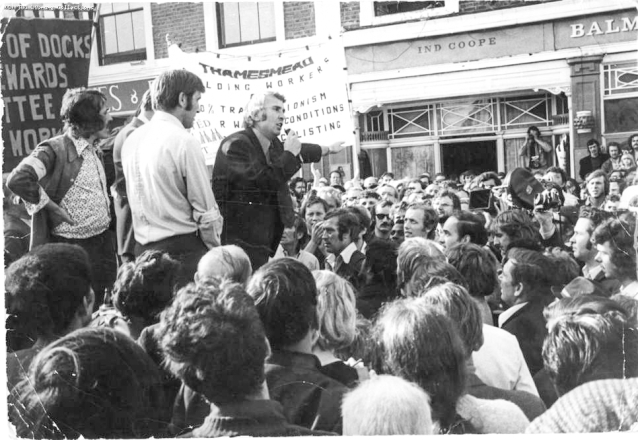
A big campaign was on at the time by London dock workers against containerisation, with some of them picketing a container depot in Newham. The NIRC issued an injunction against this. When the pickets refused to obey it, five of their shop stewards were arrested for contempt of court and slammed up in Pentonville Prison.
The AWL’s forerunner, Workers’ Fight, declared:
“Defend the dockers! Smash the Act! General strike!
“This is the crunch! Trade unionists are in jail to be held indefinitely for acting as trade unionists.
“The National Industrial Relations Court has claimed its first victims. The Tories are using their power, the power of the courts, the police and their laws against the labour movement.
“Now we must reply with our power, the power of industrial action — the power of the General Strike”.
These sentiments reflected the mood of outrage at the jailing of the dockers. A rolling series of strikes developed, despite the fact that some factories were on an annual shutdown in July. This forced the TUC to get off its collective arse and call a General Strike for 31 July 1972.
Marched
Thousands of workers marched on Pentonville Prison to demand the dockers release. I can remember being on that demonstration, feeling the power of an organised and determined working class. It was the closest I’ve ever been to a revolutionary situation in my lifetime.
The sheer strength of the protests forced the Tory Heath government to capitulate before the general strike happened. A factotum going by the name of the Official Solicitor, someone never heard of before or since, decided there was insufficient evidence for the dockers’ arrests and they were released.
The Tory government went on to suffer further defeat at the hands of the unions as a result of the 1974 miners’ strike. Heath sought to call a General Election under the slogan “who governs Britain?” — him or the unions — only to be told by the electorate it wasn’t him!
We are beholden to remember the victories as well as the defeats, and learn the lessons from both. That’s what the class enemy did under Thatcher, with her deliberate drive to deindustrialise the economy, almost halving union membership in the Tories’ term in office, and her anti-strike laws. The Pentonville Five — Vic Turner, Conny Clancy, Tony Merrick, Bernie Steer and Derek Watkins — were the unsung heroes of the labour movement. Their memory (all are now dead) still demands our recognition after all these years.
Comments?We welcome replies, corrections and debate pieces. Contact us