
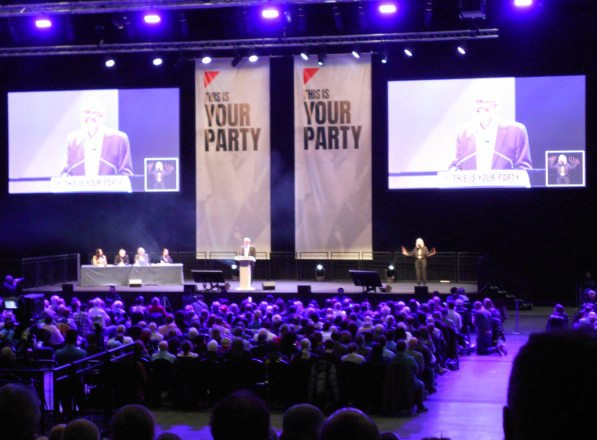
The 8 March meeting of the newly-elected Central Executive Committee (CEC) of Your Party bore all the hallmarks of a planned coup. Papers were not circulated until nearly 8pm the previous evening, although the metadata shows that many of them had been completed four days earlier. The CEC itself played no role in drafting these documents; the metadata suggests they were written by a staff member.
The Corbyn faction secured a majority in February on Your Party’s Central Executive Committee (CEC). Despite winning only 38% of first-preference votes in the regional elections, the faction was able to manipulate the electoral system so that its slate, The Many, won 14 of the 24 seats on the committee, giving it an outright majority.
They could have used this majority to reach out to opponents and share power in order to create a united party. They have done no such thing. Instead, they used the first full meeting of the CEC to concentrate power in their own hands and ensure that everyone else, particularly members organised in proto-branches, is thoroughly marginalised.
In a rushed (online) meeting lasting just two hours and twenty minutes, with pitifully little debate or justification, the coup unfolded in three stages.
Concentrated Power
First, standing orders were adopted that shifted power away from the elected CEC and concentrated it in the hands of the officers’ group and a staff secretariat. Amendments were formally allowed but not circulated in advance. Instead they were flashed briefly on screen during the meeting and movers were given around 30 seconds to explain them before votes were taken, usually with perfunctory or no speeches against.
Every substantive amendment aimed at strengthening democratic control was voted down by the Corbyn faction’s bloc vote. Proposals that the CEC itself, not the chair and officers, should control the agenda; that meetings be called with 14 days’ notice; that the CEC meet weekly during the party’s initial formation; and that officers and staff remain accountable to the CEC were all rejected. The result was a set of rules explicitly designed to concentrate power in the hands of the officers group and the secretariat.
The second stage of the coup was the installation of a leadership loyal to the Corbyn faction.
Here the faction faced a constitutional obstacle. At time of the party’s founding conference, members had voted for a collective leadership, rejecting the creation of a single leader. The intention was clearly that the leadership should unite the party’s main factions. The standing orders also state that the officers’ group should contain no MPs, and the constitution implies that officers should be elected by STV, ensuring proportional representation on the leadership body.
Obstacles
The tactic used by The Many to overcome these obstacles was simple: they ignored them. The CEC created the position of “parliamentary leader” and immediately elected Corbyn to it, effectively co-opting him into the leadership despite the constitution. The faction then used its majority to install an officers’ group consisting entirely of its own supporters. The standing orders give this group broad powers to run the party independently of, and largely unaccountable to, the CEC.
Meanwhile, the CEC was given no say over the party’s full-time staff and was even warned against revealing their identities. Karie Murphy was clearly orchestrating the meeting, with Artin Giles, Alex Nunns and press officer Angus Satow present. It is not even clear how many staff there are, though around £23,000 per month has been allocated for salaries. This combination of officers and anonymised staff will effectively run the party alongside the parliamentary leader. Typically, Corbyn himself did not attend a meeting with the messy business of solving political differences via brutal bureaucratic diktat.
The final stage was to begin transferring practical decision-making to this leadership-bureaucratic bloc.
Discussion of party finances was cut short and referred to the officers’ group. Candidate endorsements were handed to the officers. The drafting of the party’s code of conduct was handed to the chair. The pattern was clear: the CEC power was handed over the party bureaucracy.
Local Elections
One revealing discussion concerned candidates for the May local elections. A paper listed twenty-two “independent” groups that Your Party intends to back. The Many rejected a Grassroots Left amendment requiring these groups to have explicitly socialist principles, dismissing it as “purity testing”.
The same paper outlined the hoops that anyone else wishing to stand as a YP candidate would have to jump through, including vetting by the officers’ group and the payment of an unspecified fee. Yet the document also states that candidates must be selected by official YP branches, which do not currently exist.
Having achieved everything her faction needed, the chair closed the meeting, leaving large parts of the agenda untouched. This included the question of establishing branches. The issue of whether the Scottish organisation will stand in the 2026 Holyrood elections also remains unresolved, since the Scottish body still requires permission from the central party to use the name.
All of this focus on democracy and procedure can distract from the politics of the two factions. There was one vote that passed unanimously: a statement condemning the US-Israeli attack on Iran. The statement rightly denounces the attack but says nothing about the Iranian theocracy’s repression that left thousands, if not tens of thousands, dead only weeks ago. Nor does it mention Iran’s support for reactionary militias such as Hamas and Hezbollah or its long-standing backing for Assad’s murderous regime in Syria. Despite their bitter internal conflict, the majority in both factions remain united around the same narrow version of “anti-imperialism”: one that condemns US aggression but choses to not to consider that Iranian workers might have enemies closer to home than Trump and Netanyahu.
There is still some fight inside Your Party for democracy and accountability. We should support that struggle as long as it continues. But we should also recognise that the dominant political ideas shaping both sides of the dispute, ideas cut largely from the same cloth, are something that must be challenged as well.
Comments?We welcome replies, corrections and debate pieces. Contact us