
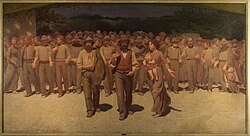
Giuseppe Pellizza da Volpedo’s famous painting “The Fourth Estate” (1901) which introduces the film
Following on from films about Antonio Gramsci, this week I stay with Italy to look at Bernardo Bertolucci’s monumental Novecento.
At 317 minutes this at times sprawling epic depicts Italy in the twentieth century up to the post-1945 period, through the prism of two lives: the agricultural worker Dalco Olmo (Gerard Depardieu) and landowner Alfredo Berlinghieri (Robert DeNiro). The two are born on the same day and Olmo works on the Berlinghieri estate. The two become friends, although Olmo never forgets his origins. He is raised in a spirit of socialist collectivity and the label “peasant” is worn with pride.
Come the First World War, Olmo enlists in the army. At the end of hostilities, he returns home determined to bring about political change. He faces up to the brutal, fascist overseer Attila Mellanchini (Donald Sutherland) and the region is convulsed by strikes against the landowners in which the village women play a leading role.
The rise of fascism and the war is a disaster for the region, but when Mussolini is ousted the village women take revenge on Mellanchini. The villagers are now armed and ready to assume power but the Communist Party tells them to hand over their weapons to the new authorities and the revolutionary impulse is lost. Olmo and Alfredo resume their friendship.
It is difficult to summarise such a long film but it’s a fascinating look into the lives of the agricultural workers of the Emilia-Romagna region (where Bertolucci was born, in Parma: the region also includes Bologna). There were some complaints about the film’s length, and there is a cut version which is best avoided.
Comments?We welcome replies, corrections and debate pieces. Contact us