
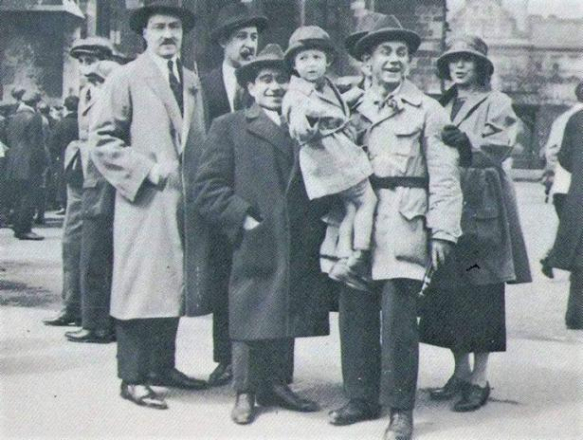
Pic: My favourite image of Gramsci – the only one I have ever seen where he is smiling – from his time in Vienna (1923). To Gramsci’s left is Vlady, the young son of Victor Serge, being held by Lucien Laurat (Otto Maschl), a member of the Austrian CP. On the far right of the frame is Serge’s wife, Liuba. Serge is either obscured by Laurat or is not in the picture.
Notes from Brisbane Workers' Liberty study course on the Prison Notebooks
Antonio Gramsci (1891 - 1937)
He was born on the island of Sardinia and later in life moved to the Italian mainland to study at Turin University. His health was never good and he suffered from a twisted spine, hence the numerous references to him as a "hunchback". Although ultimately forced to abandon his studies he became acquainted with Marxism while at University and joined the Italian Socialist Party (PSI). As an activist in Turin, Gramsci became a leading figure in the factory occupations which rocked that city and other parts of Italy in 1920. The newspaper he edited, Ordine Nuovo, became the voice of the occupation movement.
The factory occupations eventually receded but the reverberations had long term consequences for Italian society.
After the occupations were defeated, the Italian Socialist Party split, and the Italian Communist Party (PCI) was formed, with Gramsci as a founding member. He was an Italian delegate to the Fourth Congress of the Communist International in 1922, and then unable to return to Italy – where Mussolini's fascists had taken power in October 1922 – until he became an MP in the Italian Parliament in 1924, and gained parliamentary immunity.
As Mussolini tightened his grip, Gramsci was arrested in November 1926 and sentenced to twenty years in prison.
His health deteriorated, and the authorities released him in 1937 when he had only a few months to live.
His most famous work is the Prison Notebooks, written in jail and then (though from about 1930 at least Gramsci was known to disagree with Stalinist policy) published by the Italian Communist Party from 1947.
There is no complete translation of those Notebooks into English yet, but substantial selections have been published over the years, since a first tiny one in 1957. He writes about state and society, the party, Italian history, culture, the North-South divide in Italy, and much more. Especially since 1956 and the Communist Parties' formal dissociation from Stalin, Gramsci’s work and life have become major issues of discussion on the left.
"Kabak"
Christo Kabak is apparently a fictional character based on the Bulgarian Khristo Kabakchiev, who was a Comintern delegate at the January 1921 congress where the Italian Socialist Party split and the Communist Party was formed. "Kabak" is a kind of proto- Stalinist who urges Gramsci to spark an insurrection (Kabakchiev's fellow-delegate, Matyas Rakosi, was an ultra-left in 1921 and a notorious Stalinist later, but not in Italy in 1920). In the film, Gramsci refuses, arguing that the workers are not properly armed or prepared and he is not willing to sacrifice their blood in what would be a futile venture. Whether adding in the invented Kabak-Gramsci debate helps our understanding of a complex political situation is a matter of debate.
Monsters
“It is the time of monsters” is a paraphrase of a line from the Prison Notebooks. The original reads “The crisis consists precisely in the fact that the old is dying and the new cannot be born; in this interregnum a great variety of morbid symptoms appear.”
Some further reading
Paolo Spriano, The Occupation of the Factories: Italy 1920. Pluto Press, 1975.
Gwyn Williams, Proletarian Order: Antonio Gramsci and the Origins of Communism in Italy 1911-1921. Pluto Press, 1975.
Perry Anderson, The Antinomies of Antonio Gramsci, New Left Review, 1976
Martin Thomas, Gramsci in Context, Workers' Liberty 2012
Martin Thomas, The usable Gramsci, bit.ly/u-gra
By Gramsci:
Selections from the Prison Notebooks (1971)
Selections From Political Writings: 1910-1920 (1977)
Selections From Political Writings: 1921-1926 (1978)
Selections From Cultural Writings. (1985)
The International Gramsci Society website has a detailed chronology of his life, a bibliography, an international journal and much more.
Comments?We welcome replies, corrections and debate pieces. Contact us