
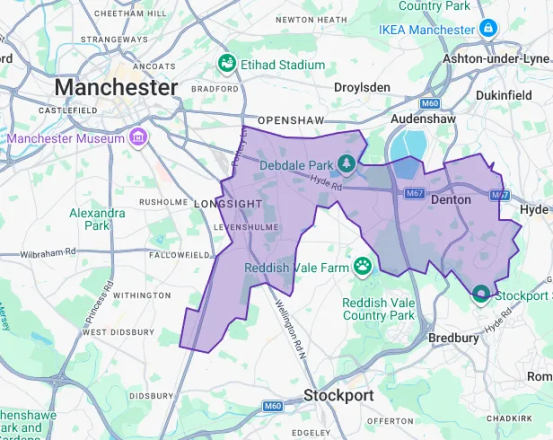
The decisive win for the Greens in the Gorton and Denton by-election, with 14,980 votes and 41% of the total — pushing Reform into second place — was a small triumph for ordinary human decency over division and hate.
It is a relief that the people who voted for Hannah Spencer kept the particularly nasty far right racist Matt Goodwin out of Parliament. Goodwin’s response to losing says it all: "I think the progressives were told how to vote, and I think what you saw was a coalition of Islamists and woke progressives that came together to dominate a constituency.” Why doesn’t he just be more “straight talking” and call it a “Muslim-commie coalition”?
In retrospect a Reform win was always unlikely in a constituency with its diverse and left-leaning population: the combined Labour-Green percentage vote from 2024 held up well (64% in 2024, 67% in 2026).
Labour was pushed into third place with 25% of the vote. Their campaign was bad. While Labour had plenty of people out in the constituency for the campaign, it was mismanaged, bland or politically woeful. Labour’s focus was on competing with the Greens for the “stop Reform” vote. At one point they used extremely reactionary messaging with bizarre claims about the Green’s policies on drugs (“[teaching] our children to use drugs including crack and heroin”) and sex work (“[letting] our daughters be used for legal prostitution”). Desperate stuff.
And no doubt Labour also deserved to be punished for its appalling political performance in government. On the other hand the evidence from polling shows that Labour would have fared much better if Andy Burnham had been the candidate — one poll shows 49% support for Labour with Burnham. As it is, the by-election has generated significant political shifts and cracks in the first-past-the-post system. That presents a series of problems for socialists.
Some commentators have called this an "Orpington moment", for the Greens. The rough analogy is with a 1962 by-election in Orpington in which the Liberals came from nowhere to halve both the Tory and the Labour vote and win.
At that time the Liberals, appeared to most people as left-wing compared to Tory-Labour "Butskellism" (policy differences between Labour and Tory were smaller then than now, and the Liberals would develop the slogan "which twin is the Tory?").
The Liberals would double their general election vote in 1964, then stagnate until their bigger breakthrough in 1974. The near-term electoral trajectory for the Greens is probably more hopeful for them.
They have had electoral surges before, such as the 1989 Euro-elections, where they won 15%, but this is bigger. It puts them on track for good results in the 7 May council elections.
The Greens already run dozens of councils, mostly in coalitions, and have nothing much good to report from that. But, with pressure for council cuts generally less than it has been in recent years, they are unlikely to suffer much discredit from running more councils only as moderately liberal managers (as they will).
On the other hand, while Zack Polanski has said his aim is for the Green Party to replace Labour, that is very unlikely. They could win in a number of constituencies but not enough to replace Labour by the time of the General Election. They simply do not have the support for their brand of only-very-slightly ecologically-conscious social democracy.
As importantly for us, the Greens are unlikely to replace Labour’s connections to the labour movement any time soon. That is why we will continue to push for the unions to use their great latent power inside Labour to fight its leadership on cuts, on rebuilding the NHS and taking a clear stance on Labour’s anti-migration policy. Such a turn from the unions is now beyond urgent.
With the May elections looming, the situation for Labour is about to get much worse. It is clear Starmer must go, but when, who will replace him and under what conditions? All the likely alternative leaders have stepped away for now. From their various individual tactical points of view (Streeting-Mandelson, Rayner-HMRC, Burnham-parliament), that made sense.
Yes, all the contenders were either not much better or even worse, but, with mobilisation from below, the exiting of Starmer could reopen life in the Labour Party and encourage unions and local Labour Parties to assert themselves.
We now need the left, trade unionists and community activists to come together in a fight to beat Reform politically. In most constituencies that will mean something like this: getting out to campaign for Labour where Reform is a threat; for Your Party and Green members to take a turn to organising against the far right; and for newer leftist Green members to expand their political horizons and activity beyond electoralism and involve themselves in political campaigning — e.g. defending migrants, campaigning for the restoration of services. It also means getting our unions to produce materials to help members organise in their workplaces against Reform’s policies.
Comments?We welcome replies, corrections and debate pieces. Contact us