
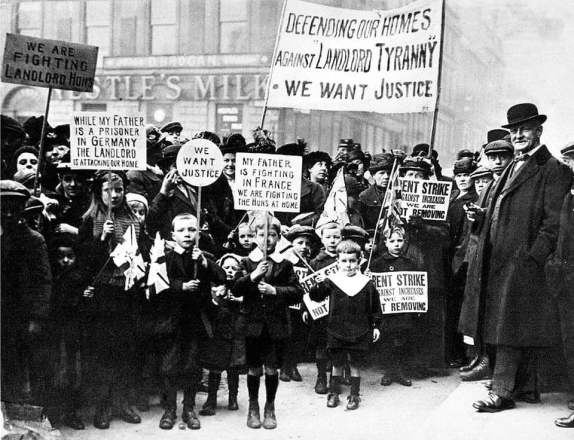
In early 1915, less than a year into the First World War, Glasgow’s working class was facing a housing crisis. Housing had already been a major concern for the city’s tenement housing residents, primarily industrial labour men and their families, since the late 19th century. Many homes were in a state of disrepair. Then, between 1912 and 1915, jobs in shipyards and munitions factories drew around 70,000 more to Glasgow’s industrial areas. Only around 1,500 new homes were built to accommodate them.
Glasgow had quickly become Britain’s most overcrowded city, and the surge in housing demand did not go unnoticed by landlords. In fact, the chair of the Landlords’ Association, Mr Speirs, had circulated a memo declaring that it was ‘a time for raising rents’. Many tenants at the time were women whose husbands were away at war and could not afford rent increases on top of skyrocketing food prices.
In February, landlords across the city notified tenants of an immediate 23% rent hike. Between January and March 1915 there were 6,441 evictions, marking a dramatic increase from the 738 evictions in August-September 1914. Tenants had very limited recourse to resist the landlords’ bailiffs, political connections and court backing. Nonetheless, a number of working class women began to organise against the rent increases, and February 1915 also saw the beginnings of Glasgow Women’s Housing Association (WHA).
The WHA started in Govan, as South Govan Women’s Housing Association, under the chairing and organising of Mary Barbour. Barbour was a socialist who had joined the Independent Labour Party (ILP) in 1896 and was involved in various organisations throughout her life, including the Scottish Cooperative Women’s Guild and Socialist Sunday Schools. It was her idea to focus efforts on the people who were most often home during the day and had the time to organise effectively: women. This was especially important given the wartime restrictions on workplace strike action. Barbour worked alongside fellow woman activists from the ILP including Helen Crawfurd (a former suffragette who left the WSPU in protest at its support of the First World War, and later left the reformist ILP for the Communist Party), Agnes Dollan (who co-founded the Women’s Peace Crusade alongside Crawfurd and Barbour), and Jessie Stephen (who went on to become one of the most active members of Sylvia Pankhurst’s Workers' Suffrage Federation and the first woman president of Bristol Trades Council). The movement spread across the wider Clydeside area. Glasgow Women’s Housing Association became colloquially known as Mrs Barbour’s Army.
Housing action escalated in March 1915, when a landlord tried to evict the wife of a soldier based on debts amounting to one pound. Led by prominent ILP member John Wheatley, hundreds of outraged neighbours blocked the way into her home and prevented her eviction. By May, a rent strike organised by GWHA was kicking off. Soon around 25,000 Glaswegian tenants were refusing to pay increased rents. It was the first of its kind in Europe.
The Women’s Housing Association hosted regular organising meetings, often in members’ homes or tenement closes; and cards were placed in windows announcing ‘RENT STRIKE. WE ARE NOT REMOVING.’
The women organised protests in which they wore signs as placards, with slogans like ‘Partick Tenants’ Strike. Our Husbands, Sons and Brothers are fighting the Prussians of Germany. We are fighting the Prussians of Partick. Only alternative: MUNICIPAL HOUSING.’ But perhaps their most effective action was in resisting eviction. A woman, acting as a sentry, would sit with a bell in the neighbourhood or tenement close on lookout while other women went about their household tasks; whenever the bailiff’s officer arrived to evict a tenant, she would ring the bell. The other women would descend on him: first to attempt to shame and/or cajole him into not evicting the tenant, and then to stand in the way and hurl flour bombs (paper bags full of flour), wet clothes, rotting fruit and other missiles at him until he gave up. It’s said that they would also pull his trousers down to force a retreat.
The tactics were highly effective, and the rent strike inspired men in nearby factories to strike for higher wages as well. By Autumn, similar rent protests were popping up in Dundee, Aberdeen and a handful of major industrial cities in England. Autumn also saw a further escalation of Glasgow’s rent strike movement when, in Govan, a housing factor (an intermediary between landlord and tenant) convinced a woman to pay the rent increase by lying that the other tenants had paid. Word of this got to Mary Barbour, who brought thousands of shipyard workers to the street of the housing factor’s office to demand the return of the money. The woman was promptly given her money back.
Apparently undeterred by events in Govan, on 17 November 1915 a factor in Partick decided to prosecute 18 non-paying tenants whose rents had been put up. Most of these involved shipyard, engineering and munitions workers. In response, industrial workers from Parkhead Forge steelworks and other workplaces across the city went on strike in support of the tenants and against increasing rents. They sent deputations to the court, and their terms were clear: if the tenants were prosecuted, they would refuse to go back to work. Thousands of women and workers remained at the courts all day. Between ten and twenty thousand in total marched with a band of tin whistles, hooters and a large drum, holding placards: 'RENT STRIKERS. WE ARE NOT REMOVING'. The Sheriff Court did not like the look of this.
The combined industrial and housing protests were highly impactful at challenging the authority of landlords and the state. The government was concerned about the protests growing into a national movement, and about the impact of solidarity strikes on war efforts. When the Sheriff Court telephoned the wartime coalition government’s Munitions Minister, Lloyd George, for support, he advised that the city drop the charges that same day and promised that the government would act. Celebrations outside the court lasted for hours.
Less than a month later, on 25 December 1915, the government’s response – the Rent Restriction Act – received royal assent. The Act froze rents at 1914 levels for the duration of the war plus six months unless improvements were made to a property.
While one of the movement’s key original goals of municipal housing was not achieved, Glasgow’s 1915 women’s rent strike is widely considered one of the most successful examples of working-class direct action in Scottish history.
Comments?We welcome replies, corrections and debate pieces. Contact us