
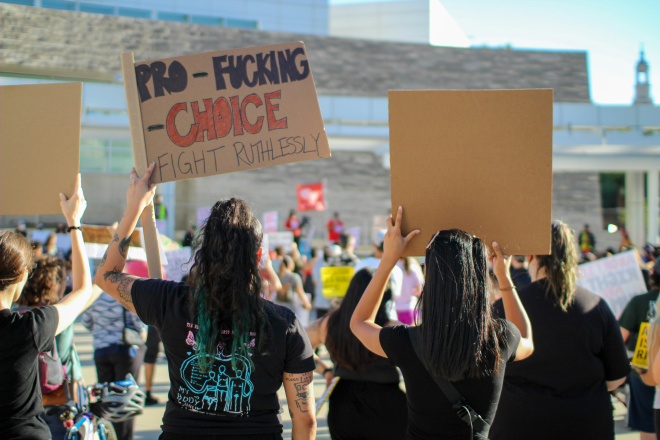
A sentiment that is not uncommon to hear in discussions about abortion rights in the UK is ‘At least it’s not as bad as America’. In Coercion: Surviving and Resisting Abortion Bans, Kylie Cheung presents the stark reality of the state of reproductive rights in a post-Dobbs USA, charting the complex labyrinth of laws that criminalise and trap abortion seekers and providers, and explores the domestic and international ramifications of this. It is full of the sort of stories evoked in those ‘it could be worse’ conversations. These horror stories are not mere cautionary tales but the real lives (and deaths) of those oppressed by abortion bans oppress.
Cheung documents how this situation did not materialise overnight in June 2022, when the Supreme Court voted in ‘Dobbs v. Jackson Women’s Health Organization’ to end the constitutional right to abortion. Rather it developed over a series of legal battles – and as liberal politics, assuming the fight was won, abandoned the cause of reproductive rights. Rather than serving as an ‘it could be worse’ comparator, Coercion shows those of us outside the USA why it is still vitally important to fight for full reproductive rights and the full decriminalisation of abortion.
It would not be possible to cover the entire breadth of Coercion in this review, so I focus on Cheung’s most salient points and those that feminists and activists for reproductive justice in the UK can immediately learn the most from.
ABORTION BANS AS STATE VIOLENCE
Cheung uses, and I will use, the term ‘women and pregnant capable people’ when describing the impact of abortion bans. ‘Pregnant capable people’ covers anyone who can become pregnant, including queer and trans people and children.
Cheung proposes that abortion bans are a form of state violence against women and pregnant capable people, and that this is their intended function, not an unfortunate side effect. Throughout Coercion, she demonstrates how abortion bans harm women and pregnant capable people, as individuals and on a societal level. This does not stop at the initial denial of choice over what happens to one’s own body. Abortion bans trap people in abusive relations, ensnare them in long and expensive legal battles, imprison them for crimes against fetuses, and drain their finances as they travel great distances to receive reproductive healthcare. Those who fight abortion bans have their organisations shut down, funding withdrawn, premises encroached on, and volunteers and activists attacked. Pregnant people are not the only victims. All potential fertility is policed by abortion bans, and anyone who could, or looks like they could, become pregnant is affected.
THE END OF ROE
Like how the UK’s Abortion Act permits abortion in certain circumstances by suspending the Offences Against the Person Act, ‘Roe v. Wade’ did not repeal abortion laws, but created a right to abortion before the point of fetal viability. As such, Cheung highlights, it left room for the imposition of term limits and the creation of laws to block access to abortion. Indeed, Dobbs did not appear out of the blue. In her introduction, Cheung cites ‘McKenna v. Miller’, a 2013 custody battle over a fetus in which the father – who had expressed not wanting anything to do with the pregnancy – was given custody rights as the mother moved state whilst pregnant. This move was considered ‘irresponsible’ and ‘reprehensible’ by the court. The decision was eventually reversed by an appeals court, but it is a chilling precursor to the current legal minefield created by abortion bans.
Another pre-Dobbs law that appears frequently in Coercion is Texas’ S.B.8. Introduced in 2021, it allows state residents to sue anyone who helps an individual access abortion care outside of Texas for up to $10,000, allowing abusers and rapists to harass victims and their support networks, and profit off their pregnancies. After ‘Dobbs’, in 2024, a Texas anti-abortion agency launched a campaign to recruit men who were interested in suing their ex-partners under this law.
The overturning of ‘Roe’ by ‘Dobbs’ ‘altered if not altogether tore the fabric of society for women and pregnant capable people,’ but its restoration should not be the end goal, Cheung tells us. It was never strong enough to prevent these laws from being passed and ensure reproductive justice; the rights to have children, not have children, and to raise children in safe environments, free from violence.
THE POST-DOBBS LANDSCAPE
Thirteen American states have full abortion bans and according to the Center for Reproductive Rights, another twelve are hostile to abortion and likely to introduce bans. Around forty states have fetal homicide laws, intended to protect pregnant people, but now used against them to criminalise abortions and pregnancy loss. Throughout Coercion, Cheung details how these laws enable violence against women and pregnant capable people. In first the two years after ‘Dobbs’, research estimates that 65,000 rape-induced pregnancies occured in the Unites States. The first public abortion case after ‘Dobbs’ saw a teenager sentenced to jail for ending her pregnancy to leave an abusive partner.
The dangers do not end at forced pregnancies. TRAP laws – Targeted Regulation of Abortion Providers – which exist in twenty-five states, are linked to increased domestic violence and homicide. Much of Coercion is spent analysing the close relationship between abortion bans and domestic abuse. Cheung speaks to the National Domestic Violence Hotline, who report increased incidences of reproductive coercion since ‘Dobbs’. Access to abortion can be key to escaping an abusive relationship, and as such abortion bans punish victims for protecting themselves. In 2024 the Hotline reported that, in a survey of 3,400 respondents, five per cent said their partners threatened to report them to law enforcement if they had an abortion, and five per cent threatened to sue them if they had an abortion. Horrifyingly, the leading cause of death for pregnant people in the US is homicide, most often by intimate partners.
Coercion demonstrates clearly that access to abortion can be a matter of life or death. These preventable deaths come in many forms – by murder, pregnancy complications, or doctors delaying life-saving abortions. When access to abortion is limited, maternal mortality increases, often dramatically; between 2019 and 2022, maternal deaths in Texas rose by 59%. To cover this up, some states have stopped recording or analysing maternal mortality data.
Cheung highlights that barriers to abortion, and the ensuing impacts, are compounded by other forms of oppression. People of colour, undocumented immigrants, poor people, those with disabilities, queer and trans people and victims of domestic violence are at the sharp end of the state violence enacted by abortion bans. Chapter 6, which covers pregnancy in the carceral system explores sexual violence, reproductive oppression and coercion in prisons, where people of colour are overrepresented, and ICE facilities.
LEGAL CONFUSION
Abortion bans generate, and rely on, confusion about the law and a fear of criminalisation. Where exceptions in abortion bans exist, this is often not clear to those seeking them, or even their doctors. There is also the fear of being reported by doctors and medical staff, especially by those who have managed their own abortion. Cheung shows us that this fear is far from irrational; the most charges in a year for pregnancy loss, including by abortion, occurred from June 2022 to June 2023, after the introduction of ‘Dobbs’.
Navigating these laws is extremely stress inducing, and (in some cases prohibitively) expensive. In fact, in America’s privatised healthcare system, so is being the victim of sexual assault – the average cost of a sexual assault survivor’s emergency room visit is $4000. Again, this has a greater impact on those who are already marginalised, who are often less likely to have medical insurance, and the time and money required to travel for an abortion.
Cheung reminds us that the work of abortion bans stretches far beyond criminalising the ending of a pregnancy: their aim is total control of our bodies. In Alabama, which has a track record for incarcerating pregnant people, miscarriage caused by alleged substance abuse can result in a 99-year prison sentence. ‘Dobbs’ has facilitated access to emergency contraception, which parts of the right conflate with abortion. Access to other healthcare and medicine which potentially impact fertility is impaired too. Cheung relates the story of a 14-year-old who was denied medication for her arthritis and osteoporosis because the drug, methotrexate, can induce miscarriage. Coercion spells out that through abortion bans, the right seeks to control all potential fertility, and the bodies of all women and pregnant capable people.
RAPE EXCEPTIONS ARE A FALLACY
Anyone who reads Coercion can never again think that rape exceptions to abortion bans work. Cheung highlights that they serve to legitimise bans, and imply that there are good, worthy abortions, and bad, frivolous ones. Rape exceptions are often inaccessible, and to work, rely on rape being easy to prove, and for this to be done in a timely manner, in a medical and legal system that is hostile to survivors of rape and sexual abuse. Thus, rape exceptions fuel the misconception that rape is easy to prove to the police and other authorities. In reality, an organiser from North Dakota’s Prairie Abortion Fund tells Cheung, they are ‘just another round of violation of [survivors’] autonomy within the health care system, within a police and judicial system that routinely hurts survivors.’
Rape exceptions are disingenuous and do not work. We should be wary of criticising restrictive abortion laws for their lack of rape exceptions, Cheung argues, when laws with rape exceptions ‘carry all the same implicit violence.’
HEALTHCARE WORKERS AND ABORTION BANS
Coercion contains interviews with and stories from many organisations facilitating and funding access to abortions, domestic violence organisations and advocacy groups doing extremely important work in an increasingly hostile environment. What is largely missing from the picture is the voice of healthcare workers, although this is perhaps not surprising in a country with a privatised healthcare system.
Rather, Cheung describes how abortion bans sanction medical abuse. There are stories of doctors denying abortions due to fear of prosecution under anti-abortion laws, in some cases leading to a patient’s death. Several abortion ban states have threatened doctors with imprisonment; for example, abortion providers in Louisiana can face 15 years in prison and $200,000 in fines. Yet, in the face of the unimaginable pain and preventable deaths of patients like Josseli Barnica, who died of sepsis because doctors waited 40 hours for the foetus’s heartbeat to stop to complete her miscarriage, it is hard not to regard the actions of the doctors involved as cowardly.
In some states with abortion bans, including Louisiana, Cheung reports that there has been an increase in C-sections as an alternative to emergency abortions for dangerous pregnancies. Cheung argues that this circumvents legal risk, but is done at the expense of patient safety; Physicians for Human Rights report that this will lead to unnecessary complications.
Elsewhere, abortion bans have effectively caused brain drains, with medical professionals leaving to states where they won’t be prosecuted for their work. As a result of such an exodus, in 2023 a rural Idaho hospital had to shut its labour and delivery department. Abortion bans rearrange medical infrastructure, which has a greater impact on communities already marginalised by the healthcare system.
What Coercion does not say, but what is clear from this to me, is that so long as reproductive healthcare is controlled by the state and medical system, healthcare workers must be organised, and supported by their unions, and by the left, to fight these abortion bans. It carries a great risk, but this means protecting and prioritising patient safety and disobeying abortion bans. Given the dire state of American healthcare, Coercion also leaves you thinking about the need for radical community care in the absence of official medicine.
DECRIMINALISE ABORTION
Cheung’s conclusion is firm: only the total repeal of abortion laws; ending state intervention and policing of pregnancies, will allow the conditions for reproductive justice to be achieved. No ‘rights-based’ framework, or half-way suspension of laws that ban abortion, or laws restricted with term limits, will do this. Crucially, these laws and exceptions can be overturned, as ‘Roe’ was, and are under attack from a steady drip of anti-abortion campaigning in the UK. In the meantime, Cheung reminds us, surviving abortion bans depends on our willingness, the willingness of friends, families, communities, comrades and strangers, to resist abortion bans: to pool resources, offer help, refuse to spy on and report each other.
Workers’ Liberty calls for access to abortion as early as possible and as late as necessary. We are for the removal of all barriers – including criminalisation, mandatory waiting times, the requirement of institutional approval, financial charges, insufficient provision, and term limits – and for the decriminalisation of abortion, which would lead to it being regulated in the same way as other healthcare procedures. Our support for abortion rights is based on bodily autonomy. Nobody should be forced to stay pregnant against their wishes.
Comments?We welcome replies, corrections and debate pieces. Contact us