
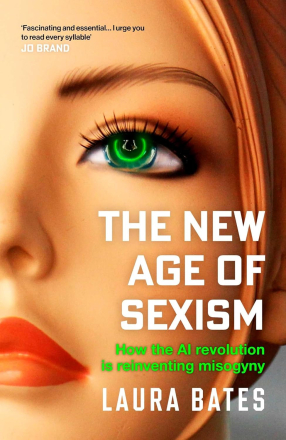
Capitalism continually produces industries and products that add little value to society or to our quality of life. AI is developing at extraordinary speed and, used responsibly, could genuinely benefit us by taking over mundane tasks and freeing people from unnecessary labour. As socialists, this potential shouldn’t be dismissed; our aim is greater freedom from the commodified labour that capitalism forces upon us.
But that ideal is blocked by the system itself. Within capitalism, even promising technologies are quickly redirected toward trivial, exploitative, or harmful ends. Instead of serving collective wellbeing, AI often reinforces the desires shaped by a system built on accumulation, misogyny, and racism.
It is no surprise, then, that AI has entered the most intimate parts of our lives – sex. This is the focus of Laura Bates’s new book, The New Age of Sexism: How the AI Revolution is Reinventing Misogyny. Bates examines how emerging technologies reproduce and amplify the misogyny already embedded in society, raising urgent questions about power, exploitation, and the future of intimacy under capitalism.
The book opens with deepfakes, one of the most alarming developments in AI. These AI‑generated images, videos, or audio clips can depict real people with uncanny realism. Harmless examples – like a viral video of a kangaroo being denied boarding on a plane – show how easily people are fooled. But the same technology can fabricate political announcements, incite panic, or spread dangerous misinformation.
More disturbingly, deepfake tools have long been used to create non‑consensual sexual images of women. Bates highlights the case of Almendralejo in Spain, where 20 girls were targeted after classmates generated fake nude images of them using an app called ClothOff. This is not an isolated incident. In 2023, Twitch streamer Atrioc accidentally revealed he had viewed deepfake porn of female colleagues, causing significant distress and long‑term psychological harm.
Bates also examines sexual harassment in the metaverse – often dismissed because it happens in a 'not‑real' world – and the rise of AI‑powered sex dolls. These technologies reduce women to interchangeable parts and create commercial spaces where misogyny is normalised.
Manufacturers frequently design these dolls to appear childlike or ‘youthful,’ using descriptions like ‘innocent,’ ‘tight,’ and ‘schoolgirl.’ This reinforces patriarchal ideals that women are most desirable when stripped of adult features. Bates notes that such ‘idealised’ robots risk reshaping men’s expectations of intimacy, distancing them from real human connection.
Dehumanisation is a recurring theme. Bates cites reviews from men who praise dolls for allowing them to avoid being considerate or emotionally engaged. Many describe real women as ‘manipulative’ or ‘nagging,’ framing dolls as a way to bypass consent entirely. Some users even request dolls modelled on women they hate, or use them to enact rape fantasies. Manufacturers defend this as a ‘safe outlet,’ but in reality these products entrench harmful attitudes rather than reduce violence.
The industry also blurs fantasy and real‑world consequences, especially when dolls are dressed as nurses or secretaries – professions already facing high levels of harassment. Rather than addressing misogyny or loneliness, this market rewards and reinforces them. As Bates shows through the example of a cyber‑brothel in Berlin, these spaces are overwhelmingly male and reflect a broader cultural hostility toward women.
The book left me enraged. It exposes how technologies are built around a straight, white, male default, turning AI into a collective assault on consent. Chapter 6, on AI ‘girlfriends,’ is particularly disturbing. These apps let users design an eternally compliant partner, creating what Bates calls ‘an explicit and convincing illusion of a woman who is eternally subservient.’ This isn’t momentary domination – it’s continuous, every time the app is opened. Such tools erode men’s ability to see women as full human beings, replacing real relationships with a frictionless fantasy where disagreement never exists.
At the core of this book lie stark truths: dehumanisation and the deliberate evasion of consent. Tech companies are not only failing to design technology that is harmless and inclusive – they may be fundamentally incompatible with the very idea of it. Bates argues that progress does not require ‘breaking some things,’ a pointed rebuttal to Mark Zuckerberg’s infamous mantra. But in a capitalist system where these companies operate, profit is valued far above harm reduction. The damage their technologies cause is retroactively patched over with flimsy band‑aids, never meaningfully addressed. As Bates writes, AI models ‘regurgitate the harms and inequalities inherent within the material… vomiting our racism and sexism and class inequality.’
Preventative thinking is almost entirely absent. As Bates repeatedly highlights, ‘an overwhelming male workforce creates products that cause or facilitate unintended harm.’ What we are witnessing is not just a technical failure but a systemic evasion of consent – one that creates unsafe environments, especially online. For those who grew up before social media, this might sound abstract or exaggerated. But for many people, including me, the online world is not separate from daily life. If AI continues to reproduce and amplify these harms, the result will be a further shrinking of public space for women and minorities, pushing us out of the digital sphere altogether.
One criticism I had was the book’s repetitiveness. As someone with a history of harassment and assault, I already expected the content to be triggering, but the density and overlap made it emotionally heavier. Chapter 5 could have been merged with the earlier deepfake chapter, and Chapters 7 and 8 would have been stronger combined, as both address how a tech sector dominated by white men reproduces discrimination far beyond sexual violence.
Ultimately, this book is an essential read, even with its occasional density. I’m still not convinced I’ve captured the full scope of what it covers here. It is a book that will make you angry – and perhaps push you toward action. The book is even more necessary to read considering recent legislative changes proposed by the UK government such as the recent Online Safety Act's attempts to address some of these issues. It requires platforms to implement robust age‑verification systems to block children from pornography, self‑harm content, and other harmful material. Sharing intimate images without consent has been designated a ‘priority offence,’ obliging major platforms to remove such content proactively. The government has also moved to tackle deepfakes by banning so‑called ‘nudification’ apps.
But all of this raises a deeper question: how effective can regulation be within a system still governed by profit and demand? Online activity evolves at a pace legislation cannot match. An app can be created in minutes; once an image is generated, it can be saved, duplicated, and distributed endlessly. As Bates notes, even the Act’s legal definition of ‘image‑based assault’ remains limited, leaving significant gaps in protection.
If we want to address these issues meaningfully, we have to confront them at their root. That means reshaping boys’ and men’s views of women from an early age, teaching consent as a fundamental principle, and talking honestly about gender – not only its most violent expressions, but also the subtle, everyday expectations that shape behaviour. And, in the spirit of genuine transformation, it means imagining a world where capitalism is no longer the organising force of our lives.
None of this will be achieved through banning a few harmful apps or passing laws that declare something ‘wrong’ while leaving the underlying culture untouched. As long as misogynistic behaviour is tolerated – even normalised – in private and public life, legislation alone will not change it. What we need is sustained conversation, collective pressure, and a willingness to challenge the systems that make this violence possible in the first place.
Comments?We welcome replies, corrections and debate pieces. Contact us