
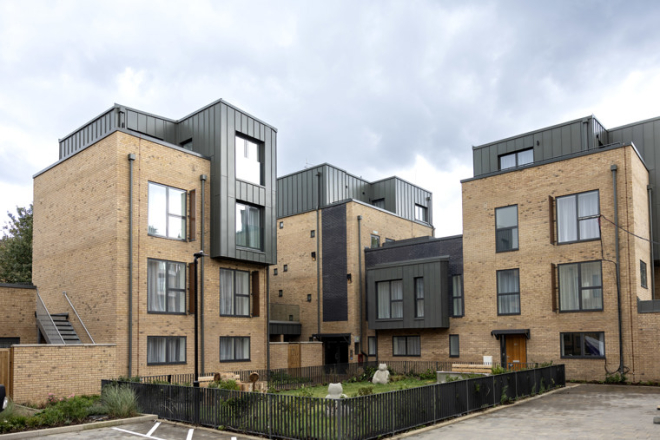
Pic: new council flats. Building stopped for decades after Thatcher blocked it, and is still far too meagre
In December, the Labour government proposed major reforms to the National Planning Policy Framework (NPPF). At the heart of the proposals is a strengthened presumption in favour of development.
There will also be a default “yes” to housing and mixed‑use schemes within roughly 800 metres of railway and tram stations. This applies both in big cities and in so‑called “well‑connected” stations outside urban areas. The plans also impose new minimum density rules: 40 dwellings per hectare near most stations and 50 per hectare around the best‑connected ones.
The fundamental weakness in the NPPF changes is that they do nothing to improve housing affordability.
Yet housing costs have risen for decades, especially for low‑income households.
• The IFS shows the poorest households spent 9% of income on housing in 1968; since the 2000s they have consistently spent over 20%.
• ONS data shows typical private renters paying 30–36% of income on rent.
The reforms rely on a familiar indirect approach: loosen planning rules to encourage private developers to build more homes, and hope that this increase in overall supply improves affordability. Yet there is no historical evidence that simply easing planning restrictions leads to genuinely affordable homes or meets social housing need.
Now developers will almost certainly build in these newly permissive station zones, but many already deliver dense, transport‑oriented projects in London and other major cities without such sweeping national reforms. What is new is the scale of the deregulation, not the pattern of development.
The most urgent housing need is for social housing, not market‑rate homes. A rough proxy for this need is the number of households waiting for social housing - now around 1.58 million in the UK. This understates the real figure, as many councils tightened waiting list criteria, excluding people who would previously have qualified.
The severity of need is stark in London, where average waits for a family‑sized home have reached:
• 107 years in Westminster
• 105 years in Enfield
• 102 years in Merton
The crisis is not confined to the capital: Mansfield (75.5 years), Slough (74.3), Solihull (27.9), Bolton (27.3), and Broxbourne (23) also face extreme pressures. Waiting lists in the Northeast have risen 28% in three years, erasing the traditional North–South divide—just in the worst possible direction.
None of this need will be met by private developers building near train stations.
Even if the reforms boost private construction, they will not significantly reduce social housing waiting lists or address affordability. The private sector builds for profit; it does not build the low‑rent homes that millions need.
The only proven solution is direct public investment in social housing: funding councils and to build genuinely affordable homes at scale. Without this, the crisis will continue, no matter how much planning policy is rewritten.
Comments?We welcome replies, corrections and debate pieces. Contact us