
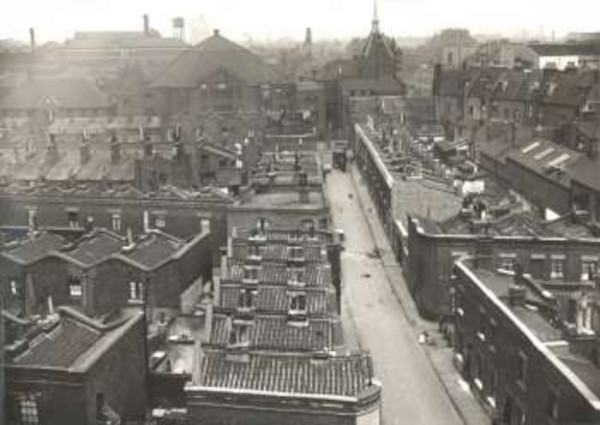
Pic: a Bermondsey street before World War 2
I grew up in Bermondsey, South East London, in the days before the area became synonymous with "gentrification". Our terrace house was a hundred years old and just over the road from the Bricklayers Arms, then the biggest rail depot in London, now given over to housing.
Some of the surrounding roads were named after battles in the Crimean War - Alma Grove, Balaclava Road - because the houses were built shortly afterwards. Our house was a seven roomed terrace with an outside toilet. In the winter the cistern froze. You couldn’t flush it! Not wishing to parody the Monty Python Yorkshiremen sketch, but during pre-teen years I had to wash in a tin bath.
In 1960 the landlord who owned this estate of around 790 dwellings wanted to sell up. He didn’t want to fork out for putting in the bathrooms and inside toilets new housing regulations demanded.
I must have been about nine when I was at a church hall meeting where the fate of the estate was up for discussion. The racist rumour mill whispered that it would be bought up by Winifred Atwell, an extremely popular Trinidadian television star at the time.
No doubt many present at the Bermondsey meeting enjoyed and even bought her records and were amongst the millions who watched her shows on ITV and then BBC. Atwell was the first black artist to have a number one on the UK singles chart. Her signature tune “Black and White Rag” became the theme tune in 1970 for the snooker programme Pot Black, snooker being more watchable as people acquired colour TVs. (For those watching in black and white, the pink ball is next to the green!) Couldn’t have a black person for their landlady, though, no matter how famous.
Although Winifred Atwell did own a few properties elsewhere in London (apparently the family of young Sharon Osbourne were tenants of hers), the idea that she had the financial resources to buy up a big estate in Bermondsey was frankly preposterous. Yet this was one of those times of racist moral panic in this instance directed against the Afro-Caribbean community, with the "fear" Bermondsey would become the new Brixton.
Bermondsey’s Labour-run council (to be merged into Southwark in 1965) decided to buy up the private estate. The decision was laudable in the sense that tenants would be much more secure with the council as their landlord than some private owner. The extent to which the decision was taken to pander to white racism could only be known if council deliberations could be accessed. ITV did a programme dealing with this, The Secret History of Our Streets, episode 3 (available on YouTube), which glossed over the racial aspect.
The MP at the time and right up until 1982 was Bob Mellish, who was an old style right-wing Labour and racist. He was particularly opposed to welcoming Asian British passport holders fleeing from the dictatorial Hastings Banda regime in Malawi.
Mellish described himself in parliament as an "anti-racialist", (a variant of "I’m not a racialist, but…") and talked about problems becoming “worse and worse for our own people” if Malawian refugees were given sanctuary. He bemoaned the six year housing waiting list for people "born and bred" in his constituency without questioning why there was such a housing shortage in the first place. Blaming immigrants for the housing crisis is a perennial trope.
Sixty-five years on from that church hall meeting, are racist views and attitudes less prevalent in working-class communities given the arrival of Farage and Yaxley-Lennon onto the scene? Is Britain less racist than it was all those years ago? Is it possible to realistically even to measure the extent of racial prejudice?
I have not been much interested in football mainly because my local team was Millwall. Never a team to reach the heights in the football league, but some so-called Millwall supporters have certainly been up there as premier thugs and racists. The club board have taken a number of anti racist initiatives, but racist behaviour from the team’s followers unfortunately continues to run deep.
Bermondsey itself has become much more socially diverse in part due to Thatcher "right to buy" legislation which allowed the flogging off of council houses. A noticeable decrease in far right activity in the borough was also evident. Was part of this down to "white flight" - movement to Farage territory in Essex?
In places like Clacton many of the predominantly elderly population have racist attitudes in varying degrees. To what extent have these have been passed on generationally?
Growing up in my circa-Crimean-war built house I’d heard of Florence Nightingale, but had no knowledge of Mary Seacole. Her contribution as a black woman regarding the welfare of the troops had been hidden from history. Hers was one of the many examples of positive black role models cited as educators worked to raise awareness and combat racism. Did any of it stick? Or are working class communities still sectioned of into "tribes" along ethnic lines?
And how was it for my family when the council took over as our landlord? A proper bath arrived in the early sixties, although they didn’t do anything about the outside khazi. My mother still had to traipse out there in the winter until she was moved to sheltered accommodation in 1987.
Comments?We welcome replies, corrections and debate pieces. Contact us