
The unsteady balance of power in Venezuela since Trump’s capture of Nicolas Maduro on 3 January has managed to hold into the later part of the month.
Interim President Delcy Rodriguez has kept her post, despite the difficult line she has to walk between the military-authoritarian nationalists in her government and the Trumpists knocking on the door.
Her party appears to have continued to rule in the manner it did before: responding to public outcries with harsh punishment and refusing to relinquish their grip on power. But now the president is a go-between for the Venezuelan ruling class and Trump rather than a nationalist demagogue basing their popular appeal on strident defiance of the USA and alliance with Russia, Cuba, and China.
On Friday 16 January, Rodriguez met with CIA director John Ratcliffe in Caracas. The CIA stated that the purpose of the visit was “to deliver the message that the United States looks forward to an improved working relationship” and that they would work together to target “narcotraffickers”, while the Venezuelan government declined to comment.
This is a pretty stark about-turn from the Rodriguez that came out the day of Maduro’s capture to demand his release and denounce the US for their intervention. Rodriguez has not publicly called for Maduro’s release since that day, and is now meeting with a force that boasted of playing a central role in spying on Maduro and infiltrating his government to aide in his capture. Will anyone from Maduro’s circle or the army attempt to replace her? We don’t know.
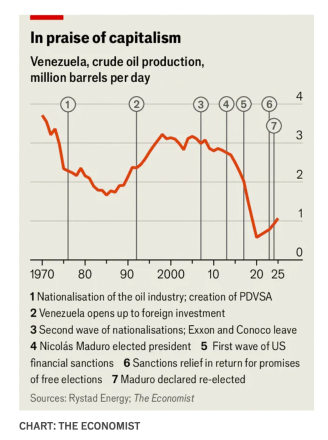
Trump’s intention in “taking” Venezuela remains impossible to summarise in anything but the broadest terms: a wish to expand his power. Trump said the operation was about oil, but there is a problem with the facts on (or under) the ground.
Venezuelan oil deposits are more difficult to process than much other oil — including the large quantities America already holds in reserve. “Heavy” oil, containing an array of contaminants and resembling more “green sludge” than “black gold”, takes much more time and machinery to refine than more liquid variants.
The complex refinement is possible, including in plants that are currently operational in the US and indeed were designed specifically for Venezuela’s output. But the extra cost and effort of doing so, and the years-long and expensive process of repairing and renewing the oil infrastructure to get more regular output beyond just seizing what Venezuela already had in storage, is not an attractive prospect in a world market tipping towards over-supply of oil.
Chevron
Responses from the major oil companies have reflected this. Chevron — which produces a quarter of Venezuela’s daily oil output — has promised to remain in operation, but other companies have been far more cautious. The chief executive of Exxon called Venezuela “uninvestable”, in large part due to the risk of assets there being expropriated by the state, as happened before in 1976 and again in 2007.
Whether oil companies choose to invest in Venezuelan oil or not is not a matter of the utmost importance for revolutionary socialists, but it indicates that Trump’s stated strategy is threadbare and doesn’t have the backing of his own capitalist class. The Trumpian reshaping of world politics that we are currently witnessing has a rudderless feel to it, leaving even experts constantly second-guessing his next move and the underlying logic.
Chief among those who have attempted to woo the president is Maria Corina Machado, who visited the White House in order to ceremonially hand her Nobel Peace Prize over to Trump. Her wishes were clear: flatter the president into naming her the next president of Venezuela, something he very bluntly rejected in his press conference following Maduro’s capture. She stated to the press that she hoped to lead Venezuela “when the right time comes”.
Trump has not changed his position, and Machado is down a Nobel prize while getting no closer to her goal.
Trump’s attention, and the world’s with him, have shifted to Iran and Greenland in recent days. But there are unresolved tensions still at play in Venezuela, and currently there is a distinct risk that the Rodriguez government will reconsolidate their power and resubdue the population, this time with the backing of the US, rather than its antagonism.
The PSL, Venezuelan section of the UIT-CI (one of the “post-Morenist” “Orthodox Trotskyist” international networks), has usefully summarised the role that the Rodriguez government is playing:
“We must be categorical: if a pact is made with imperialism, there will be more misery and plundering of our resources and no benefit for the working people […] There will be no benefits or better wages with the US and its transnational corporations. They care little about the needs of working people […]
“Between 1999 and 2014, Venezuela received more than $960 billion from oil exports. Very little of this vast amount of resources reached workers and the popular sectors. Only some welfare policies and the Misiones (missions) were implemented, which eventually faded away. Most of that money went to shady deals and corruption, arms purchases, and contracts with large transnational corporations.
“We must mobilize for an emergency increase in wages and pensions, equal to the basic basket of goods. No more austerity for working people! No more wage bonuses! Let’s discuss collective bargaining agreements; for the right to strike and freedom of association; for the full freedom of political prisoners, including those who have already been released, freedom for those imprisoned in the context of the protests against electoral fraud in July 2024.”
The demand for free trade unions, the right to strike, freedom of association and the release of all political prisoners are fundamentally important in Venezuela now. They could form the basis for democratic elections for a new constituent assembly, able to remove the president’s excessive constitutional powers.
To call for these things now is not to “distract” from the Trump attack on Venezuela: it is the only just way to fight back against it. The Venezuelan working class is the force we must look to, and its ability to wage war on the ruling class both of its own nation and its imperial enemy relies on freedoms that must be won in struggle.
Comments?We welcome replies, corrections and debate pieces. Contact us