
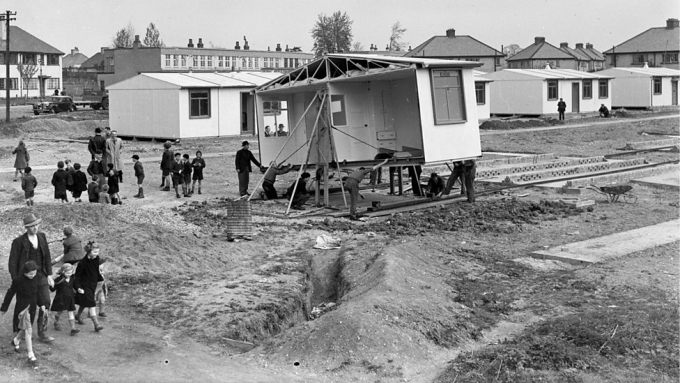
Pic: The "Homes for All" programme, 1946.
In June 2025 the Labour government launched an industrial strategy described as a “10-year plan to increase business investment and grow the industries of the future in the UK.” In June 2025 the Labour government launched an industrial strategy described as a “10-year plan to increase business investment and grow the industries of the future in the UK.” This strategy was made up of sector plans for key industries. But there was no sector plan for housing.
Yet having sufficient, secure, genuinely affordable housing for all is a key social need. More than that it would help tackle many other problems. For example, councils are spending huge sums on temporary accommodation and topping up housing benefit so that people can stay in private rented accommodation. These costs are pushing many councils close to bankruptcy.
Now Labour might argue that a sector plan is unnecessary because they have pledged to deliver 1.5 million homes during this parliament. But Labour will not build these homes themselves. Instead, they hope private developers will respond to incentives. Hope, however, is not a plan. What we need is a clear, actionable strategy.
The UK housing market is dominated by the top ten firms, which produce up to 50% of all new homes. This concentration gives them structural power to influence policy and resist reforms that would increase affordable housing obligations. These firms prioritise profit margins over housing volume. Despite rising profits, they have not significantly boosted output because they control large amounts of development land and slow build to keep prices high.
This objection is always trotted out when demands are made to build council homes en masse. Our fiscal rules won’t allow it, we can’t incur more debt etc.
It’s a cliché but true that governments can always find money when they want to do something.
For example, Labour has agreed to provide a loan of up to £36.6 billion to finance the construction of the Sizewell C nuclear power station.
For that same amount you could build in the region of 200,000 flats.
You can of course levy a tax to fund council building or stop the Treasury paying tens of billions per year to the Bank of England in interest payments. So the money is there.
Of course if you build a council house you get an income in return. Say you build a house for £300,000 and it is built to last at least 30 years. If rent pays back that cost over the 30 years then building is self-financing – provided you take the long view.
So social bonds could be issued by, say the Bank of England to finance large scale building programmes, with debt service being covered by net rental income.
A real plan would involve the state taking responsibility for removing bottlenecks in the supply chain, scrapping Right to Buy, ensuring enough trained workers, and guaranteeing fair conditions for those workers under a national union agreement, with councils and regional authorities being funded and tasked with building homes directly.
Currently, UK house building faces severe supply-side pressures. There is a shortfall of up to 500,000 construction workers, and prices for key materials like bricks and cement have risen by more than 37% since 2020. Without intervention, these shortages will keep driving up costs and slowing delivery. Only the government can address these problems by investing in construction skills and stabilising supply chains.
Of course we don’t have to build all homes by traditional methods. We could look to Modern Methods of Construction (MMC), such as modular and prefabricated homes.
History shows what works. In 1944, the Emergency Factory Made Housing Programme used centralised planning, standardisation, and industrial capacity to meet urgent housing needs. We need something similar today. Labour should lead by building homes, not just hoping others will.
For decades, government policy has focused on making house building more profitable, hoping this would lead to more homes. It hasn’t worked. The private sector will not build at the scale required unless profits are guaranteed. Councils and regional authorities have the motivation to meet social needs, but not the money. The solution is simple: give them the funds and the mandate to build.
Labour’s industrial strategy talks about growing future industries. But housing is not just an industry. It is a basic human need. Without a sector plan for housing, Labour’s strategy will fail to address one of the most pressing crises in Britain today. We need bold action, not wishful thinking.
Comments?We welcome replies, corrections and debate pieces. Contact us