
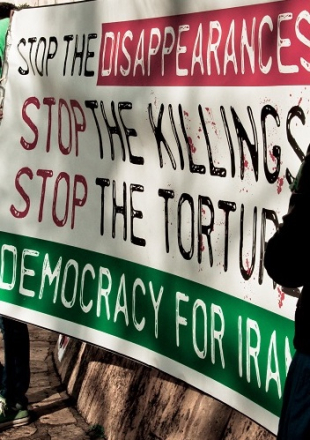
Trade union organisations, including the teachers’ union, pensioners’ unions and the truck owners and drivers’ union have issued statements of support for the protests in Iran. The Syndicate of Tehran bus workers stated: “Deprived people are fully entitled to take to the streets against the authorities’ repressive policies, the state’s all-out attack on livelihoods, structural corruption, deep class divides, to confront runaway inflation. The solution for workers and labourers is unity and organisation.”
The clerical Iranian regime has replied with brutality. The so-called Supreme Leader, Ali Khamenei, denounced the protesters as “rioters” who should be “put in their place.” The state is using tear gas and, occasionally, live fire.
Over a dozen protesters have been killed and scores arrested, so far. Blindfolded men have appeared on state television confessing to fantastical anti-regime conspiracies allegedly organised by foreign powers.
Repression is particularly harsh in the Kurdish area in north west Iran and Balochistan in the south east as well as in provincial towns.
Internet coverage is being restricted.
Many shops, schools, universities and government offices have been shut since Wednesday 31 December, when the government announced closures due to cold weather and the need to manage electricity supply. In fact the state intended to prevent opportunities for the opposition to meet and organise.
Thursdays and Fridays are weekend days in Iran, and Saturday 3 January was a national religious holiday. It is yet not clear if retail and other enterprises will reopen from Sunday 4 January.
President Masoud Pezeshkian has attempted to show some verbal conciliation, knowing very well that the suffering of Iran’s workers and poor is real and support for the regime is narrow. Official inflation is running at 52%, one third of Iran’s wealth is now in the hands of one percent of the population, perhaps 40mn people are living below the official poverty line.
Power cuts
Iranians suffer regular power cuts, water shortages, and air pollution levels which are responsible for tens of thousands of deaths each year.
The prestige of Iran’s regime suffered badly in June when the state was battered by a US-backed Israeli bombing campaign aimed against Iran’s nuclear weapons programme. Across the region Iran’s allies, including Hamas and Lebanese Hezbollah, have also been badly beaten following the Hamas pogrom of October 2023 and the Israeli war on Gaza which followed.
Now Israel and the US are threatening a further wave of bombing. A new wave of foreign attacks on Iran would help the regime, at least in the sense of allowing it to rally the population on a nationalist basis.
Probably 80% of the population oppose the clerical state, although the working-class opposition lacks coherence, depth and breadth of organisation. However, the working class remains the key to the only type of “regime change” which could produce a new society which benefits the big majority of Iran’s population, our people, the workers and the poor.
Despite some indications last month that members of the police force were angry that their pay was forcing them to take second jobs to survive, the central mechanisms of the repressive state, the IRGC and Basiji militia, remain intact and coherent. The state will not easily fall.
The statement of the Tehran bus workers contains the key. The working class must use any opportunity it now has to strengthen its organisation in the factories and enterprises. And all left organisations with any influence in Iran must see this as central: build up working class self-organisation, confidence and power.
For women’s freedom and workers’ power in Iran!
Comments?We welcome replies, corrections and debate pieces. Contact us