
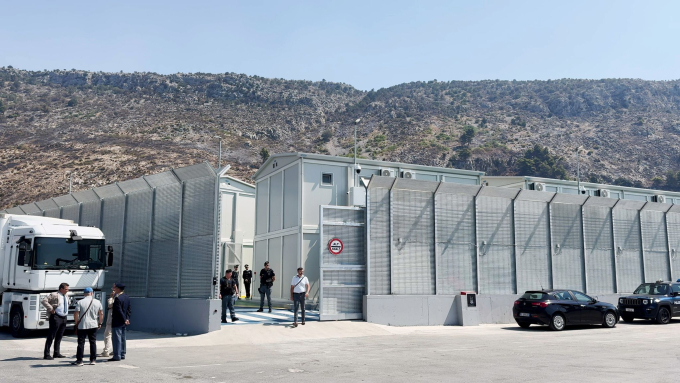
Pic: an Italian detention camp in Albania
Italian Prime Minister Giorgia Meloni's "Albania Plan" has been touted as a bold innovation in migration policy. It is exploiting the lives of desperate people for her own nationalist propaganda.
From the outset, the agreement with Albania was more of a spectacle than a solution. The Italian government invested hundreds of millions of euros in detention centres in Shëngjin in order to showcase its tough stance on migration, while concealing and ignoring the violence of the system.
The promise was simple: fast-tracked procedures and removal of people from Italy within a few days. In practice, the only thing that moved quickly was the propaganda. Human beings were shunted back and forth through the courts, while the extremely expensive centres remained largely empty.
Reality repeatedly contradicted Meloni's narrative. Italian judges ordered that all 73 people transferred to Albania between the end of 2024 and the summer of 2025 be repatriated to Italy. Subsequently, the European Court of Justice also dealt a severe blow to this “great reform” by ruling that Italy's list of safe countries violated European Union law, because states cannot simply declare entire populations safe and deprive individuals of the right to challenge that label.
However, instead of drawing the obvious conclusion, EU interior ministers chose to follow Meloni's example. In December 2025, they approved the use of Albanian camps as repatriation centres under the new EU Pact on Migration and Asylum, turning a failed Italian experiment into a model for the entire bloc, thereby validating Meloni's “Albania Plan” at least in part.
States most affected by immigration, such as Italy, Greece and Spain, are promised solidarity, but the substance of the pact is more fences, faster pushbacks and a longer list of safe countries to which people can be returned. Human rights organisations warn that this will lead to more detentions, more legal loopholes and more people trapped in limbo at the EU's externalised borders.
Even from an anti-migrant point of view, the project is a fiasco. The money spent on the Albanian facilities far exceeds what would be needed to house and manage people in Italy, while the actual expulsions are a laughable number. The project has reliably produced only one thing: a talking point for a government that prefers to wage culture wars against migrants rather than confront bosses, landlords and the wealthy. The whole operation highlights how the far right uses migration to reorganise politics around fear of difference.
From a class perspective, the “Albania Plan” is an attack on today's migrant workers and tomorrow's entire working class. A system capable of depriving migrants of their rights in camps abroad will use the same logic (segregation, exceptional rules, weakened protection zones) against other undesirable groups whenever it suits capital and its states.
Meloni's agreement with Albania is not just a bad solution; it is a deliberate project to strengthen borders, divide workers and shift politics even further to the right. It should be opposed not with complaints about practicality, but with a clear socialist demand: open the routes, defend asylum rights and organise migrants as part of the working class, not as people to be herded to the periphery of Europe.
Comments?We welcome replies, corrections and debate pieces. Contact us