
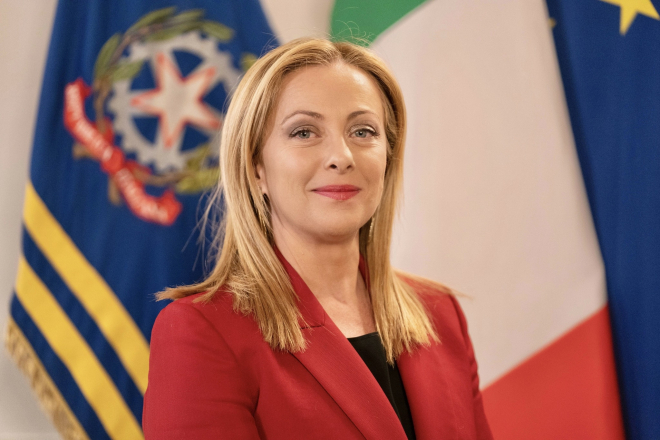
The Italian general election in October 2022 brought to power the most right-wing government Italy has seen in decades. It is composed of three parties: Brothers of Italy (FdI), led by Giorgia Meloni, a post-fascist party descended from the Italian Social Movement and currently leading the governing coalition; Forza Italia, founded by Silvio Berlusconi, a liberal-conservative party that represents the moderate wing, loyal to business interests; and Matteo Salvini’s Lega, which is even more extreme than FdI: openly xenophobic, it admires Putin’s Russia and the MAGA movement and mobilises fear and nationalism to strengthen the coalition’s grip on power.
Meloni’s ideology is based on a strategic combination of cultural conservatism and the defence of neoliberalism. Pursuing the slogan “God, family, and nation,” her government is committed to attacking the autonomy of women, LGBTQ+ groups, migrants, and simply those who hold different views on family. Members of Meloni’s government interfere in schools, the media, and cultural institutions to propagate an image of what it means to be Italian, based on Catholic moral values, with no room for feminism or gender studies.
Economically, it has contributed to job insecurity, strengthening the power of capital, while presenting itself as a defender of the rights of “productive workers.” Under the guise of strengthening “flexibility” and “competitiveness,” there is no doubt that labour laws have been weakened, promoting low-wage, short-term labour. Furthermore, their decision to end the “citizen’s income” is more than a simple ideological or political shift, as its primary purpose is to urgently discipline “inactive workers” by pushing them into precarious jobs. Cuts to social security benefits would serve to “reduce dependency,” while tax credits, on the other hand, would “support businesses,” once again underscoring the preponderance of Italy’s industrial and financial capital.
Deplorable
Immigration policy is the most deplorable aspect of her agenda. By entrusting the processing of asylum requests to countries like Tunisia and Albania, it demonstrates a profound disregard for the lives of migrants. Organizations working to rescue migrants in the Mediterranean Sea are threatened with prosecution, sanctions, or simply bureaucratic pressure. Deaths at sea, caused in part by political initiatives, are used to validate claims that the country is being invaded.
Meloni, despite her nationalist rhetoric, has proven herself a staunch supporter of NATO and the EU. She fully supports arming Ukraine and aligning Italy with the Western bloc. Her reliability in foreign policy has earned her a certain credibility among other countries, especially in contrast to Salvini’s ambivalence and his penchant for Russia. Her alignment now reveals the superficiality of her claims to “sovereignty.” Whenever the interests of capital, Brussels, or Washington are at stake, ideological posture gives way to submissive pragmatism.
The opposition remains divided, lacking a clear and coherent political objective. The Democratic Party oscillates between empty centrism and coward social liberalism, incapable of developing any viable alternative to the current status quo. The Five Star Movement (M5S) occasionally advances left-wing ideas (for example, opposition to military spending and welfare cuts), but due to its populist nature, it does not represent a valid alternative (it governed with both the Lega and the Democratic Party in two different governments). The unions, battered by decades of bureaucratisation, have limited themselves to calling purely symbolic, brief, and inefficient strikes.
For socialists, there is no doubt about what must be done. Rather than simply highlighting the government’s reactionary nature, which is obvious to anyone affected by its consequences, we must strive to rebuild, on the foundations of workplaces, neighbourhoods, and schools, a class-based movement capable of opposing, on the one hand, nationalism and authoritarianism, and, on the other, its fuelling power: capitalism. Individual actions will not save us: only through collective organisation, ideological formation, and continuous struggle can we put an end to the hegemony of the far right in Italy, Europe, and the world.
Comments?We welcome replies, corrections and debate pieces. Contact us