
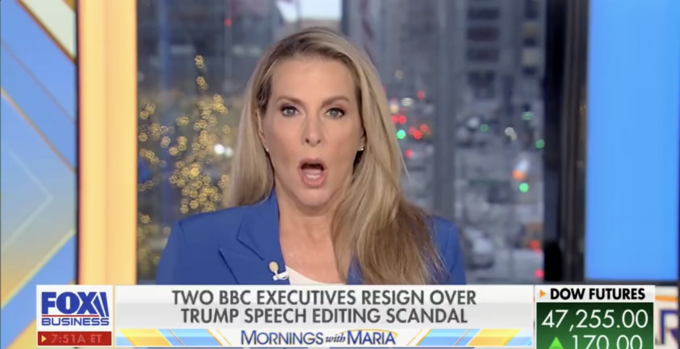
Trump’s barrage on the press has traversed national boundaries once again: his new target is the BBC.
Tim Davie, the director general of the BBC, has been made to step down after Trump and his acolytes attacked the British news institution for editing of a speech Trump made immediately preceding the 6 January 2021 attack on the US Congress. The edits put together two sections of Trump’s speech on that day, one telling supporters to go to the US Capitol, another telling them “fight like hell”.
In truth, the two things were said at different points, and the BBC has formally apologised for the editing error. However, that the impression given of Trump’s speech was not inaccurate. He did deliver a rambling hour of angry rhetoric used to rile up his base. The words “peacefully and democratically” were used once, inserted by his speechwriters at the last minute. Much has been made of those three words (amidst an hour of angry rambling) in legal defences of Trump’s role in 6 January.
Trump has insisted that the apology and Davie’s resignation are not enough – he announced on 10 November 2025 that he would sue the BBC for $1 billion.
Trump has used money and legal clout against many media outlets in the USA, mostly with success. Paramount, owner of CBS News, agreed to pay him $16 million. Disney-owned ABC paid him $15 million and briefly suspended talk-show host Jimmy Kimmel. The US Corporation for Public Broadcasting was shut down in August 2025 after Trump blocked federal funds for it, though small local non-profit public-broadcasting operations survive. The Washington Post, strongly anti-Trump in his first term, was ordered by its owner Jeff Bezos, now close to Trump, to make no recommendation in the 2024 election. Trump has sued CNN too, without success, and has legal cases outstanding against the Wall Street Journal, The New York Times and the Des Moines Register, which those papers are resisting.
Trump has got the Canadian federal government to apologise for a video issued by the Ontario state government using clips from Ronald Reagan to criticise Trump's tariffs, but his move against the BBC is his biggest outreach outside the USA so far.
And most successful: he has already got Davie and Turness to resign.
Trump is following up with his suit for $1 billion damages. He can't bring the suit in a British court, with Britain's punitive libel law, because too much time has passed since the original BBC show, so he is bringing it in Florida. There, his legal chances are lower, but the BBC is visibly scared. (Meanwhile, Trump is also going to the Supreme Court to try to get the one big judgement against him in 2021-4 - the civil case over his sexual abuse of E Jean Carroll - reversed. All the other cases against him, Trump got dismissed after he took office in January 2025. He has pardoned all the Capitol rioters of 6 January 2021, the "J6 patriots", and talked of funding compensation for them).
The Tory government made it a mainstay of their tenure to attack the BBC for purported left-wing bias, though they never resorted to legal threats like Trump's. The Tories could well use this to threaten the BBC with withdrawal of public funding (the licence fee) under a future Tory or Reform-Tory coalition government. And the Tories' agitation clearly had some impact on the broader population. The Labour government is ostentatiously offering no defence of the BBC against Trump.
Davie (a former Tory parliamentary candidate, so certainly no communist) has refused to admit any wrongdoing while stepping down, and has given speeches to BBC staff encouraging them to “fight for our journalism” in the face of Trump’s authoritarianism. It is hard to think that heads would have rolled in the same manner if the subject of the controversy had been anyone other than Trump.
This has come at a bad time for debates around the BBC’s bias.
Last week, BBC editor Raffi Berg announced he was taking Owen Jones to court for libel, over an article Jones wrote about Berg’s role in supposedly biasing the BBC’s coverage in favour of Israel and against the Palestinians.
Since the beginning of the war in Gaza (and before) many leftists have asserted that the BBC is distinctly biased against Palestinian voices. If that means that leftists shrug at the BBC-Trump conflict, that will be very wrong. The BBC is a news outlet for a capitalist state, and has the flaws that bourgeois outlets do – it’s why we think the working class should have its own revolutionary press. But the working-class movement does not have its own investigative reporters, and as bourgeois news institutions go, the BBC is fairer and more reliable than most if read critically. As we said back in January 2025:
“Someone who follows the BBC or the Guardian with the necessary critical eye will know the basic facts on Gaza, better in fact than someone relying instead on e.g. Socialist Worker. To say that 'the genocide couldn’t have happened without the Western media' is to encourage activists to stop reading the only institutions that can afford to pay reporters.”
If the BBC is cowed even further by Trump, that will be a loss for freedom of the press worldwide, and a bad outcome for those with an interest in knowing what is happening in the world.
Comments?We welcome replies, corrections and debate pieces. Contact us