
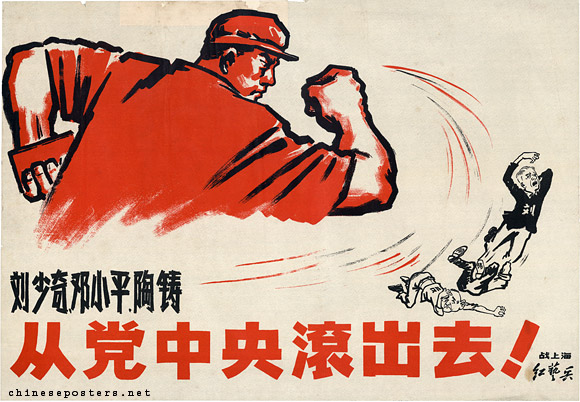
The high days of China’s Cultural Revolution ran from August 1966 through to mid-1967. School students, university students, and, later, some groups of workers, were mobilised to get rid of “capitalist-roader” officials and the “four olds”, old ideas, culture, customs, and habits.
At that time it had some of the shine of an actual revolution. It was seen as an inspiration by many revolutionary-minded people across the world, even by some who puffed themselves as very “correct” Trotskyists, like the Socialist Labour League in Britain. [*]
“Taken as a whole, the movement and its demands constitute an undeniably progressive factor and a deterrent to bureaucracy in China… This is not a ‘cultural revolution’ but a movement for political reform which, given a Marxist leadership, could develop into a political revolution.
“That is why the greatest support for Mao’s programme has come from the youth. More than a hundred million student and working-class youth have responded to the call to fight bureaucracy.
“As in Hungary [1956] they have fearlessly stormed police stations and barracks, communes and factories risking torture and execution to fight the bureaucrats. And as the ‘Time’ magazine commented: ‘China is going through an upheaval the like of which has not been seen since the French Revolution’.
“In appealing to the workers and students to follow the example of the Paris Commune Mao has given a new impetus to revolutionary thought and practice in China”. (Newsletter, 14 January 1967).
Caricature
The “Cultural Revolution” was always a caricature of a revolution. The students and even workers were fundamentally make-weights for one faction in the bureaucratic ruling class against another. Even in the most out-of-top-level-control moments, there was no deliberative democracy. Meetings would be “struggle sessions”, in which unlucky officials would be denounced, forced to “self-criticise”, often beaten, sometimes beaten to death. The elaborate CCP “cadre ranks” system (27 ranks of pay and privilege), for criticising which Wang Shiwei had been denounced as a Trotskyist and killed in the early 1940s, remained intact.
Many individual officials were purged, but Mao always remained beyond challenge. Mao’s personality cult was ratcheted up, with billions of copies of his Little Red Book (from the army’s publishing house), portraits of Mao everywhere, and 600,000 statues of him erected in Shanghai alone.
Its background was:
• The 1958-62 “Great Leap Forward”, in which China’s rulers attempted a crash industrialisation, was in some ways modelled on Stalin’s efforts in the 1930s. But where Stalin imported advanced machinery from the West to build giant new enterprises, Mao pushed small-scale enterprise dependent on mass labour with little mechanical aid: backyard steel furnaces, hand-dug irrigation works, etc.
• The GLF was economically disastrous and killed 30 million people, or more, through famine and repression. The furnaces produced junk; most of the irrigation works were useless. Mao had to retreat.
• In July 1960, Russia pulled out its specialists advising Chinese industry. In 1963-4 the Chinese and Russian government exchanged bitter polemics. The Khrushchev regime in Russia was then trying (with little success) to boost its economy by unleashing market forces and individual-enterprise profit motives. The Chinese Communist Party (CCP) denounced this as “revisionism” and conversion from “socialism” to “state capitalism”. Liu Shaoqi, China’s head of state at the start of the Cultural Revolution, and known as a critic of the GLF, was denounced as “China’s Khrushchev”.
• In 1962-4 Mao, seeking to regain hegemony after had been forced to back down on the GLF, had pushed through a “Socialist Education Movement” in which maybe five million officials were purged. Further purges in the immediate run-up to the “Cultural Revolution” hit the top levels of the armed forces and Chinese Communist Party organisation.
Those “cold” purges were not enough. Despite other purges in the 1950s, much of the administrative, managerial, and academic apparatus was still run by people from the old Nationalist regime. The Maoist takeover of 1949 had been much more a military conquest than a revolution.
Very many people welcomed the takeover as bringing Chinese independence from foreign powers; stable, less-corrupt government; and a prospect of economic growth, after many decades of invasion and civil wars. The Cultural Revolution showed that, in the cities at least, Mao still had immense personal prestige remaining from that. But the Maoists needed the “bourgeois experts”, and the “bourgeois experts” were happy to cooperate. The CCP had governed sizeable areas of China for some time, but poor rural areas, small on China’s vast scale.
And many of the veteran “Communist” cadres had been formed, politically, as fighters for Chinese independence and for land reform. A vague idea that “the Soviet Union’s today is our tomorrow” (the big slogan of the 1950s) committed them only to economic development, not to ultra-statist or ultra-voluntarist experiments.
So Mao and the voluntarists had to, and could, resort to popular mobilisation.
It started with a “big character poster” campaign at Beijing University in May 1966, instigated by a junior academic with top-level connections. The whole Cultural Revolution was very “literary” in some ways, with many initiatives developed through wall-posters and through “instructions” in the official newspapers. (There were no dissident ones).
In June 1966 classes were suspended for primary schools (103 million students), secondary schools (13 million), and universities (500,000). Most schools remained shut for a year or more; many universities, until well into the 1970s.
The Red Guards
In August “Red Guards” mobilised at two élite secondary schools in Beijing, mostly attended by children of CCP officials and “bourgeois experts”. At one the students beat a vice-principal to death. Half a million, maybe up to two million, people would be killed or pushed to suicide over the coming years.
The Red Guards movement fanned out on the streets, attacking high heels, long hair, short skirts, jeans, and under-age drinking. They destroyed ancient structures and artworks. They looted the homes and offices of many better-off people, and abandoned most of the loot. Across China, around seven million library books, and many more from private homes, would be destroyed. Books other than Mao’s writings became largely unavailable. (In the fading years of the Cultural Revolution, a wider range, including foreign literature, would become available again, under the counter. Especially popular then would be translations of Alexandre Dumas’s The Count of Monte Cristo and J D Salinger’s The Catcher in the Rye. Leon Trotsky’s The Revolution Betrayed also got some circulation).
In late 1966 the major activity of the Red Guards became travel from city to city (free trains and accommodation provided), and rallies outside the Zhongnanhai government precinct in Beijing addressed by Mao.
In November 1966, Wang Hongwen, a security chief in a Shanghai factory with good top-level connections (he would later become vice-chair of the CCP), initiated a “Red Worker” movement in Shanghai, mainly among temporary and contract workers. The city officials responded with “Scarlet Guards”, with workers with permanent jobs in large state-owned enterprises, a minority in the working class who had done relatively well since 1949. There were strikes and armed clashes, by the end of which half the schools in Shanghai had been seriously destroyed, and 20% written off entirely.
The Red Workers, with top-level support, won, and the new administration was named the Shanghai Commune. It resembled the Paris Commune of 1871 not at all. Troops took over security in the city from January 1967. In February, by decree from Mao, the “Commune” was replaced by a “Revolutionary Committee”, supposed to be one-third military, one-third old officials, and one-third new people.
The extirpation of political alternatives, such as the Chinese Trotskyists, by the Guomindang after 1927, and by Mao in the cities after 1949, had been complete enough to stop new substantial politics taking root in the tumult.
Revolutionary committees became the model for government across the country. There were local clashes similar to Shanghai, won by pro-Mao people, in July 1967 in Wuhan, and another spasm of open conflicts in mid-1968; but generally Mao now steered to military control, and to reintegrating compliant officials.
From August 1968 the Red Guards were formally wound down, and many millions of students were sent to the countryside, supposedly to “learn from the people”. Officials were sent to “May Seventh Cadre Schools”, also in the countryside, to be re-educated.
Changes in CCP
The CCP was substantially reshaped by the Cultural Revolution. At the semi-secret 9th CCP congress in April 1969, only a small minority of the outgoing Central Committee would be re-elected.
But this did not produce a “Maoist” CCP, one committed to forced-march economic methods and to sustaining the “people’s communes” (large state-run farms) in the countryside which had been introduced in the GLF but had begun to fall apart even before 1962. Mao’s faction would eventually lose the fight within the CCP, and Deng Xiaoping, general secretary of the CCP in 1956-66, would win, despite being called the “number two capitalist roader” at the height of the Cultural Revolution. (Liu Shaoqi was no.1).
There was a series of centrally-directed “campaigns” in 1968-71, with the army holding the ring as the structures of the CCP melted into chaos. Even the Standing Committee of the Politburo stopped meeting. The “campaigns” sifted out the new people, leaving in place at the end those who both had stamina and were deft in adapting.
From March 1968, the “Three Loyalties and Four Boundless Loves” (all to or for Mao). Then, “preparing for war”, a drive for military and industrial construction in inner China in case the US invaded the coastal areas. (This would be phased out after Henry Kissinger visited Beijing in July 1971, and Mao had a rapprochement with the USA). “Learn from Dazhai”, to restore rural “people’s commune” structures. “One Strike, Three Antis”, against “counter-revolutionaries”, graft, profiteering, waste. “Clean-up of May 16th elements”, supposedly to eliminate ultras who had overdone early Cultural Revolution rhetoric.
In September 1971, Lin Biao, minister of defence and officially designated at the April 1969 CCP congress as no.2 and successor for the ageing and ill Mao, died when a plane by which he allegedly aimed to defect to Russia crashed. The circumstances remain mysterious, but Lin had in some way fallen out with Mao.
Mao purged the military command again to keep it loyal, but also shifted away from the military and back to the old CCP structures and the “old cadres”. In February 1973 he brought back Deng to central government from his exile as a mechanic in a remote tractor factory.
In January 1976, Zhou Enlai, Mao’s indispensable no.2 since 1931, died. Throughout the Cultural Revolution, Zhou had manoeuvred to curb excesses and sustain ordinary economic life while keeping onside with Mao. That stance was well enough known that on 4-5 April 1976 hundreds of thousands gathered officially in Tienanmen Square to mourn Zhou, and clashed with police. The Cultural Revolution enthusiasts from 1966 had been disillusioned, battered into cooperation with whatever came from above, or dispersed.
The remaining enthusiasts at the top were strong enough to get Deng ousted again. But that was only to furlough, not to exile, and it was short-lived.
In September 1976 Mao died. In January 1976 he had already appointed Hua Guofeng, a former provincial official who had won Mao’s favour by deft management of his “revolutionary committee”, to replace Zhou as premier, and to be successor to Mao himself. Hua moved quickly to arrest the “Gang of Four” ultra-Maoists (including Wang Hongwen and Mao’s semi-estranged widow Jiang Qing) and put them on trial.
Deng Xiaoping
Deng returned to office, and soon sidelined Hua. He began the process which has boomed over the last almost-50 years of developing world-market private-profit capitalism in China. The “people’s communes” were officially dissolved in 1982, and agriculture shifted to individual farm households, with security of tenure on their land though it is still owned by the state.
The Cultural Revolution was soon declared to have been a damaging aberration. There was a political semi-demi-liberalisation in the 1980s, curbed by Deng after it spawned worker and student revolt in 1989, and further curbed by his successors, especially Xi Jinping.
The conversion to private-profit capitalism has happened differently in China from in Eastern Europe and the USSR, and in ways partly shaped by the Cultural Revolution.
Even before 1917 Trotsky remarked that Russia had an unusually small quotient of urban small workshops. What there was, was further suppressed by the Civil War and then by Stalin’s turn to forced-march economics from 1928-9. The Russian model of extirpating small capitalist enterprise even at the workshop or shop level was largely exported to Eastern Europe, too.
Conversion to private-profit capitalism after 1989-91 was done by “shock therapy”, with former bureaucrats taking over large state enterprises, cut-price, as their individual property.
China’s cities had lots of small enterprises. The Maoists did not eliminate them. In 1958-62 they were supposed to come under “urban communes”, but the voluntarist drive for low-tech development also had the effect of multiplying them. Certainly after 1962 many were de facto private enterprise.
The chaos of the Cultural Revolution encouraged more underground or semi-underground ventures. For example, some small businesses made good money producing Mao badges when the state-owned factories could not keep up with demand.
Deng left the state-owned enterprises intact, and they are still a large part of China’s economy today. Alongside them he nurtured small private enterprises, municipal enterprises, joint enterprises with foreign capital, and outright foreign investment (at first often in relatively small factories owned by overseas Chinese capitalists). Many of today’s Chinese-capitalist world-market giants, like BYD and Huawei, originated as small private firms. The CCP state nurtures them with credit and keeps a hand on them with compulsory CCP committees in every firm.
Small private capitalist firms have also developed in the countryside, selling agro-chemicals and hiring out machinery to farmers.
The Cultural Revolution was not good for the rural economy, but it laid some basis for what came later by shaking the administrative structures of the “people’s communes” and by developing basic health care and elementary schooling in the countryside by way of the students exiled to the countryside in the 1960s and 70s. That, in turn, will have augmented the supply of literate workers from the countryside available for the growing businesses in the cities.
Reactionary socialism
The Cultural Revolution was a “reactionary socialist” upheaval, in the terms used by Marx in the Communist Manifesto. It echoed elements from different segments of history. Some of it was like the medieval European revolts of the poor which rallied to allegedly-returned kings previously “lost”, like the huge uprising behind the “pseudo-Baldwin” (someone claiming to be the lost Count of Flanders) in 1225-6. Or like China’s Taiping rebellion of 1850-64, whose leader claimed to be the brother of Jesus Christ. (But the Cultural Revolution was urban, not rural).
Some, like a military coup with popular support. Some, like Stalin’s great purge of his party machine in 1937-8. Some, even, like the big student revolts in England’s “public” (i.e. élite) schools in the 18th century and up to 1851, which sometimes needed troops to suppress them.
In the decade from 2010, there was another wave of popular rebellions based on street action but without (or with little) structured and deliberative political organisation — the “Arab Spring” and much more, very usefully chronicled by Vincent Bevins in his book If We Burn. Unlike the Taiping and pseudo-Baldwin revolts, these were not leader cults, but democratic and social-reforming in bent.
However, because of the lack or shortage of structured and deliberative political organisation, they were all diffused, or, worse, were hi-jacked by the right. The recent “Gen Z rebellions”, in Bangladesh, Nepal, Madagascar, or Morocco, show a similar pattern. In Madagascar, the army has taken power. In Nepal and Bangladesh, elderly “above the fray” figures have been installed as interim governors, but the risk of them being replaced soon by clearly right-wing forces remains large.
There may be other revolts like the “Gen Z” or 2010s movements, but with the higher temperature and more millennarian tone which the early Cultural Revolution had. If so, knowing the precedents and lessons of the Cultural Revolution will be important.
[*] The “Healyite” SLL was then by far the most active avowed-Trotskyist group in Britain, possibly in the world; and a real force, though sectarian and erratic in politics. In the years up to its collapse in 1985 it would become a miserable affair dependent on funding from the Libyan and Iraqi governments and the PLO.
Comments?We welcome replies, corrections and debate pieces. Contact us